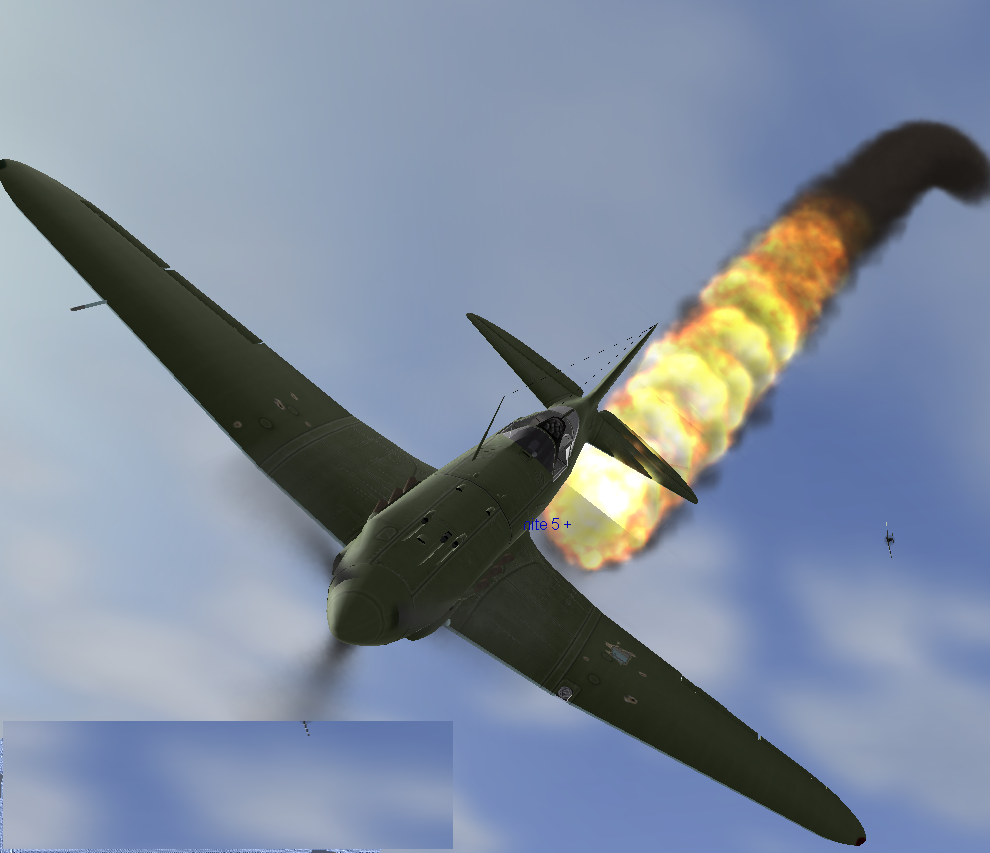
From the Guncamera
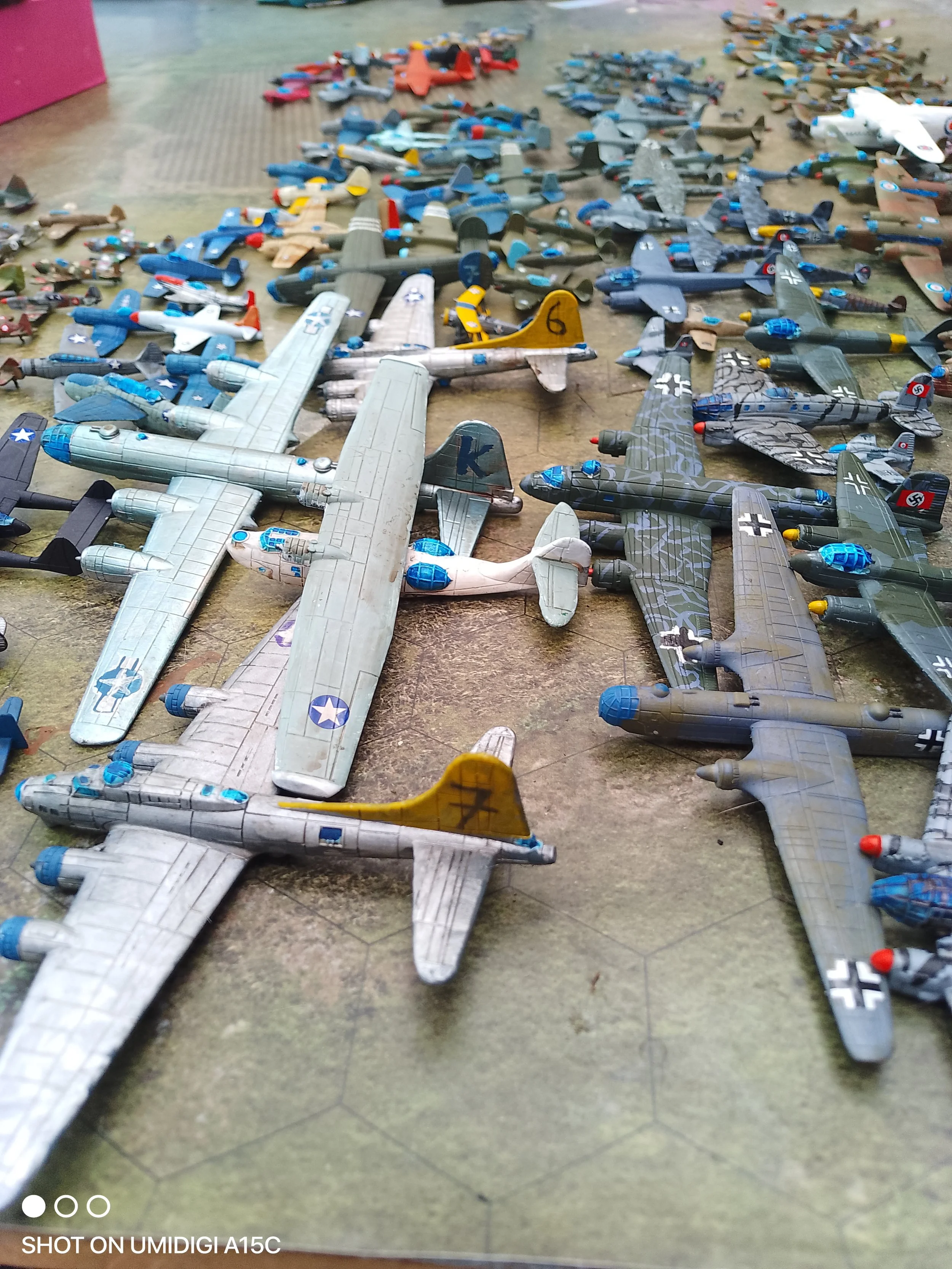
After the war, many kites were taken to the Boneyard and scrapped for their resin.
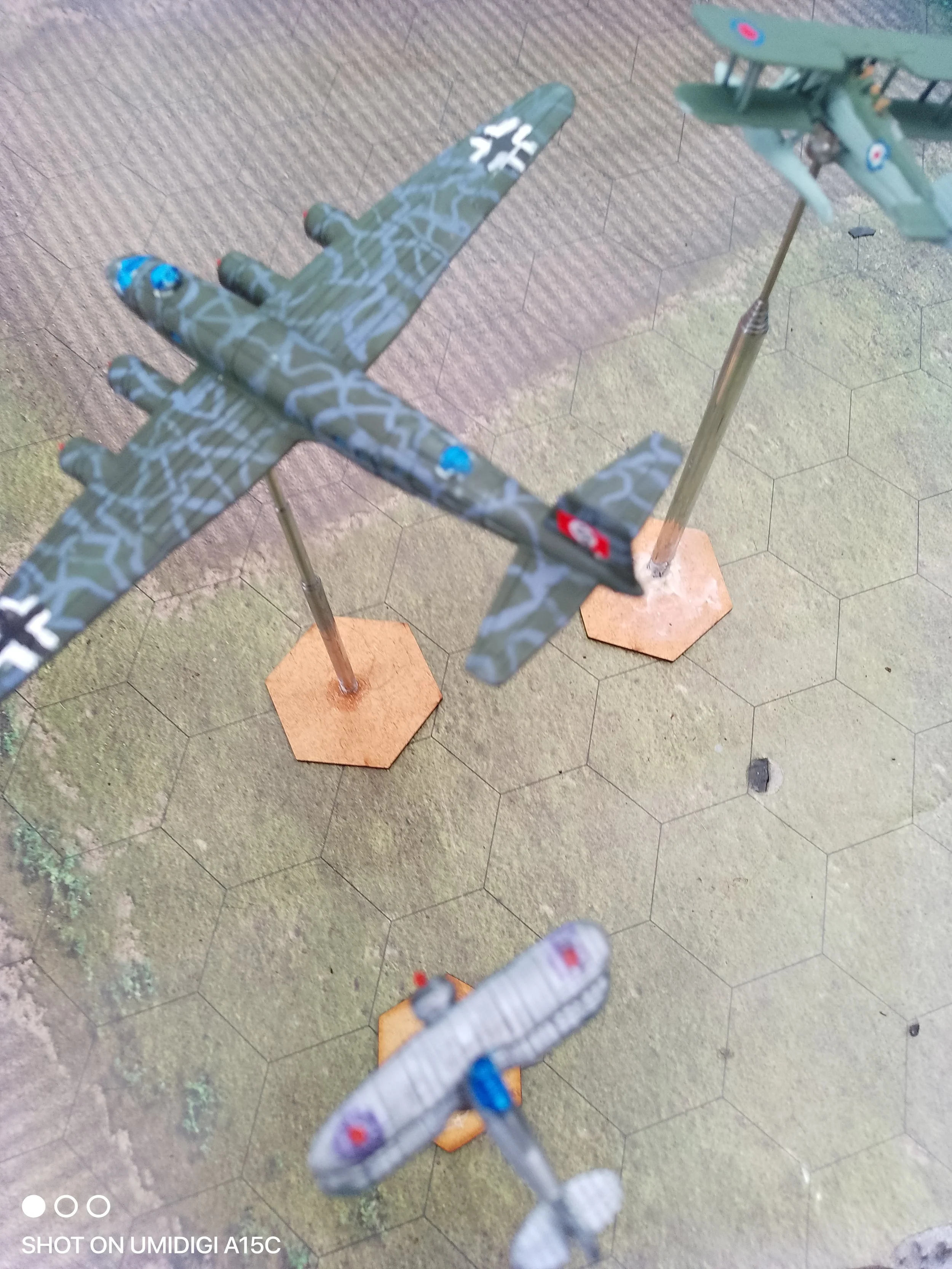
Bulldog and Swordfish duel the Mighty Kondor
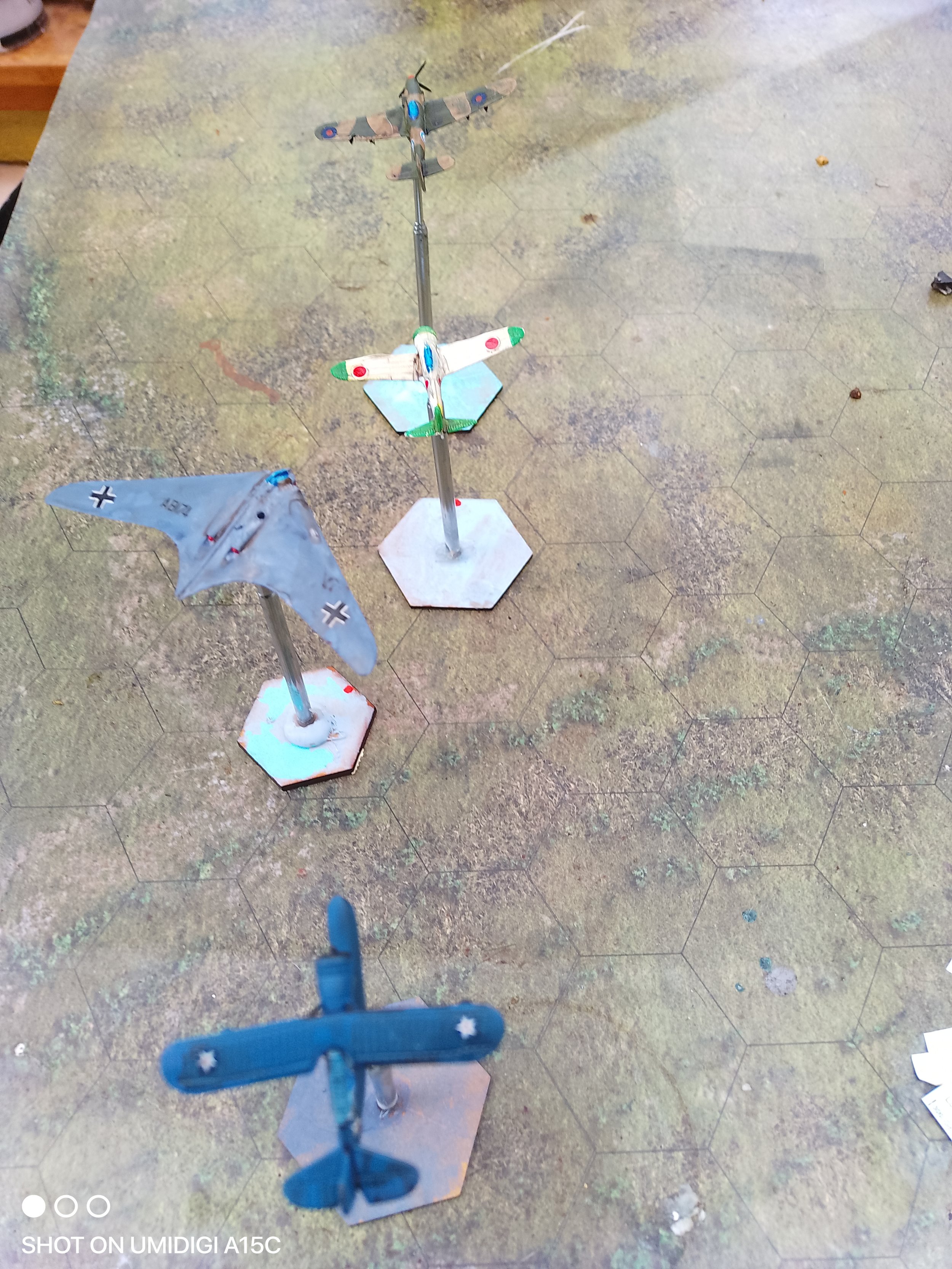
The Typhoon tries to shake the Claude who is unaware of the Horton on his 6 as the Kingfisher dives to finish it off!
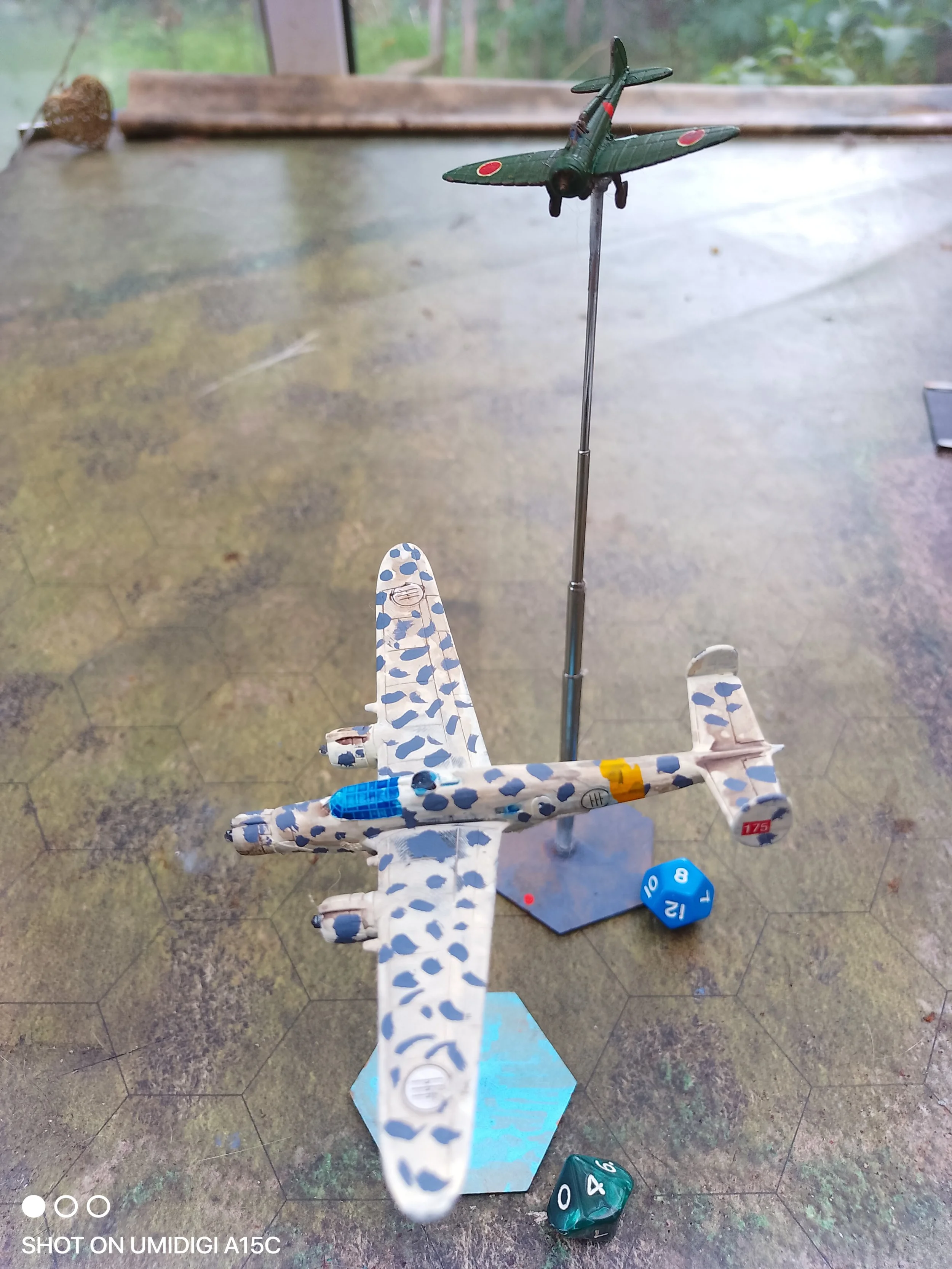
Italian Intervention in the Sino Japanese war.
Rolling Scissors
https://youtube.com/shorts/ALOs65TVNtQ?feature=share
The first of a series I hope on manouvers in the game.
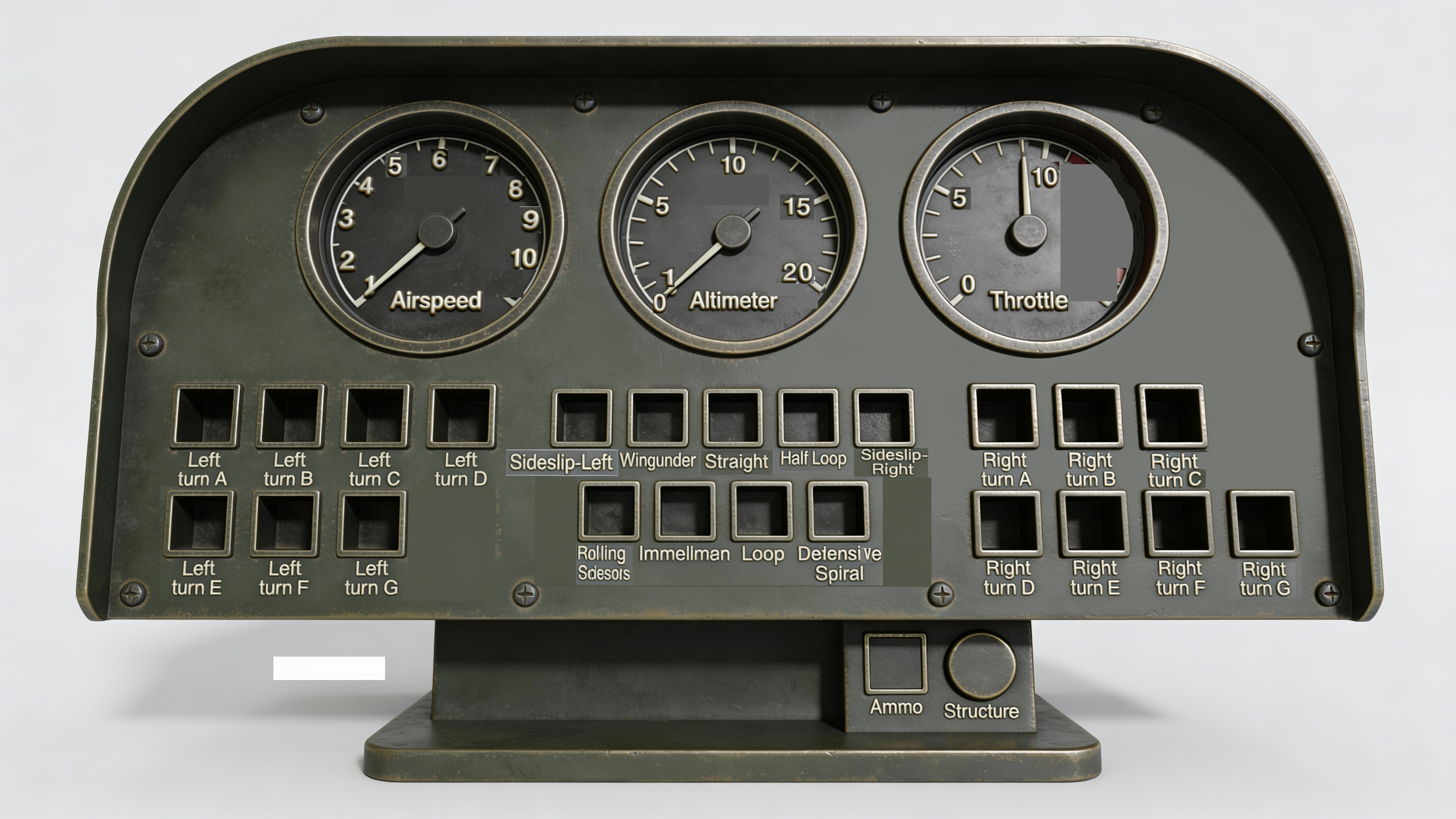
The Bomber will always get through
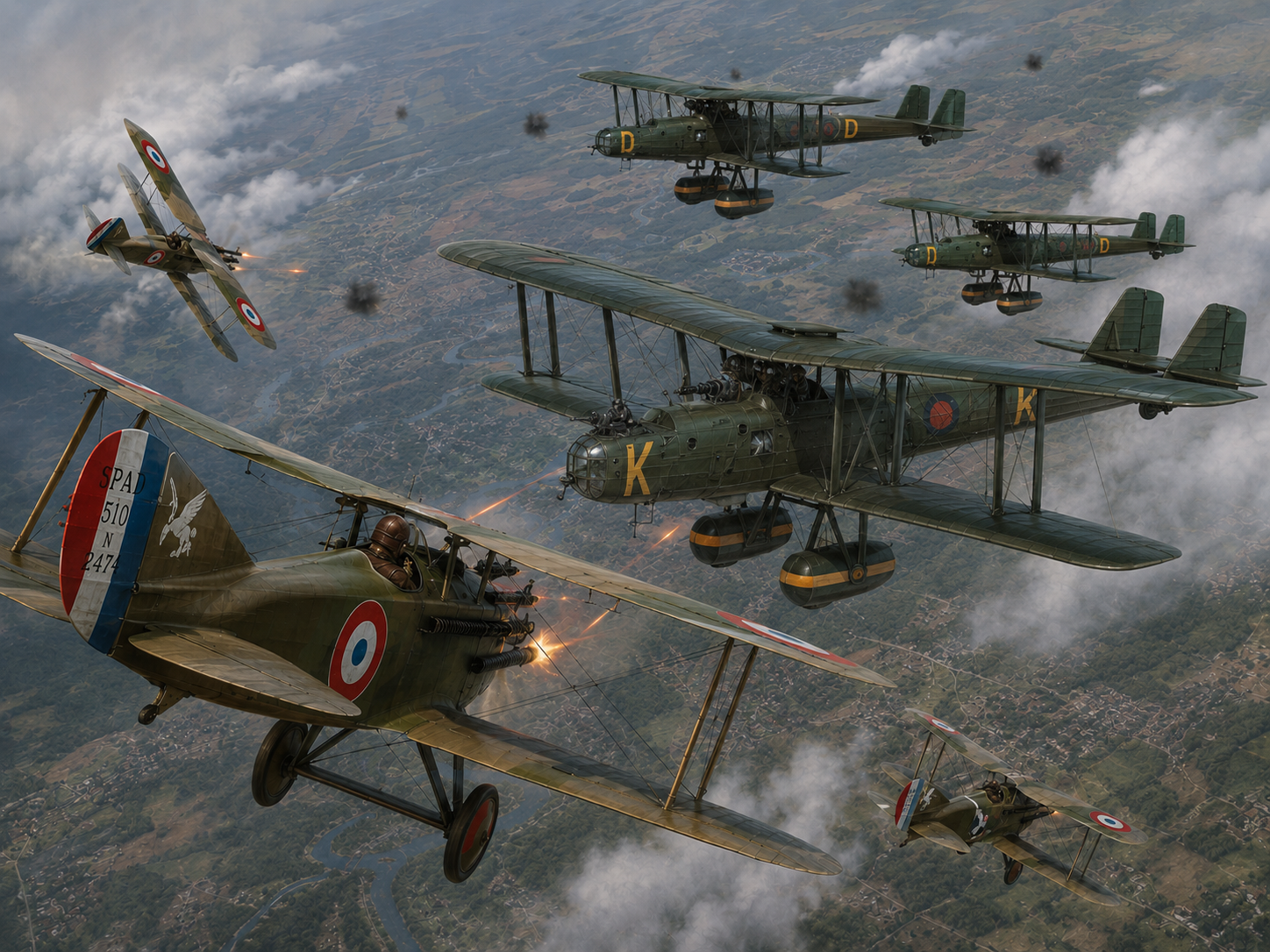
To be honest, I’m surprised AI managed to get this far with a Heyford. They are insane machines.
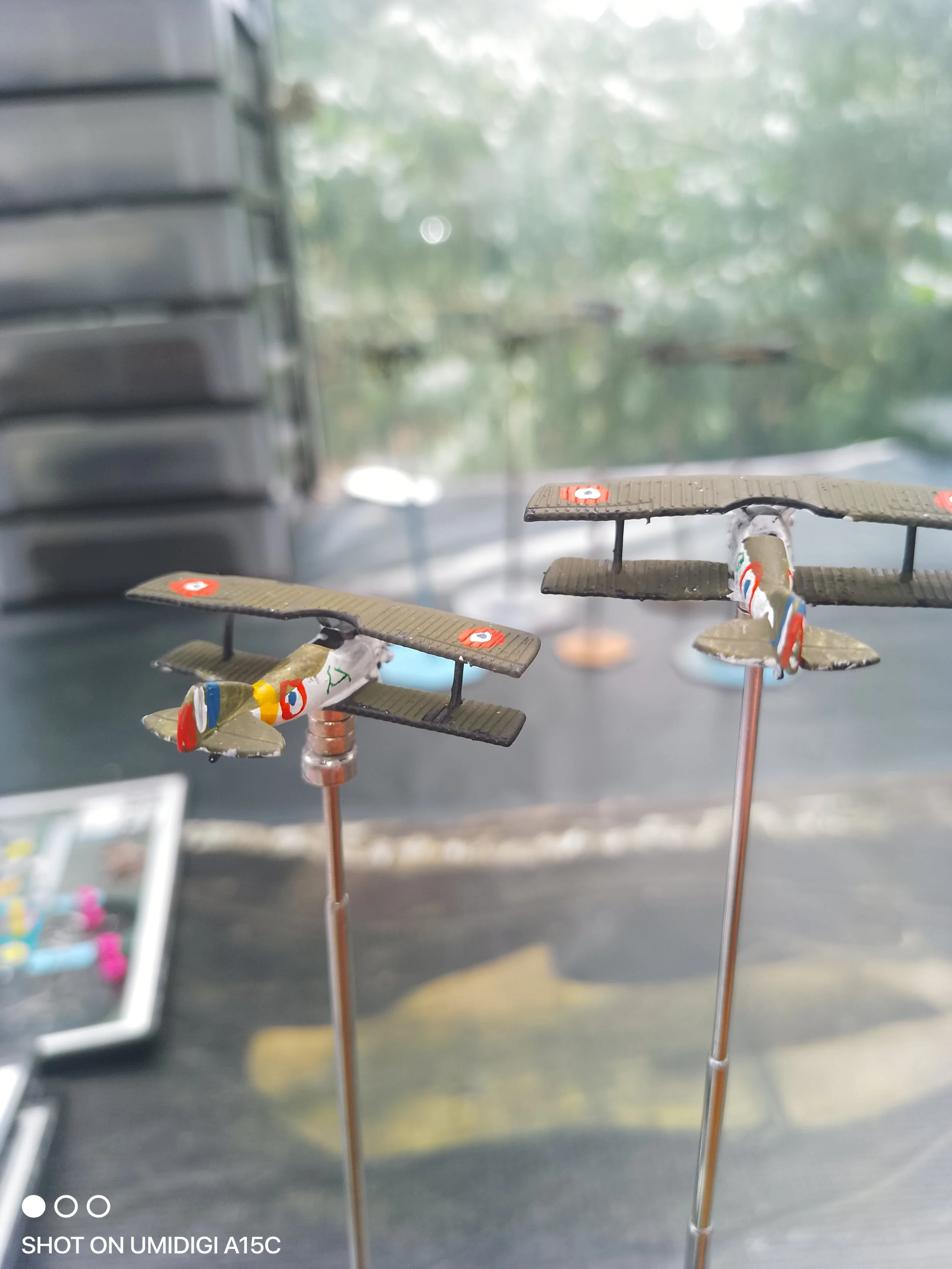
Two SPAD 510’s at ASI 3 and ALT 5 approach the bomber stream.
It was 1937 and the new Fascist French Government had responded to Britains Tarrifs with Mines and bombs and submarines.
The RAF was keen to shut down French Docks, especially Brest and Ushant bases. To this end, a large force was put together, including the very latest Bomber in the RAF, the deadly and fast Whitley. The Whitley was capable of keeping pace with the Latest French Fighter the SPAD 510. However, as there were not enough Whitleys availible, the geniuses at the Air Ministry decided to send a mixed formation of the Whitleys and the lumbering 140mph Heyfords.
“Let the Whitley act as a Citidel, around which they Heyfords shall find succour” announced the out of touch elderly ex naval officer responsible. “For the bomber shall always get through”
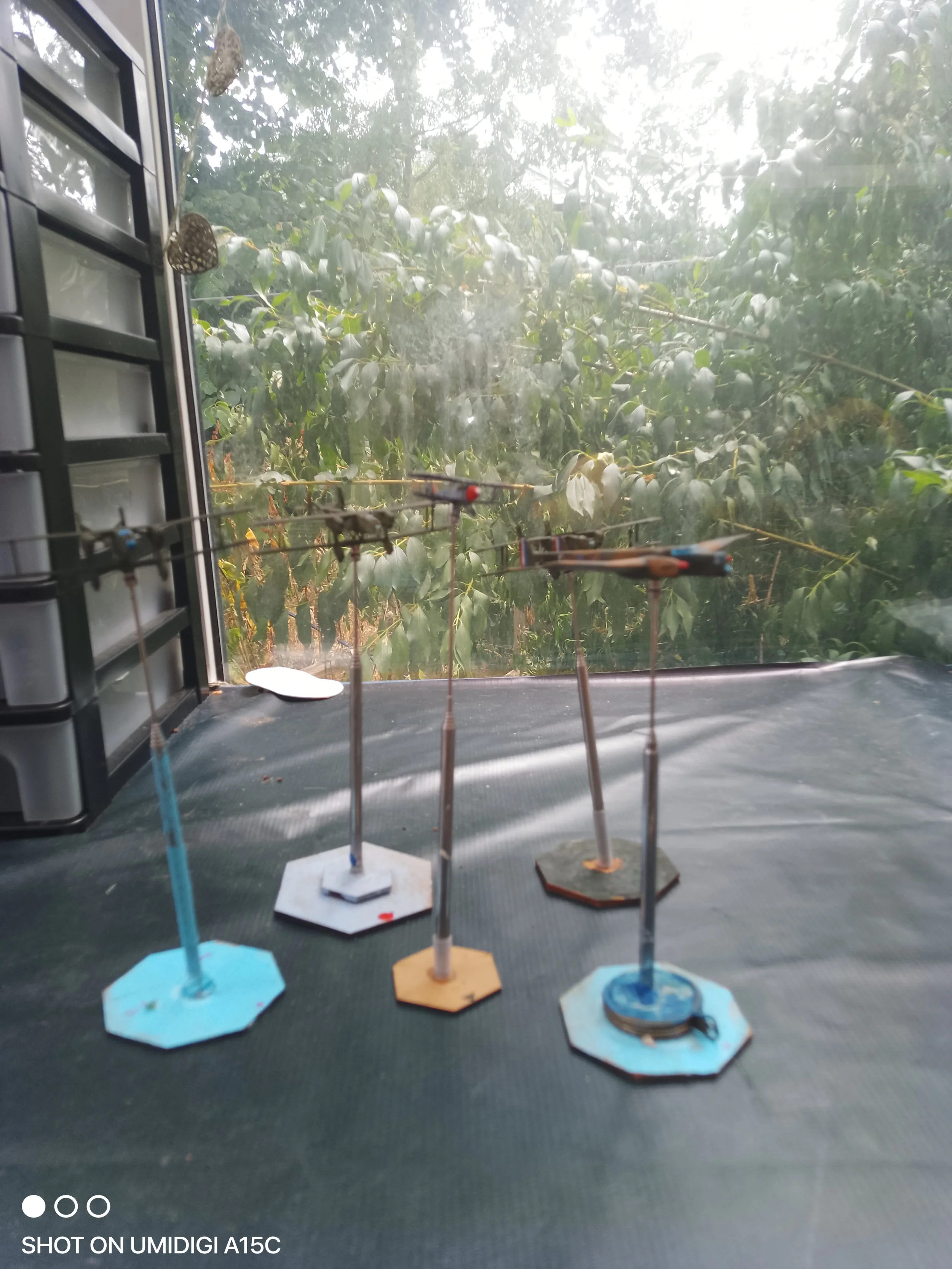
The Whitley leads the Heyfords. The Demon escort flies in the centre of the box. All at ASI 1 and ALT 6, except the Demon is at ASI 2
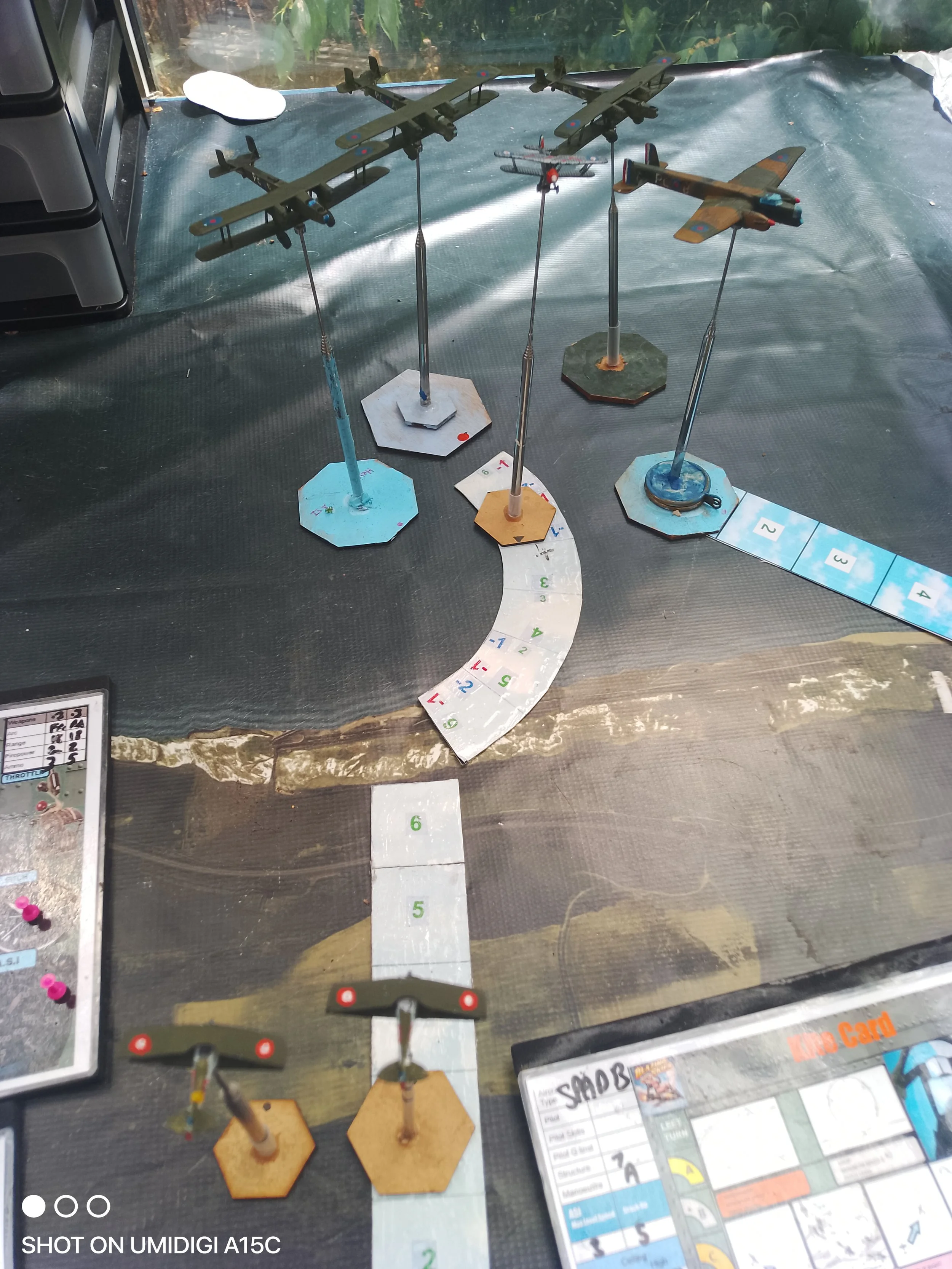
With little finesse, the SPADS bore straight in on the trailing Heyford, Styraight , Level, determined. Their combined 8 guns smashed 3 points off the Heyford at the rear leaving it on 9 structure. Fortunatly for the RAF, the damage was to struts and spars and nothing more serious.
The Return fire from the Whitleys nose turret, the Demons forward guns and the nose and dorsal turrets of two of the three Heyfords, scored three seperate hits on SPAD A to the left. However as each hit was singular, no critical damage was produced.
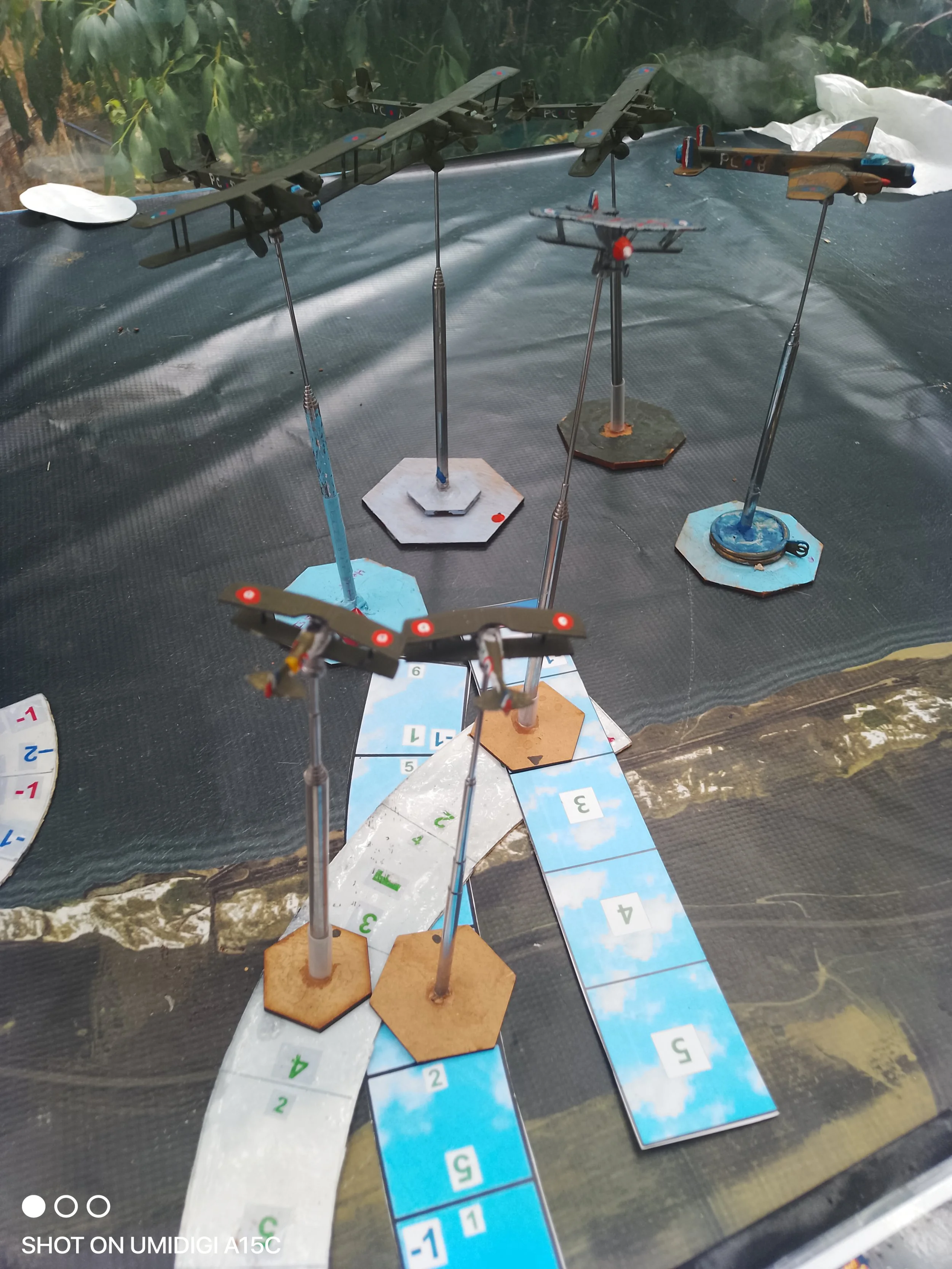
Still boring in, SPAD A gently arced to the right, but all other kites just flew straight ahead. Once again a hail of defensive gunnery fire blasted out from every position. SPAD A was reduced to 4 Structure and SPAD B to 6.
The Heyford at the rear was riddled and reduced to 7 structure. It also had its nose turret position hit and the gunner was wounded and out of action for this game.
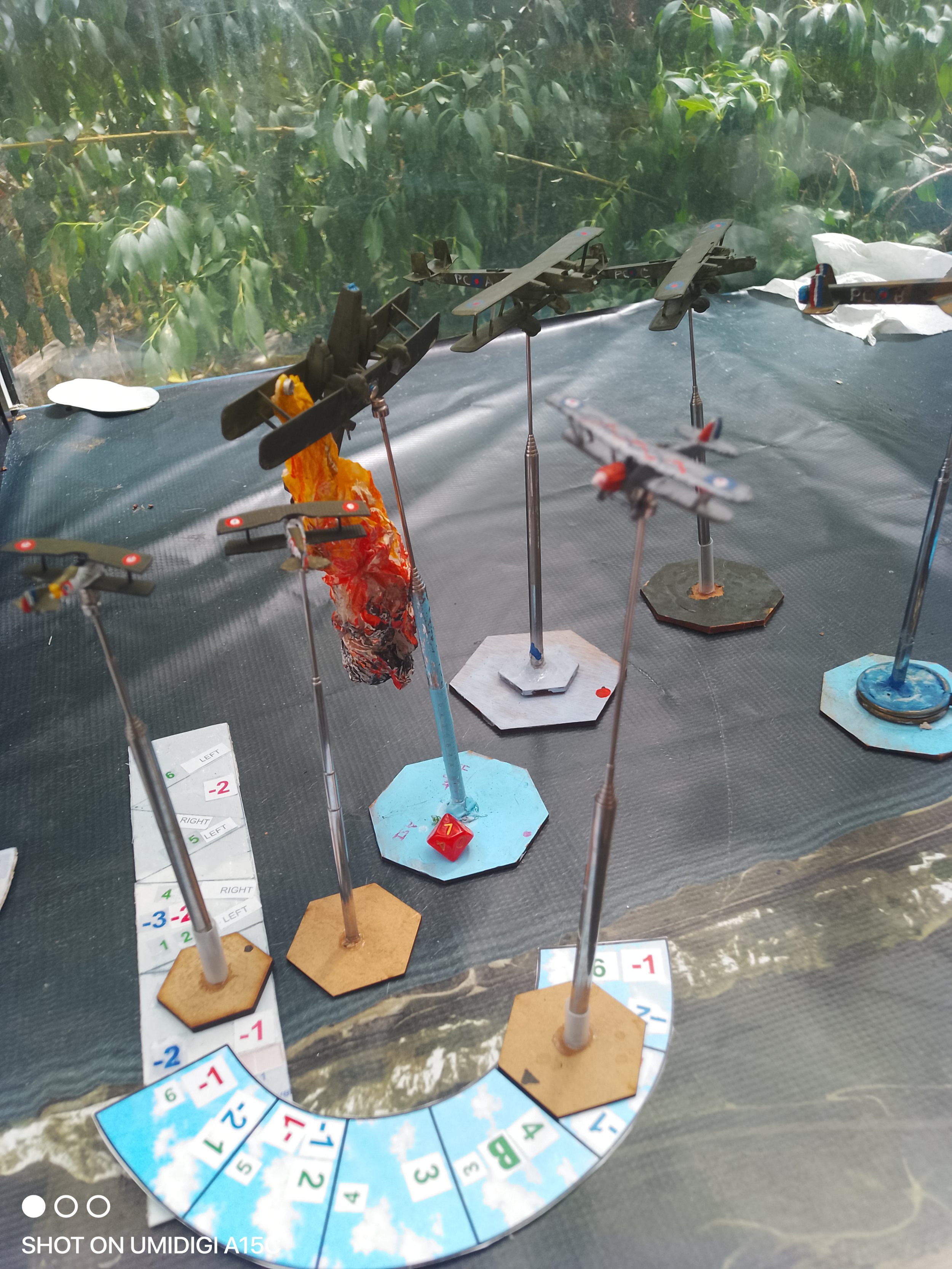
SPAD A did a very nifty SIDESLIP LEFT and SPAD B bore straight in. With the angles now much improved, a total of 8 guns scored 8 hits and critical hits to the fuel tanks and flaps saw it burst apart in the air. The Crew bailing out although two were burned.
The return fire however was now furious. The Whitleys Rear Turret joined in and SPAD A started to break apart in mid air. Its pilot leaped clear and ripped open his chute
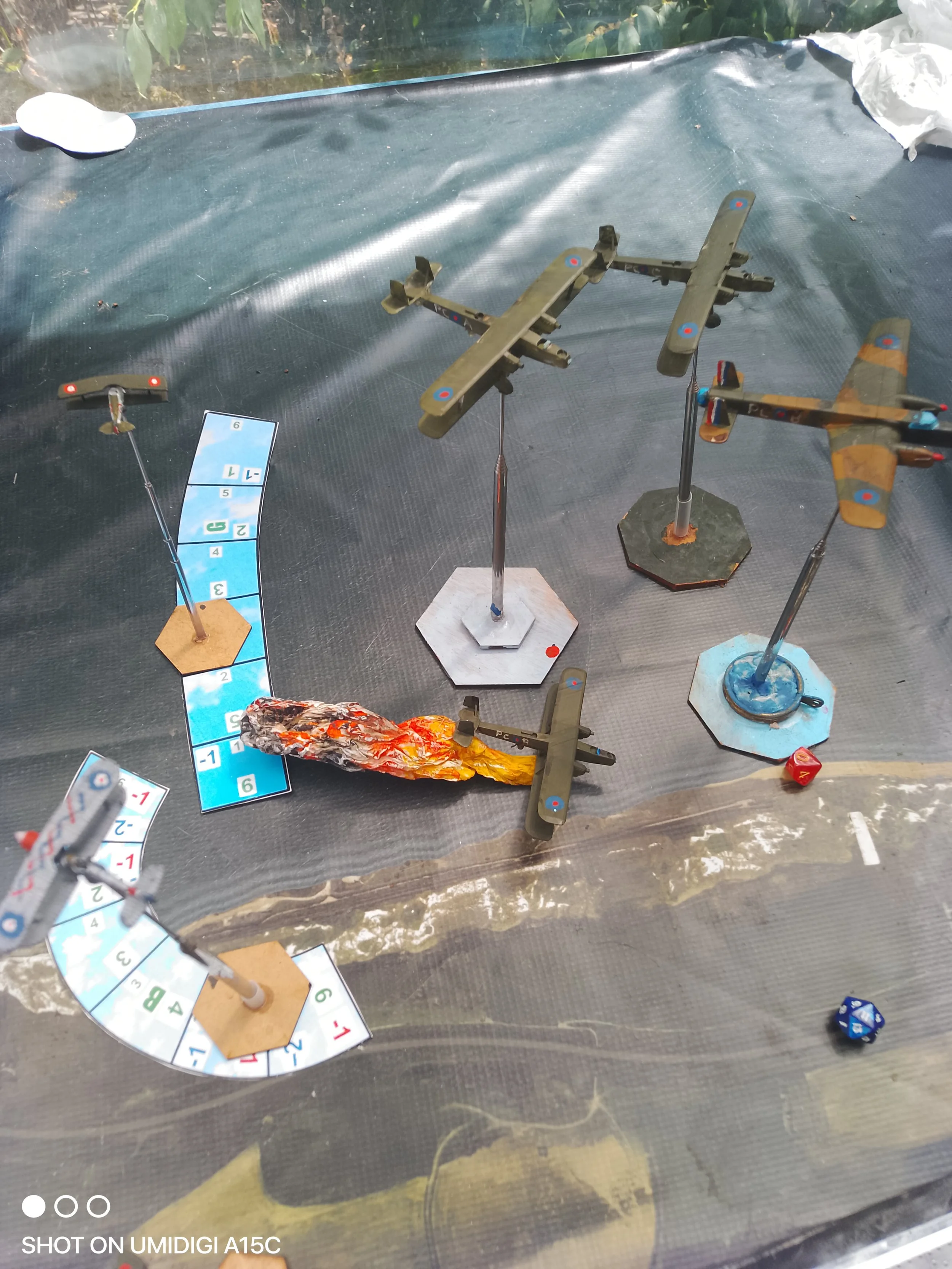
SPAD B was down to around 2 bursts and outnumbered 4:1. The Demon was coming around on his tail and it was time to say “Adui”. Tipping into a dive he weathered a hail of tail gunners fire, the Demon still being out of arc for its front guns. The Demons rear gunner let fly, but to no effect.
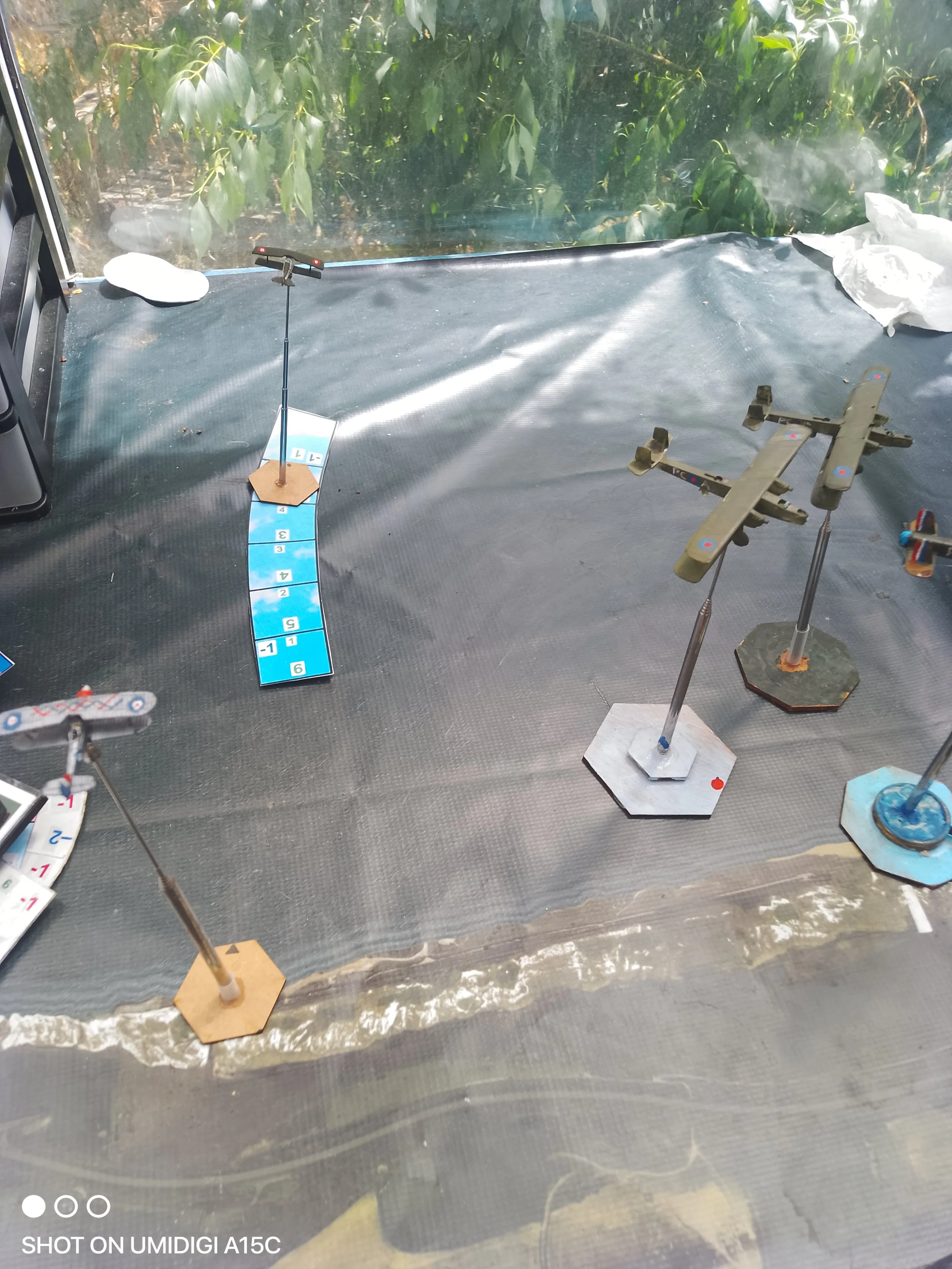
Leveling out at over 400 mph, the SPAD showed a clean pair of heels and returned to base on the deck!
Squiffy Takes the Challenge
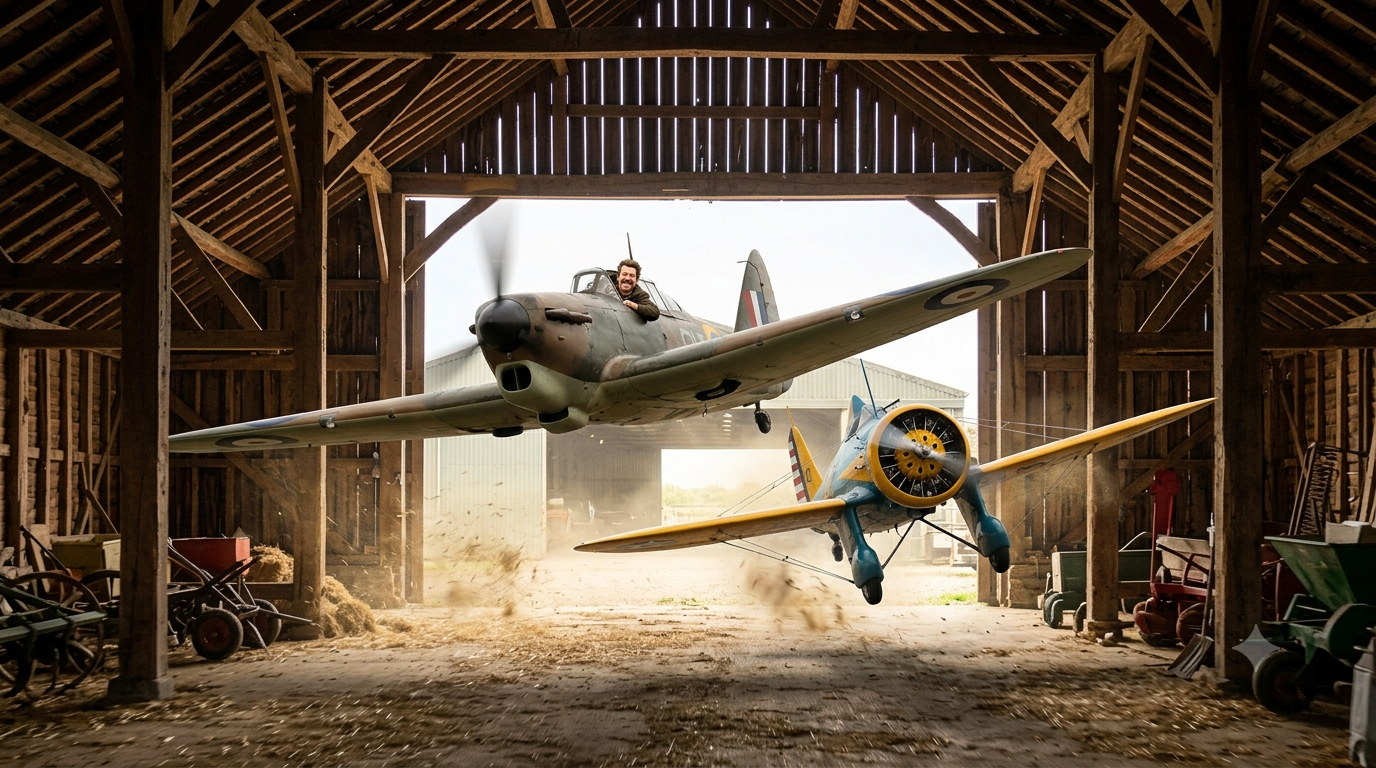
In a drunken confrontation Squiffy of 666Sq and Squidge of the “Fighting 55th”, attempt to outboast each other.
They decide to settle as Gentlemen and the following day their squadron mates set up a race course nearby. The most Daring pilot will win!
The pilots choose to use their Spitfire and P51 Mustang, but the Group Captain has heard of this nonsense and takes their ignition keys, despite the fact neither aircraft has such a thing.
Squiffy and Squidge are not to be denied! They search around and in a local barn, Squiffy finds a Hawker Hendon , used as a cropduster.
Squidge pops into RAF Museum Duxford and pushes out a Peashooter from the display area. Waving cheerio to the Limeys below, he heads back to Tangmere.
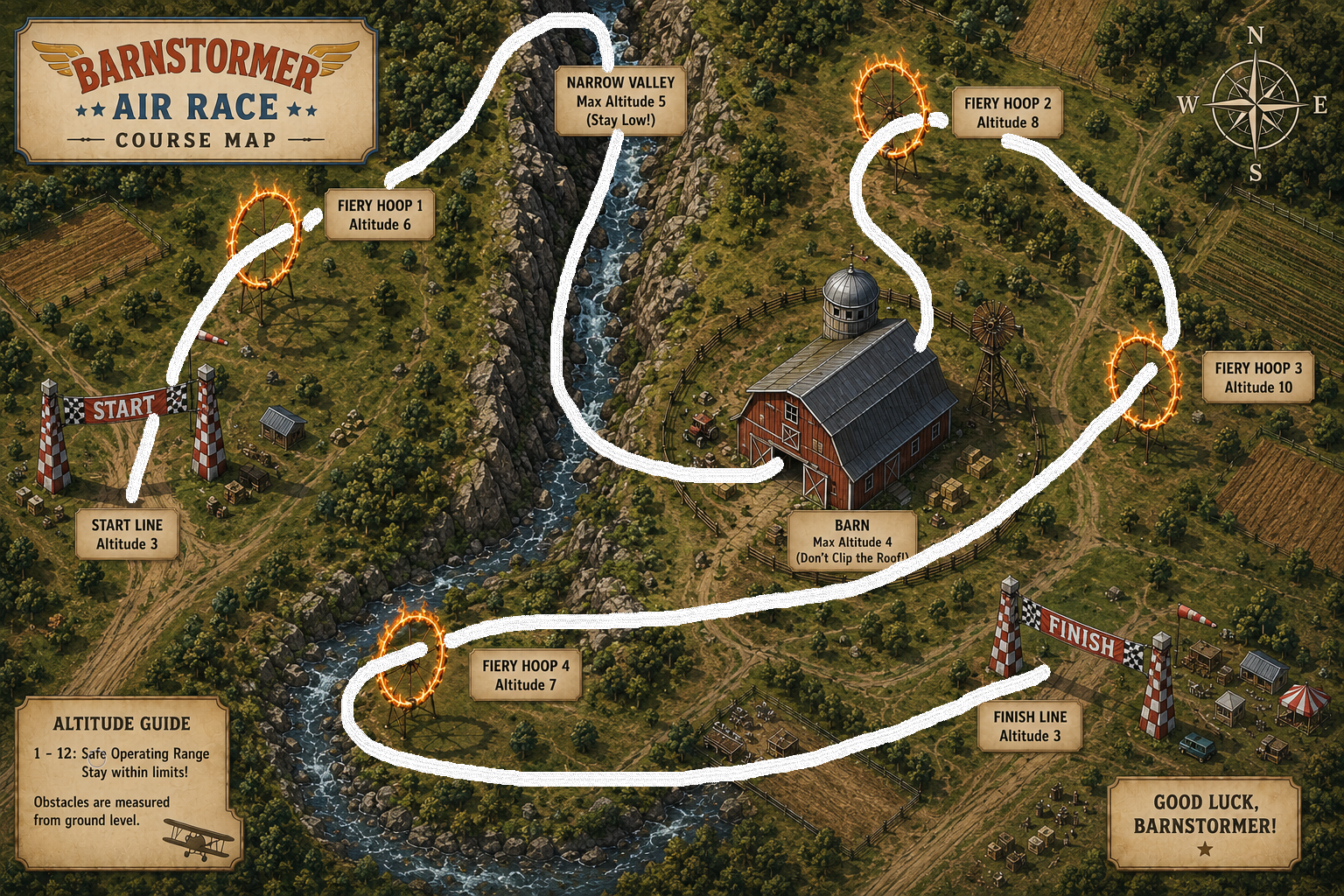
At noon the next day, the intrepid pilots are at ALT 3 and ASI 2 Facing the start line and flying alongside each other, neck and neck.
MISSION:
Both Players
The waypoints on the map must be flown through at the correct altitude or 1 below, except for the Hoops and the Barn which must be at the correct altitude. The objective is to score more points than the opponent.
Notes
Ground level is 0
The Hoops, Barn, Valley and Start/Finish lines are 5” across. The Fighters should be on a 2” Hex base.
Collision rules are in effect.
Hitting a hoop at + or - 1 altitude causes D6 damage, the “on fire” condition and a critical hit.
Hitting the barn at the wrong altitude causes an immediate prang
The Valley may be entered at Altitude 5 but lower altitude is beneficial
A player may sacrifice 5 Victory points to fire its guns.
More players may be added. If the frontage of all players kites would exceed 5” then roll off for who gets to place their kites first.
VICTORY
Per checkpoint passed 10VP
Fly at least one turn in the Valley at Altitude 1: 10VP
First across the finish line 20VP
Fire guns -5 VP
Skip or dont meet the checkpoint standards, Per checkpoint -5 VP
Alternative Kites
This scenario may be played with any aircraft. I would suggest a handicap of, if there is a 3 year gap from first flight of the kites involved, 25 VP is given to the younger Kite per 3 years difference. Example; a Henley has an advantage of 50VP over the Me262A-0.
In addition a E or F manoeuvre aircraft starts with 50 VP as they are almost certainly going to lose.
Squiffy: Secret Agent
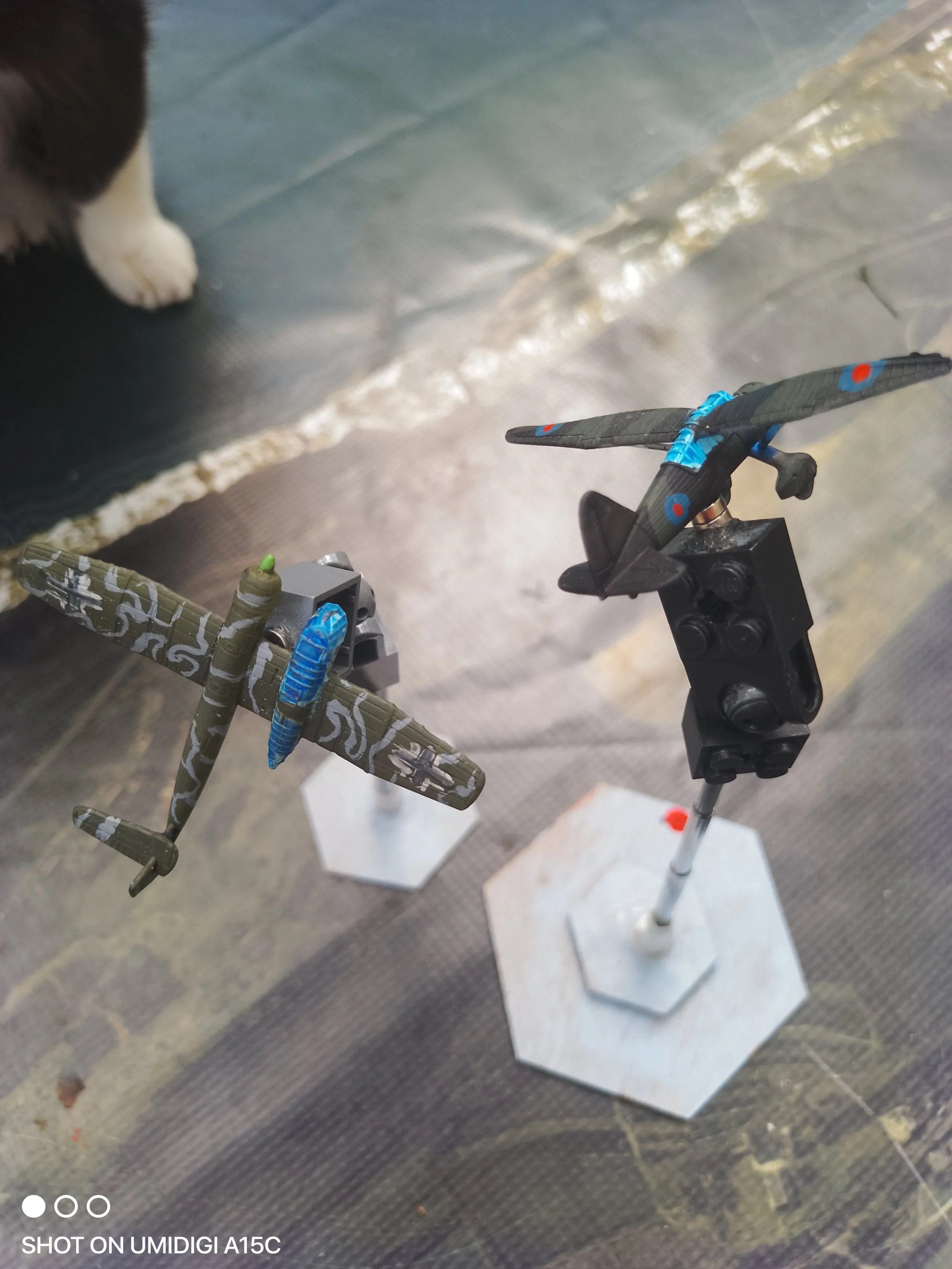
I have 2 Lysanders, It was nice to be able to choose the Dark coloured one for some real secret squirrel work! The BV 141 is a new print and when I thought about it, is a perfect opponent for the Lizzy. Both kites sneak about at low level!
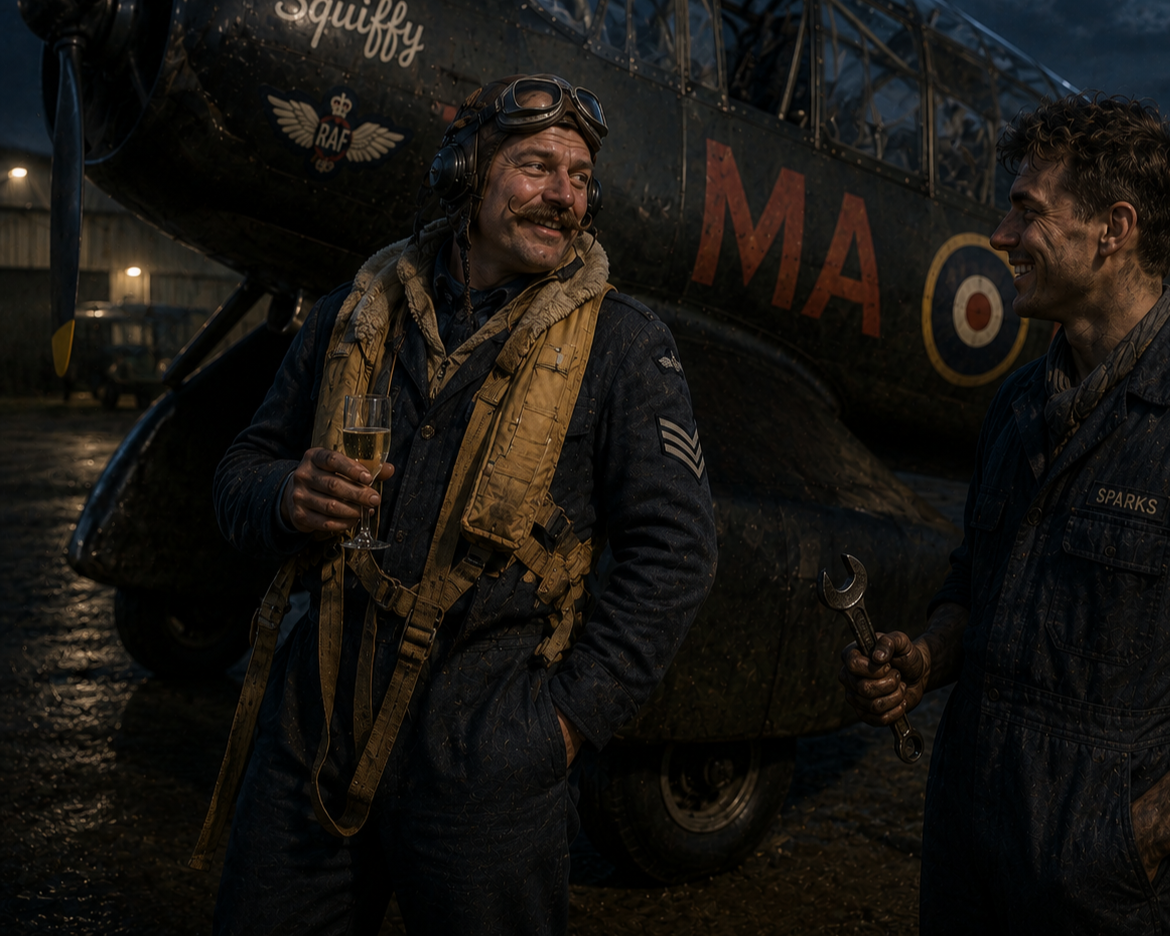
“Thats a funny looking crate Sparky, old sausage!” Exclaimed Squiffy
“Certainly is Squiffs…All a bit Hush Hush, secret cloak and dagger stuff” said Sparks. “Its a Lysander. They go and flap around over France and deliver important things to La Resistance”
“Gosh…I’ve no time for that guff” said Squiffy. “Straight in at a fellow and get him square between the eyes”!
Sparks shuffled his feet. “Bad luck then old Boy, because Featherprop wants you to drop in on our French friends and pick up a chap from a clearing in the woods….TONIGHT”
“Bother it!” sighed Squiffy. “I was off to the Flaps to see Gertie”.
“Ill keep your seat warm !” grinned Sparks.
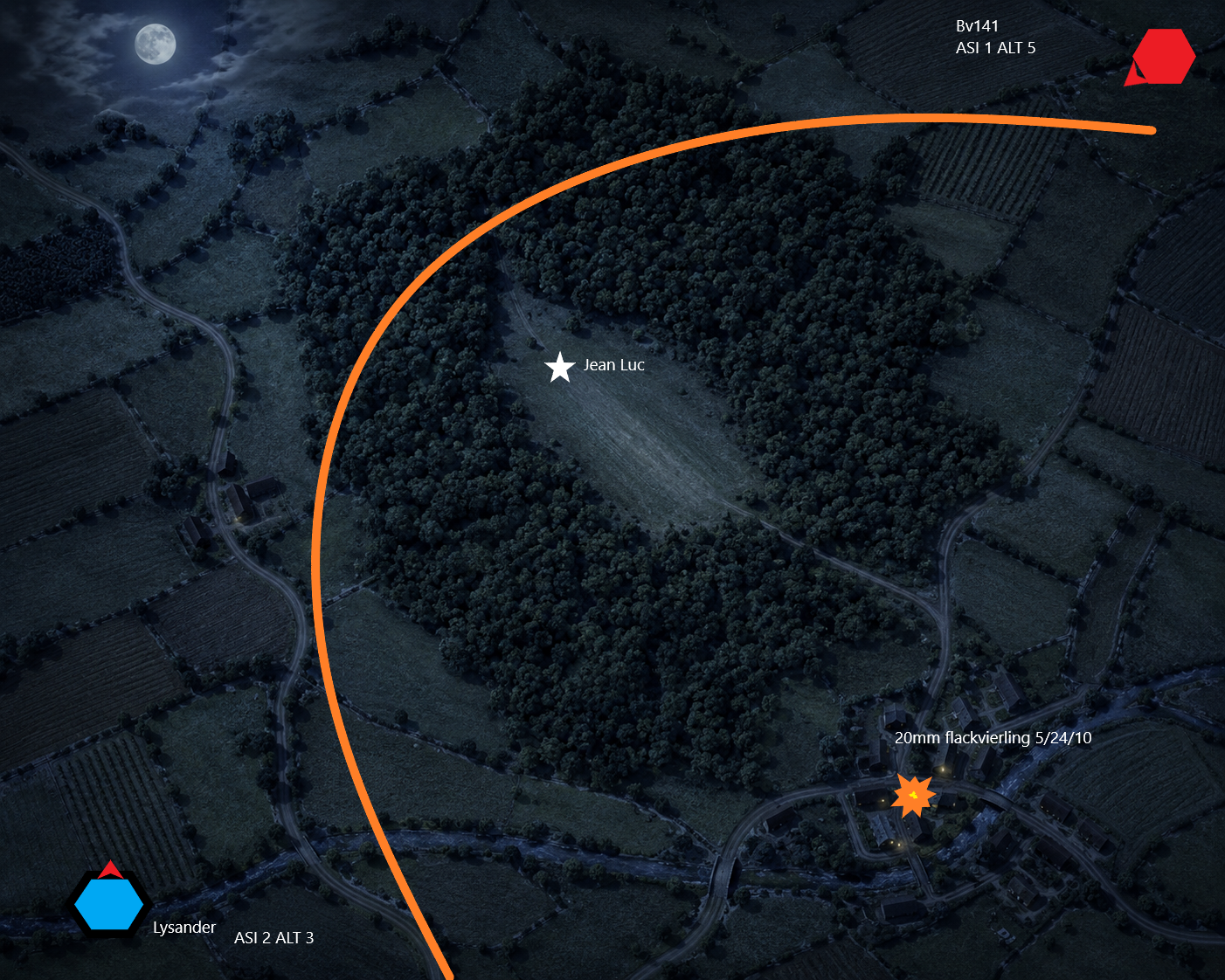
This scenario is avalible for free in the shop
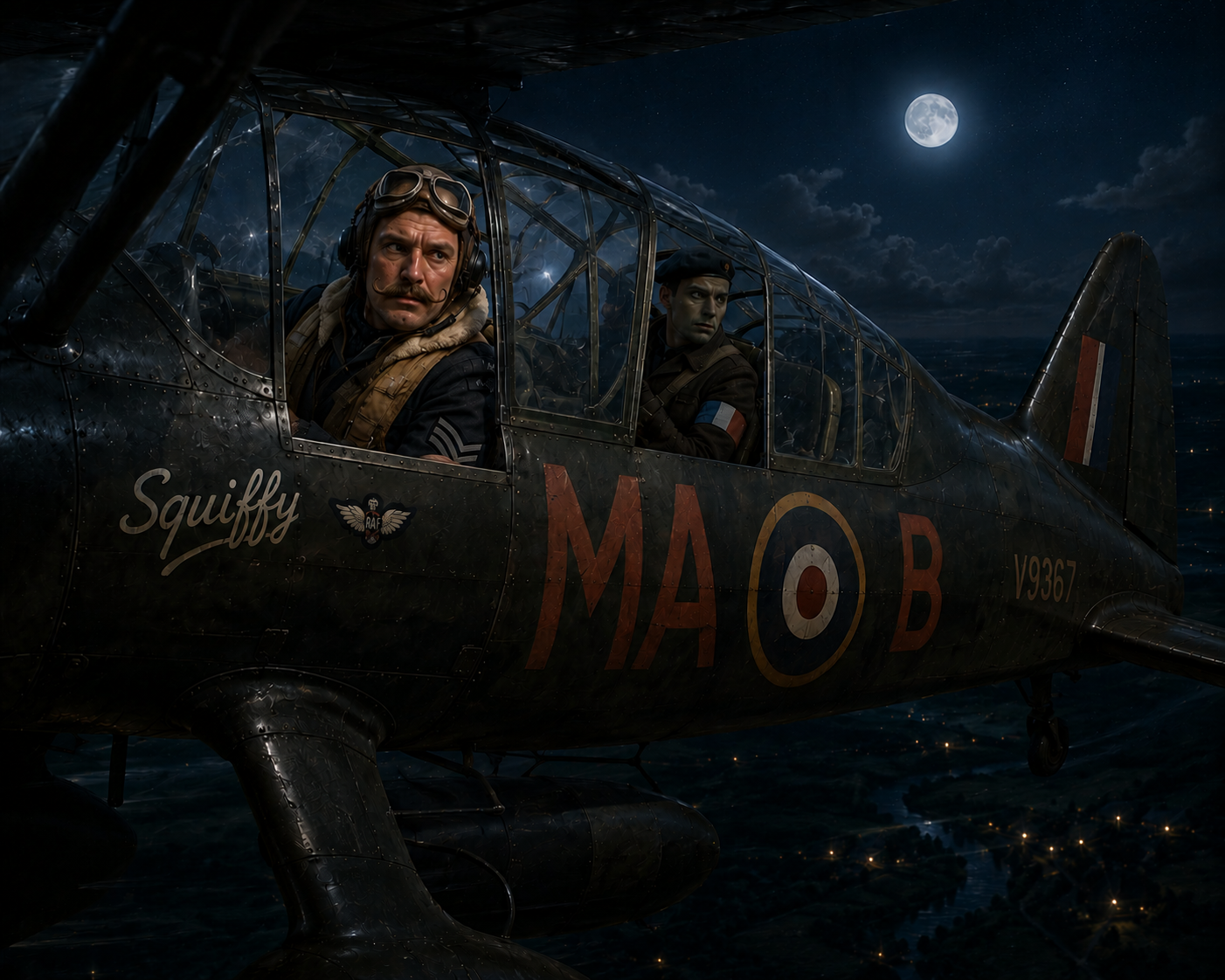
Squiffy had a word with Dusty who was happy to take the rear gunner seat in the Lysander. After a few circuits of the field, Squiffs actually liked the stubby Kite and how it lifted off and touched down on a postage stamp.
The Moon rose and the dark coloured spy plane lifted off quietly into the night.
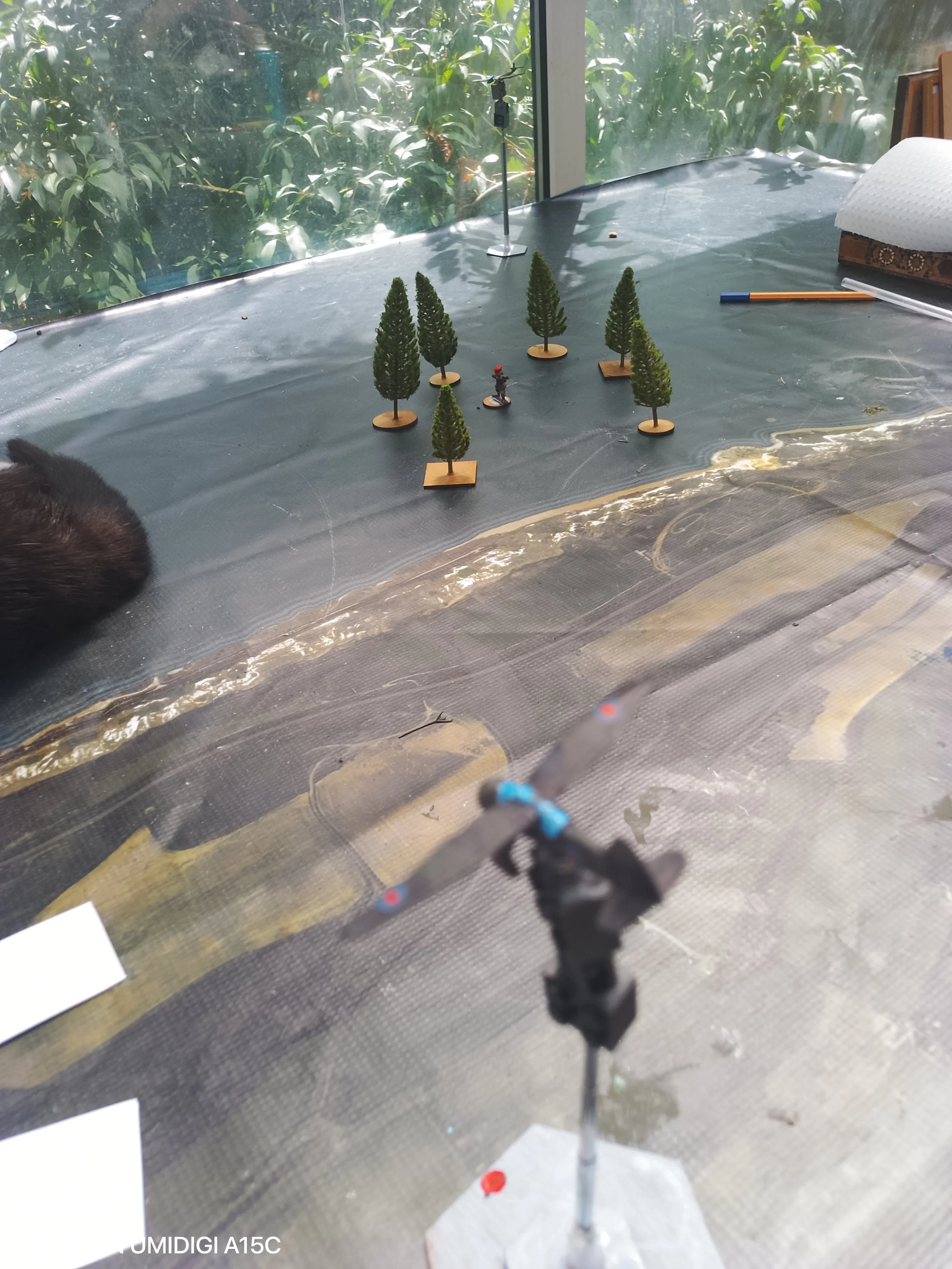
Jean Luc, with his red Beret, waits in the woods. The Bv 141 flies straight and level. Nobody has spotted anyone yet! It is a dark moonlit night. It was actually 33 degrees in the Games room and I was sweating like a French Resistance Fighter waiting for a Lysander.
With the nearby Flackvierling needing a 6 to spot and the B&V being outside 14” range for night spotting, everyone flew straight and level for six full turns. The Blohm Und Voss accellerated and Squiffy was regailing Dusty with his adventures so far. The Flackvierling failed consistantly to spot Squiffy each turn.
Squiffys plan was to bank right and dive , throttle back to 1 ASI with high RPM and touch down with 9 on the revs right next to Jean Luc
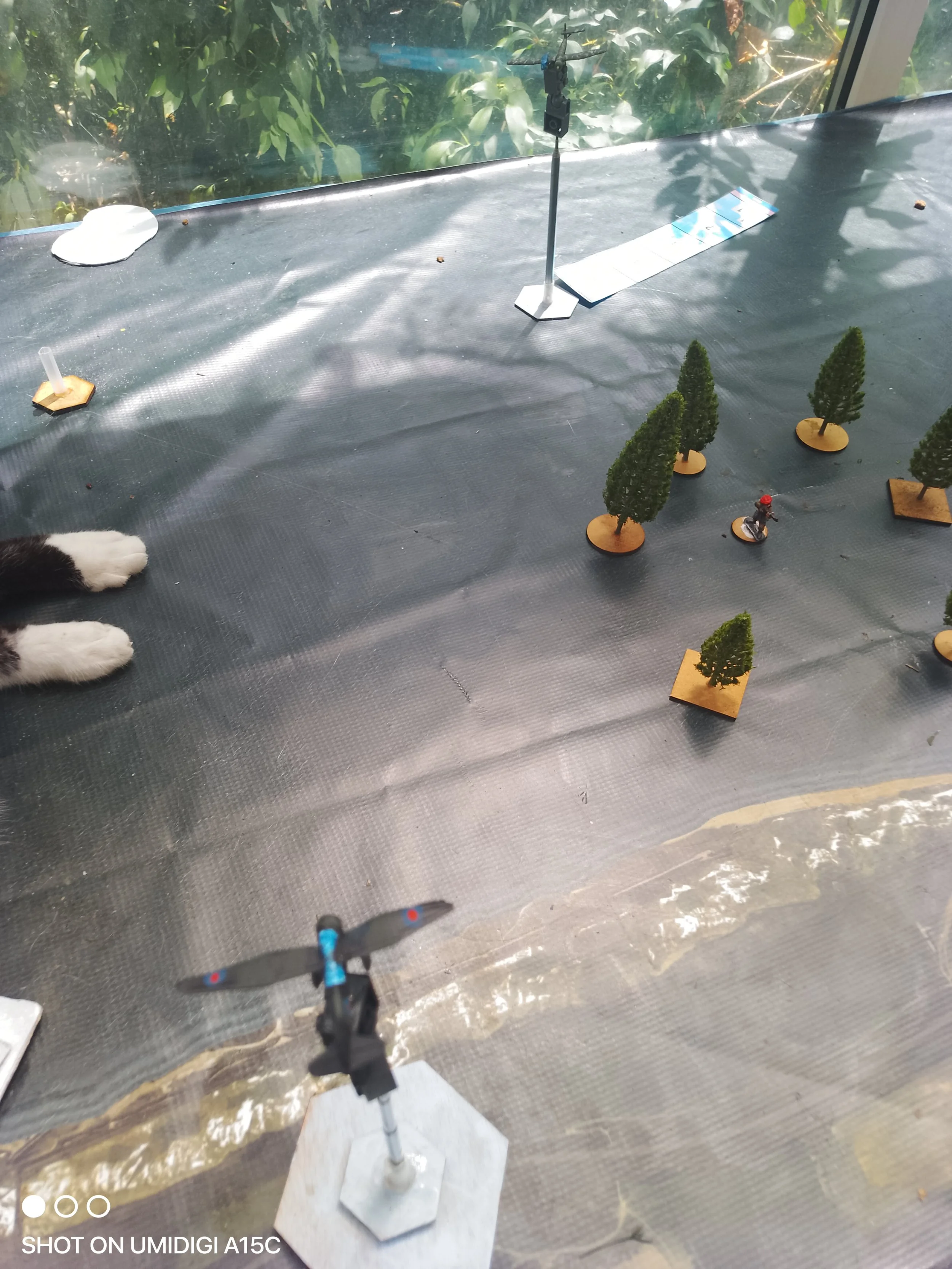
“Ok Dusty my man…theres the woods! Lets wait for his flashlight and then we’ll drop in for some crossants”.
Dusty rolled his eyes at the period-appropriate casual racism and poor spelling.
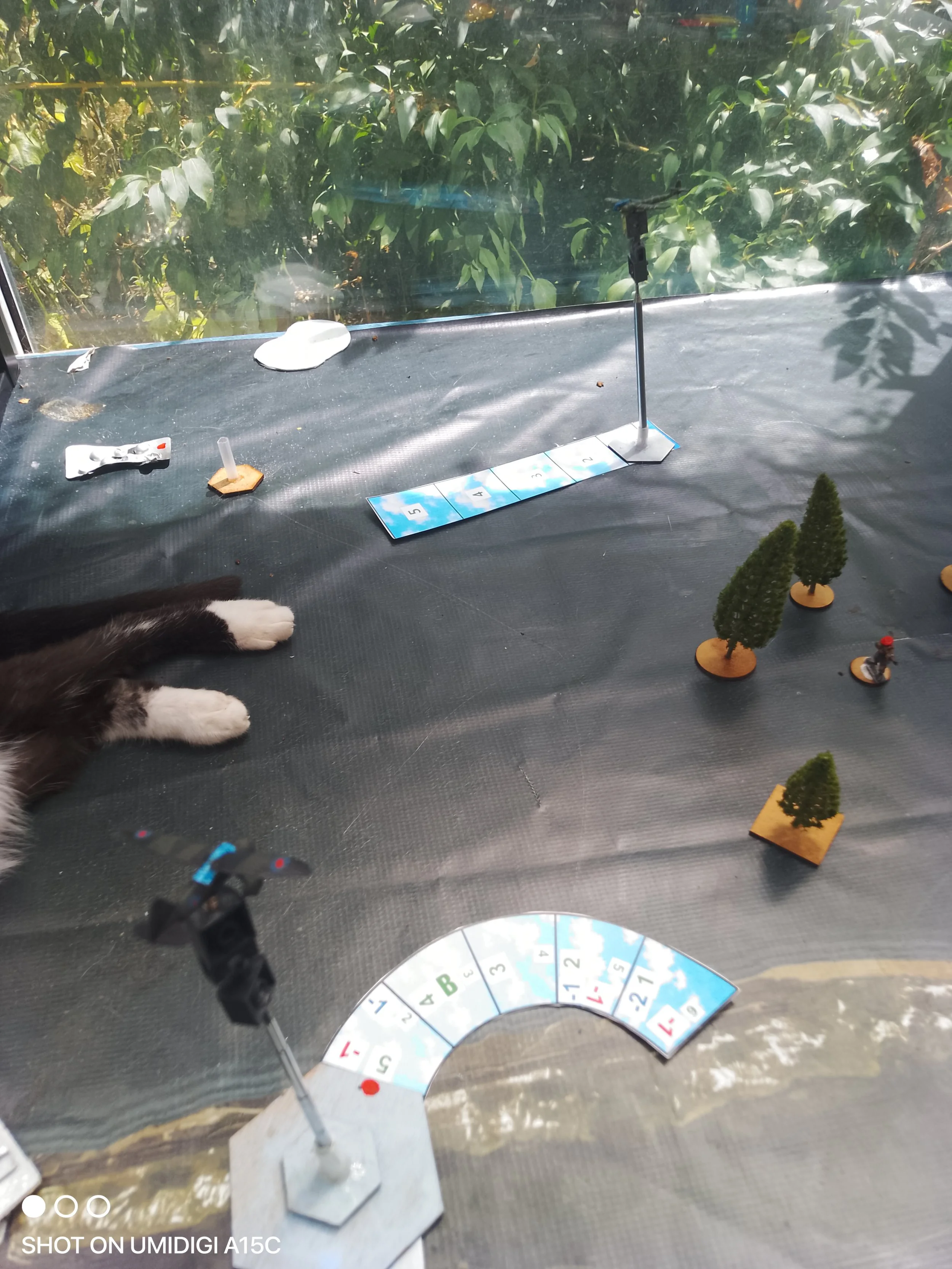
Squiffs entered a SHALLOW DIVE RIGHT TURN B and recognised immediatly the Lizzys wonderful low speed handling. In his Spitfire or Defiant or Hurricane, he would have been eating dirt at this height. The Lizzy behaved like a true lady. Just not neccesserily the kind of Lady that Squiffy usually went for. Dusty shook his head at the period-appropriate casual sexism.
Now at ALT 2 ASI 3 Squiffs was lined up for a gentle turn next turn and to lightly touch down next to the waving flashlight in the distance after bringing his speed back to 1.
For a moment he paused. Was that a plane ahead? Or a 600 ft long Tuxedo Cat basking in the moonlight.
He needed to focus.
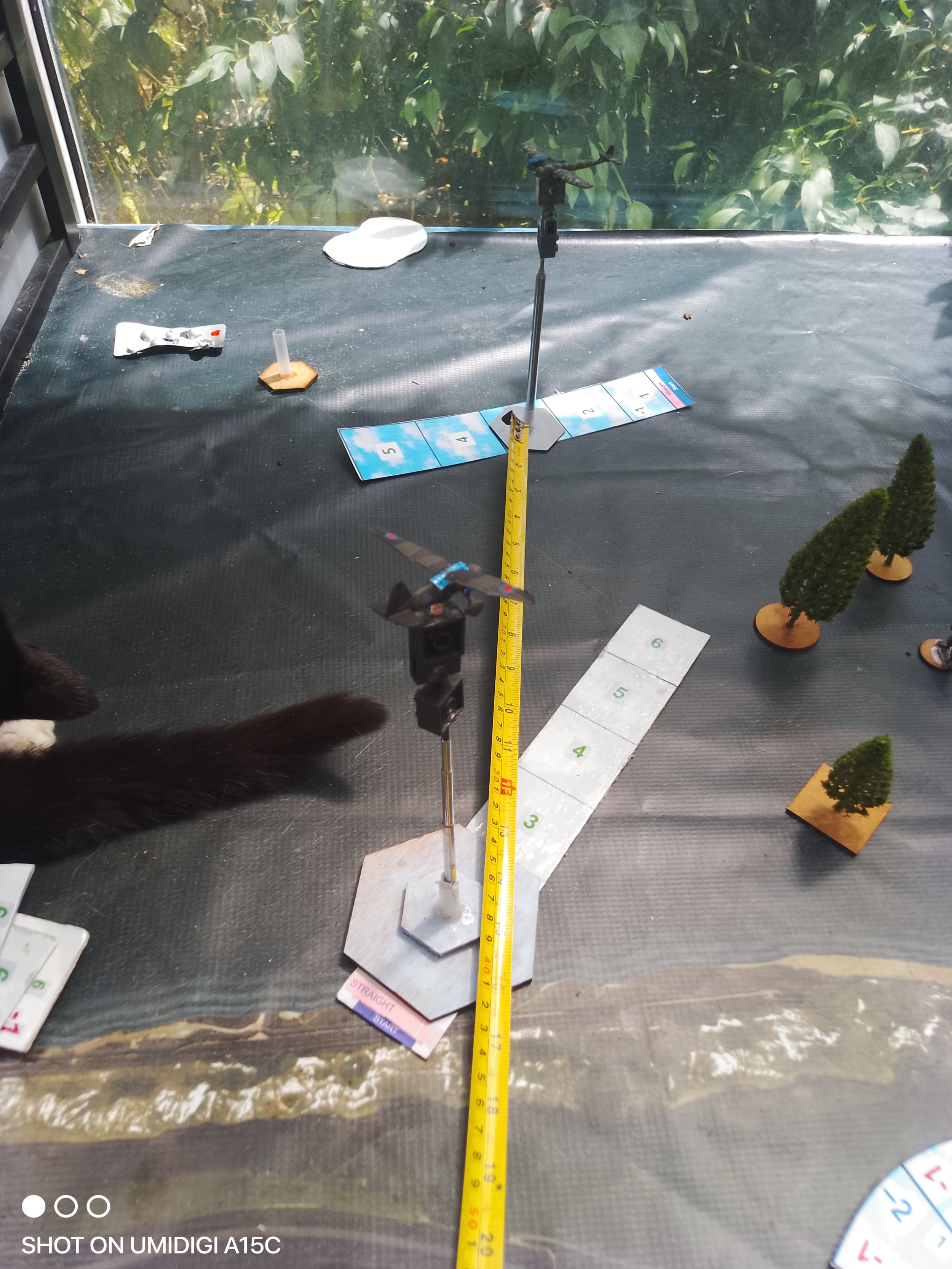
The quiet mission suddenly exploded into action!
“Great Harry!” Yelled Squiffy, “Its some sort of demented Hun Kite” . The Bv141 appeared in his sights.
“We need to get the Frenchman, Squiffs” said Dusty
“ Cant do that if we are pranged nine ways to hell old chap”. Squiffy finished his champagne. “ TALLY HO!”
The German pilot spotted the Lizzy at the same moment.
“ Großer Gott! Das ist ein Engländer! Lasst uns ihn mit unserem überlegenen Kriegergeist vernichten!” he yelled unlikely-ly
But the BV was outside the Forward arc of its guns. Squiffy however did a little RUDDER TAP LEFT and the Lysanders Twin brownings in the spats rattled a hail of dice , but missed at this range and angle.
The Flackvierling crew sprang to life. They cranked round their 20mm cannon. Counting as a turret they needed 6’s and glowing tracers flew skywards. Each one could cripple the Lizzy, but all shot by it in a cinematic effect that I cant be arsed to replicate.
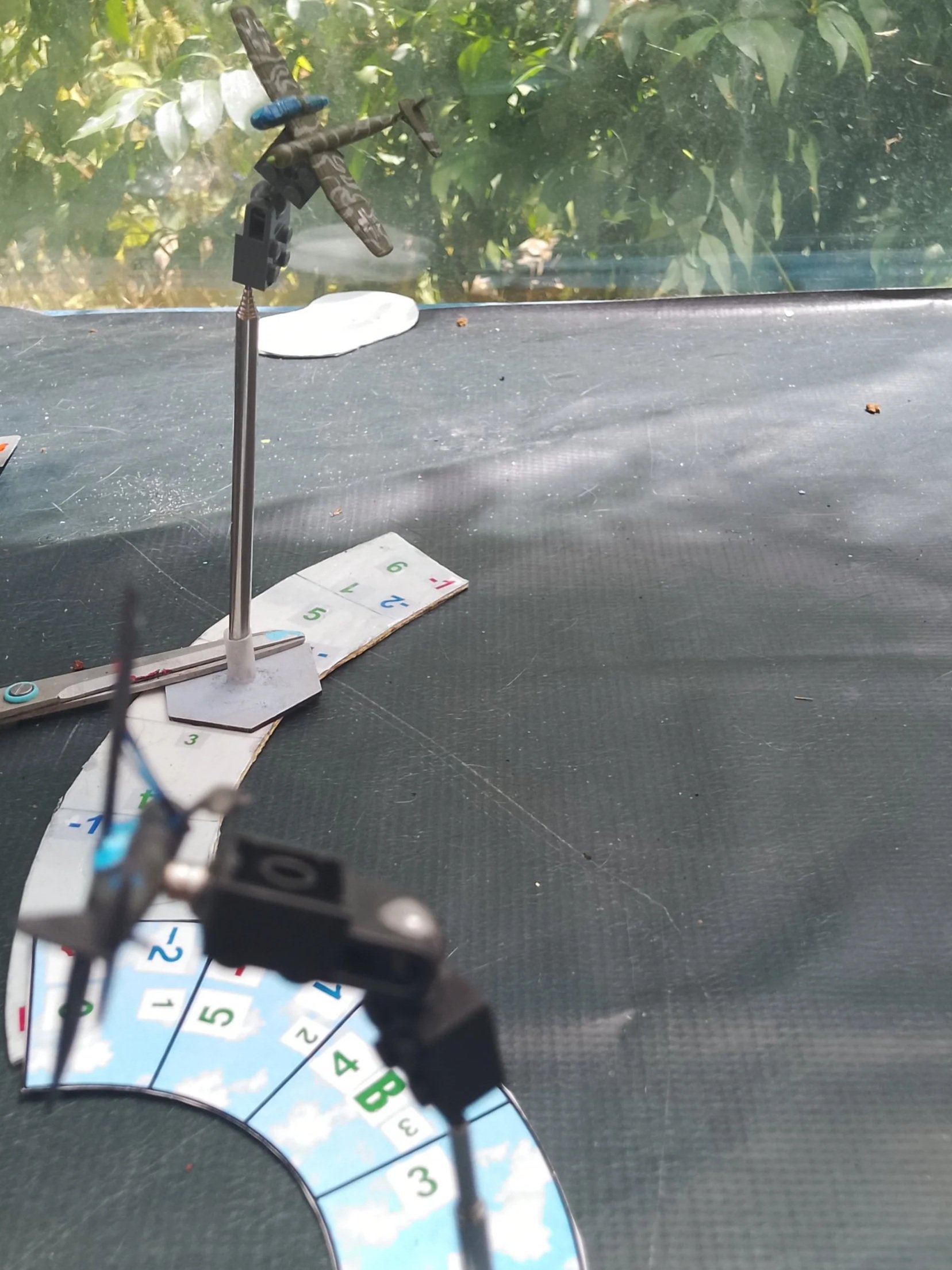
Squiffy flicked left into a B CLASS LEFT TURN LEVEL. Hans entered a D CLASS LEFT TURN SHALLOW DIVE.
Both machines opened fire and a storm of dice flew past each other making realistic zipping noises that nobody in the fight could hear.
The 20mm AAA pounded more ammo into the sky, but today was not Squiffys day to die.
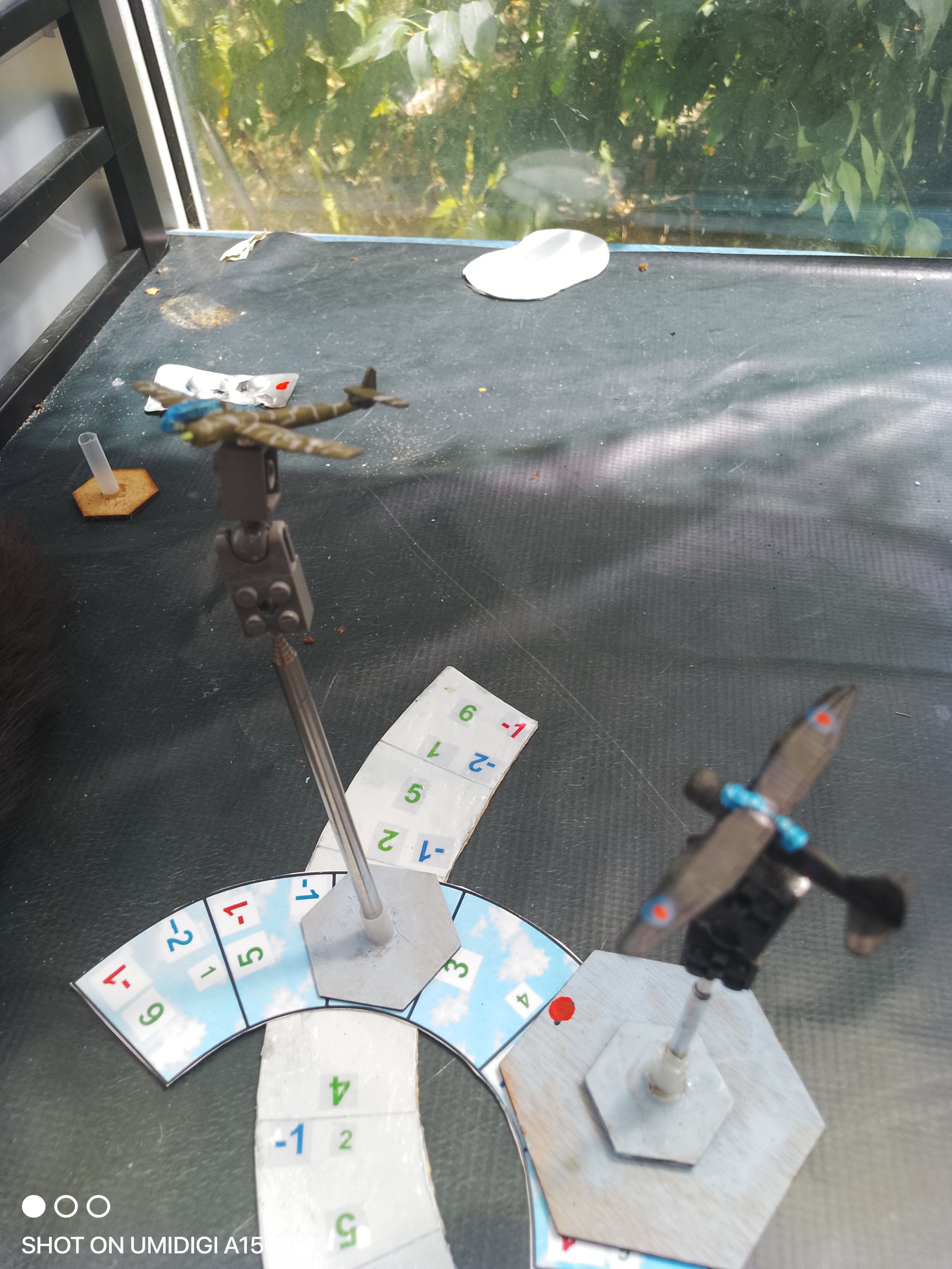
The B&V was a fairly sluggish and unwieldy crate. Hans pulled a hard D CLASS LEFT TURN.
Squiffy a B CLASS LEFT TURN.
Essentially now in a Two Circle fight, Squiffs got a lovely Leading shot at very close range of 1” + 2 “ of altitude difference. He had sold the Hun up the river, and they could not bear any guns!
Both his .303s hit, and HOW!
The propellor of the BV was clipped right off!
NEIN NEIN NEIN NEIN!
Hans hit the silk along with his WO and RT and Rear gunner. All managed to land safely as the Bv pranged into the fields.
Squiffy leveled the Lysander and now out of range of the Flackvierling approached the woods from the North.
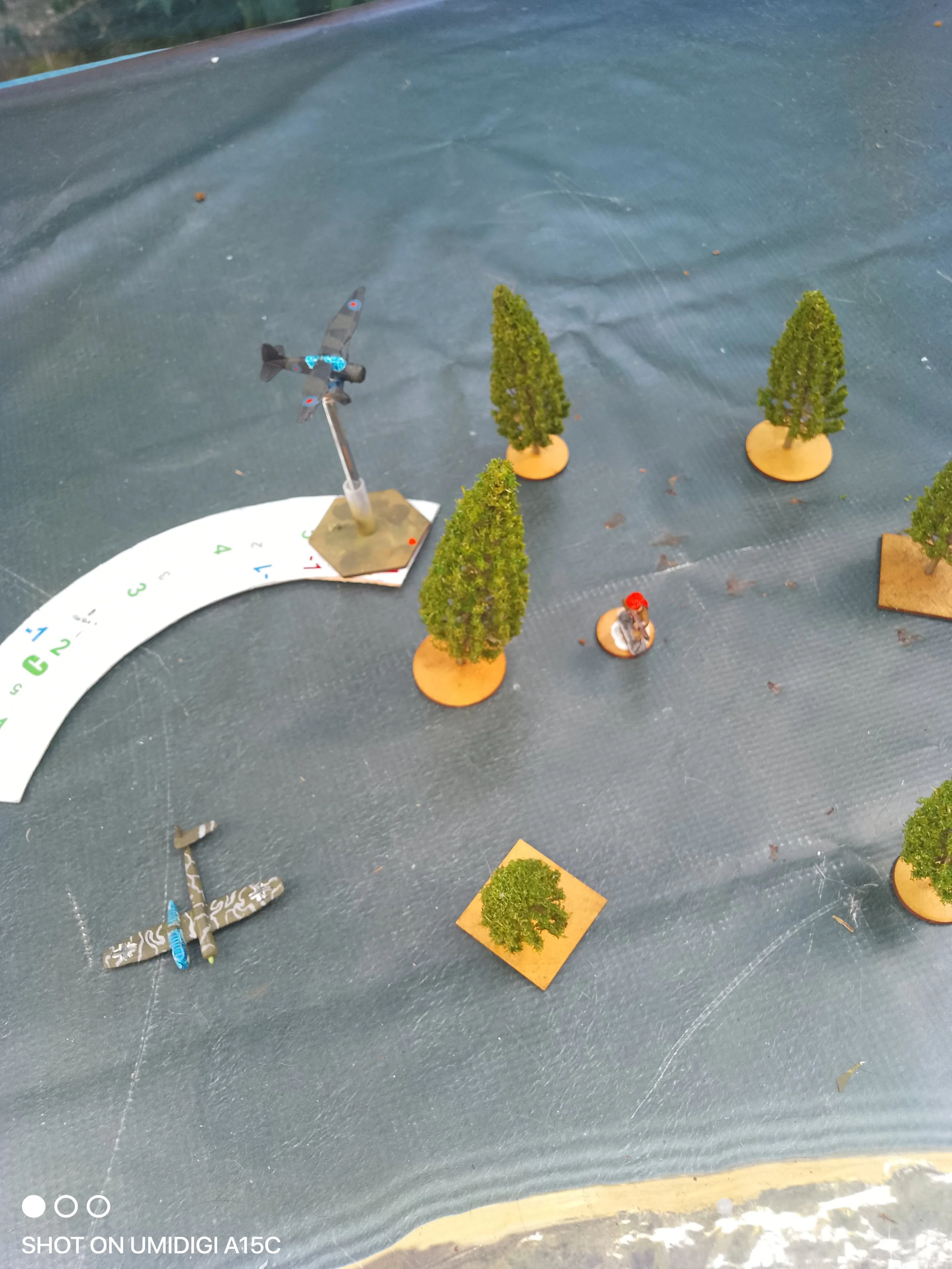
“Easy does it! This field looks a bit bumpy!”The Lysander had however the trait SPATS and touched down perfectly on the rough terrain
Squiffs had reduced his airspeed to 1 and prepared a STRAIGHT SHALLOW DIVE to land. The CARRIER trait meant he would stop dead on landing. His Revs were 9 and he had a Variable Pitch propellor. Perfect as always. His smile flashed at Jean Luc.
“ Hop on old Fromage!..Ive a date tonight back in Blighty”
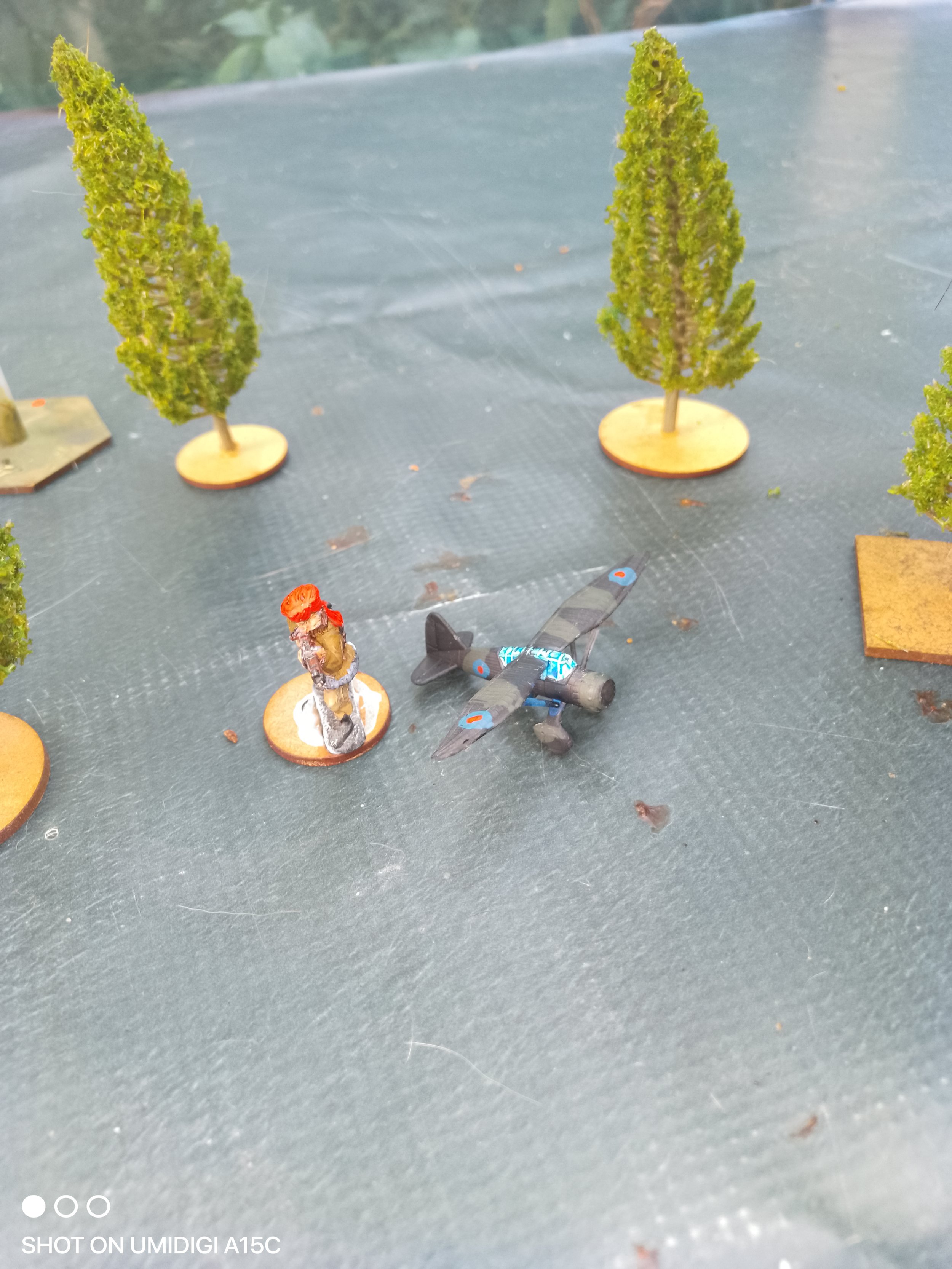
Keeping low and slow, Squiffs arrived back at Tangmere and made it through the Pub door just before closing.
He staggered to a halt.
The Pub fell silent.
“GERTIE!” he exclaimed.
Gertie looked around from the knee of Sparky Sparksworth.
“Why I aint done nuffink nor ave I whatever and that is what I say” and flounced out of the door.
Squiffy sees it through!
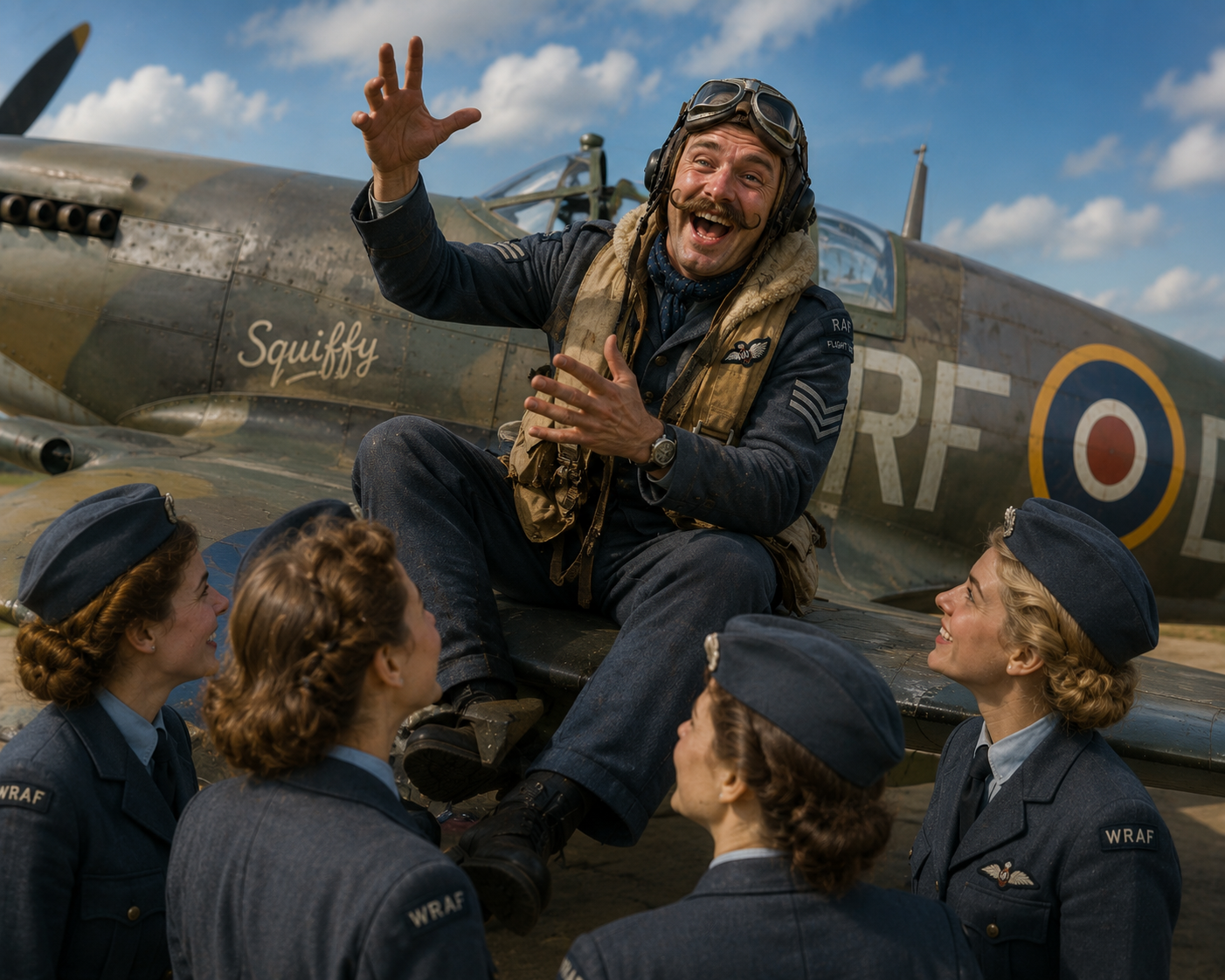
The Squadron Leaders legendary temper had rattled the door of his office, and Squiffy beat a hasty retreat followed by “ By The Lord Harry!! I’ll see you are on Jankers for the rest of the war, you blithering maniac!!” and several thrown ashtrays.
“Crumbs, looks like old Featherprop got out of bed the wrong side this morning” thought Squiffy. He headed over to the Hangers where Sparky was polishing up his new Spitfire.
“What Ho, Sparks old trout!” said Squiffy to the Sergeant
“Hullo Squiffs, Good of you to pitch up!” grinned Sparksworth. “Now bend an ear, the form is this. Von Schnorbitz is hopping mad. Seems your last Jape when you tipped custard over his new Emil was the last straw. He’s challenged you to a duel, mano-e-mano as they say. He’s going to meet you over the channel at noon tommorow”
“By Jove, the Cad!” sad Squiffy, “Well, that means we should get some pre-duel drinks in at the Flaps and Siren tonight”
“Rather”! exlaimed Sparky, “but the gen is that he’s taken BORN PILOT skill and can now adjust his pitch. I’d keep on your toes old boy”
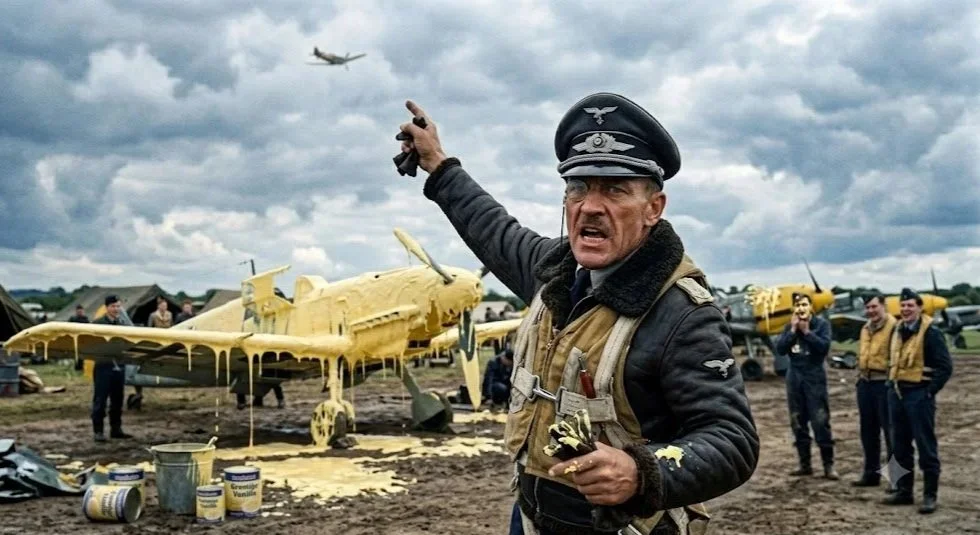
The following day proved bright and clear , as so often in those days of ninteen forty something. Squiffy lifted off from Tangmere and was soon over the Channel.
Von Schnorbitz spotted him and screwed his monacle in place “Ach So” He snarled “I did not expect Herr Squiffy to turn up, coward that he is…Zis time I shall be , how you say…putting the foot in the other shoe”
“What was that Leutnant”? said his base RT operator “Sounds like you are talking to yourself in a rather sterotyped German accent”.
Von Schnorbitz turned off the radio and opened the throttle on the Damiler Benz.
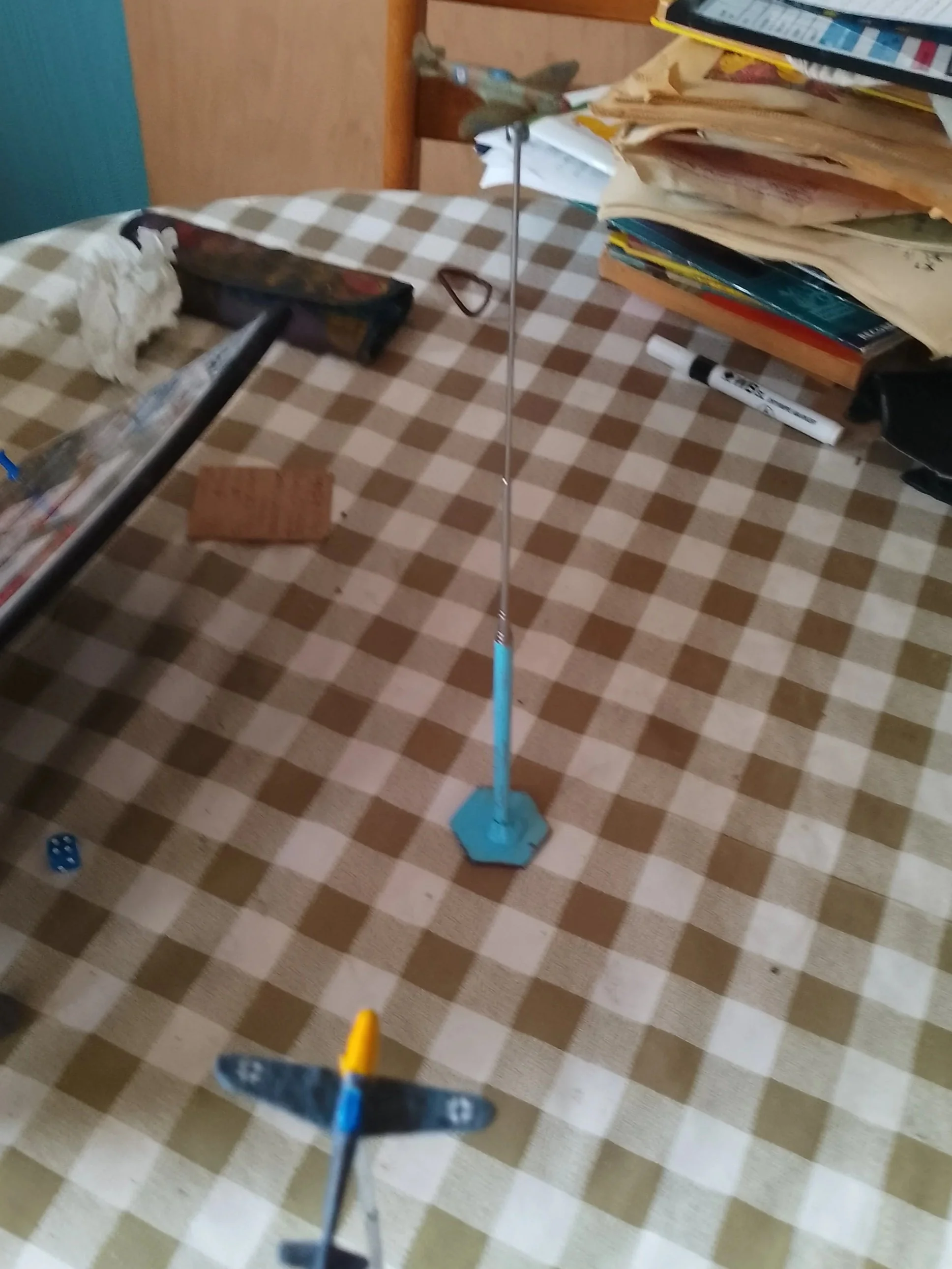
Squiffy was 3 levels above the German at Angels 11 and spotted him at 2 oclock low. The 109 at Speed 5, the Spitfire at Speed 4 .
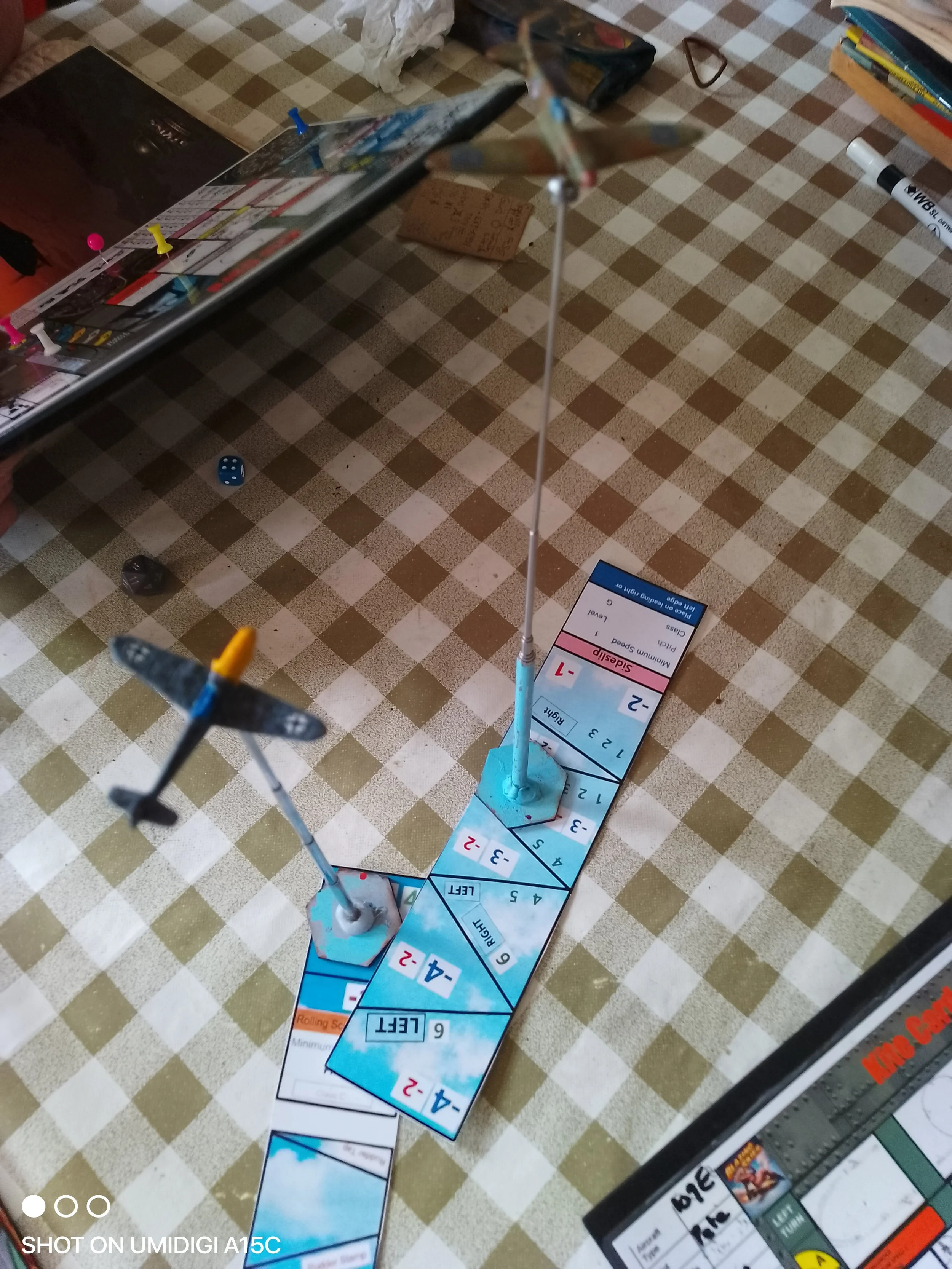
Squiffy forgot that he had “Experten” skills and diddn’t ask for break direction. He assumed Schnorbitz would pull right and overshoot. He thus went for a Squiffy Special and kicked rudder, chopped the throttle and gentle right stick to SIDESLIP LEFT, expecting the Hun to appear in his sights.
Schnorbitz however was keeping his distance, he entered a ROLLING SISSORS and found himself with Squiffys now Speed 2 and Angels 8.
“GOTT MIT UNS!” cried Schnorbitz and thumbed the trigger, letting Squiffy have the bally lot.
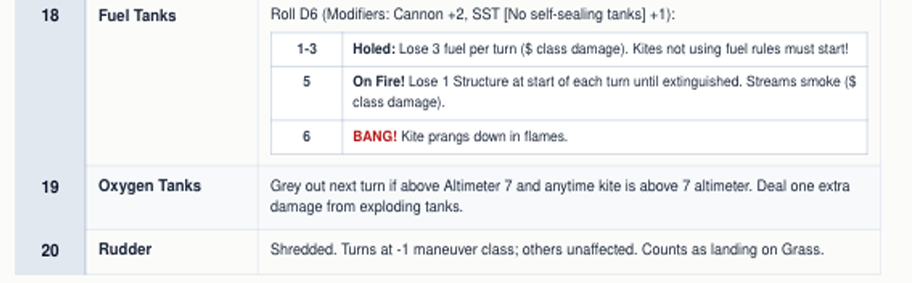
The Nose mounted 20mm cannon smashed into Squiffs fuel tank, but the Self Sealing tanks did their job. Rolling a 1 for damage the cannon simply left holes and fuel leaking from Squiffs wings.
“I SAY!” cried Squiffy. “Thats not Cricket old sponge!”
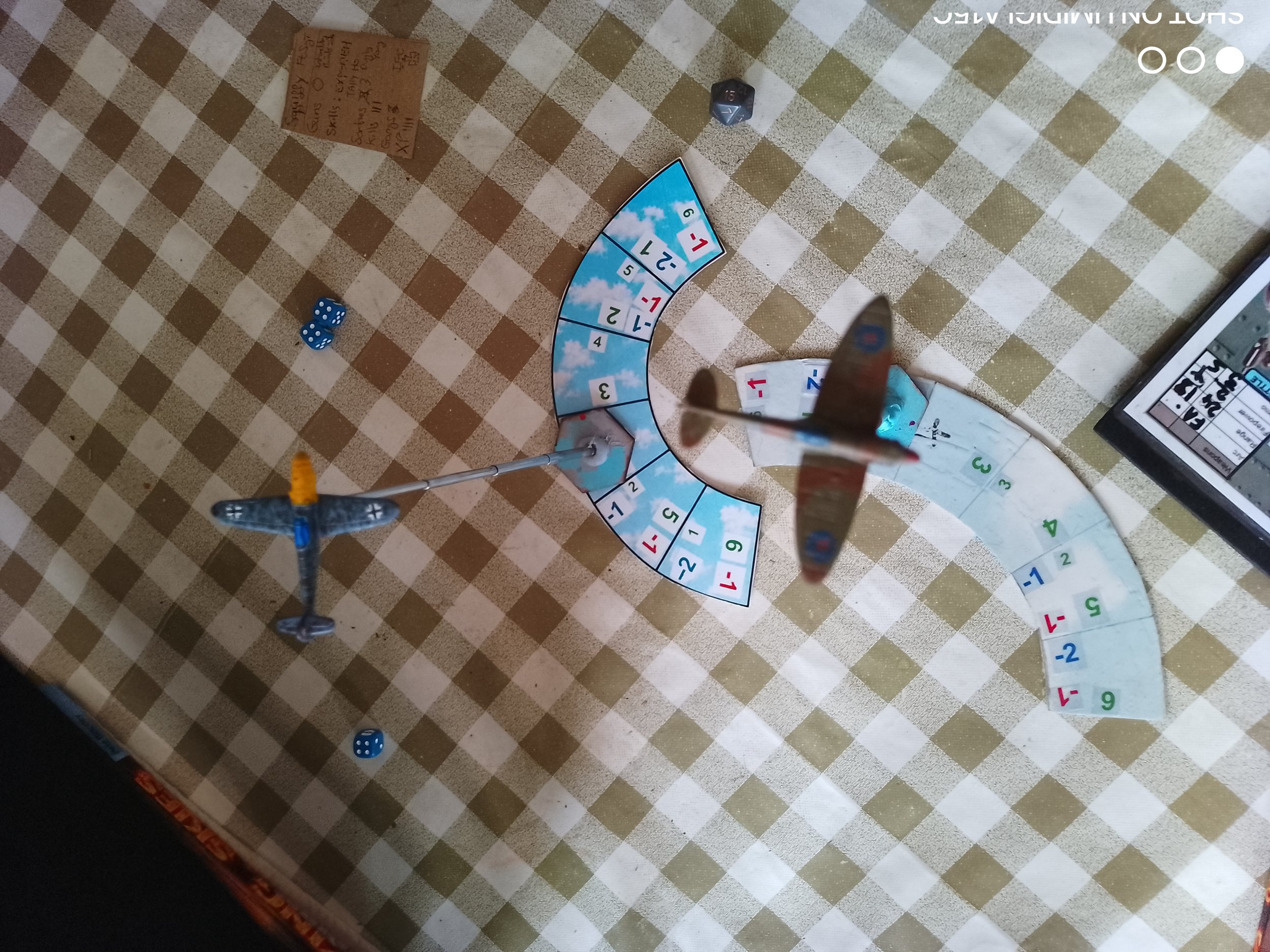
“Ive been sold a duffer!” thought Squiffy and quickly checked his Airspeed. “Time to take this party downstairs”
He dropped his nose in a SHALLOW DIVE RIGHT TURN CLASS B, losing a total of 3 height for the turn but picking up a speed. At turns end he was Angels 5 Speed 3
Schnorbitz kept on the throttle and cranked into a LEVEL RIGHT TURN CLASS B, but with his faster speed he was starting to gain on Squiffs tail.
“HO HO HO Englander! I am the last laugh having!” he radioed through to the Briton.
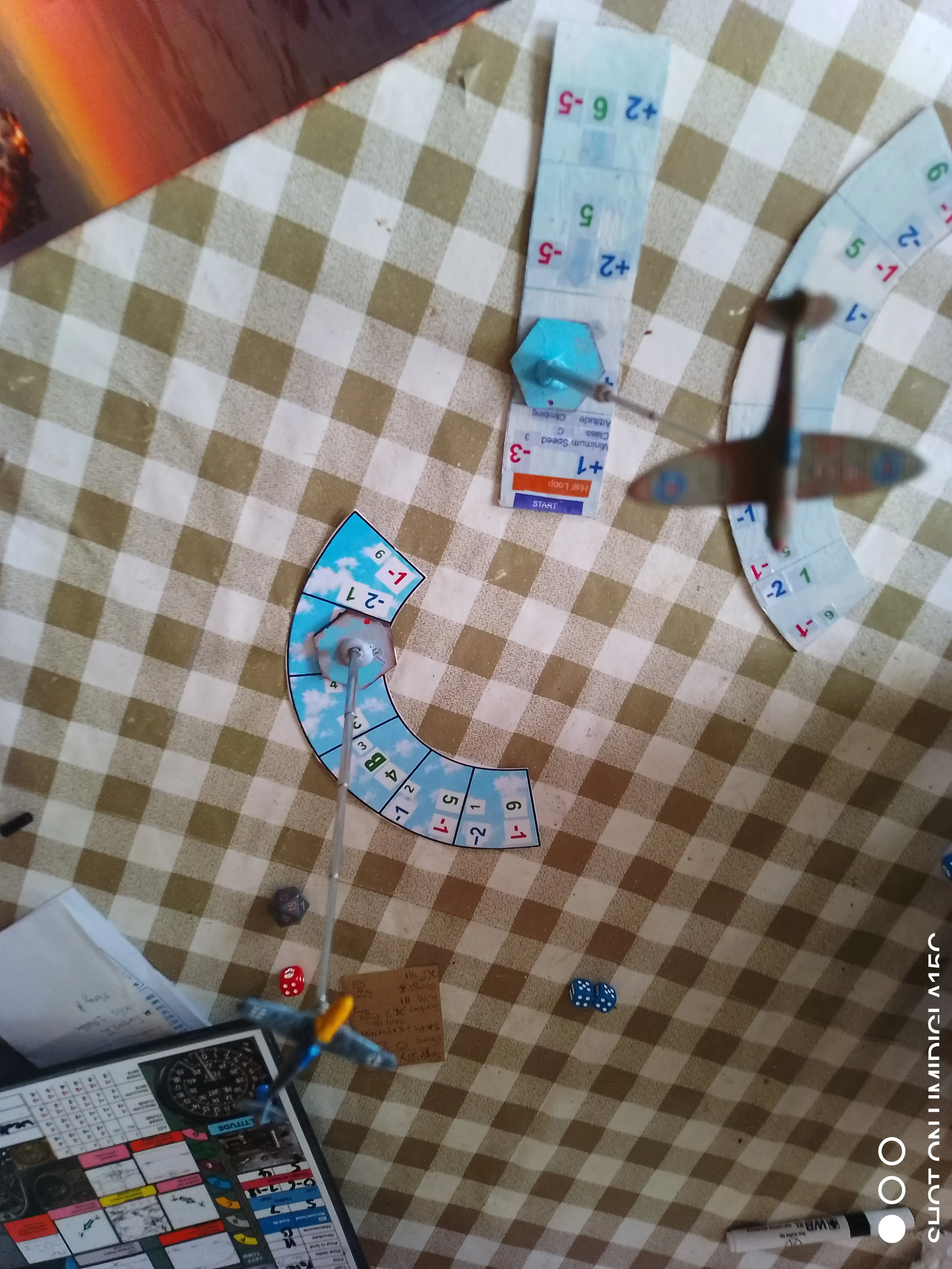
Schnorbitz revved up to Speed 4 and still at Angels 8. He carried on his B CLASS LEVEL and again had success with avoiding the 109 “weathercocking” the slats.
Squiffy revved up to speed 4 and immediatly pulled a Half Loop leaving him at Angels 6 Speed 1 and climbing with the Jerry above. Both pilots hammered each other with snapshots in their head on game of chicken. Squiffys eyes goggled as a bullet smashed his compass to bits and his old crate was looking a tad ropey.
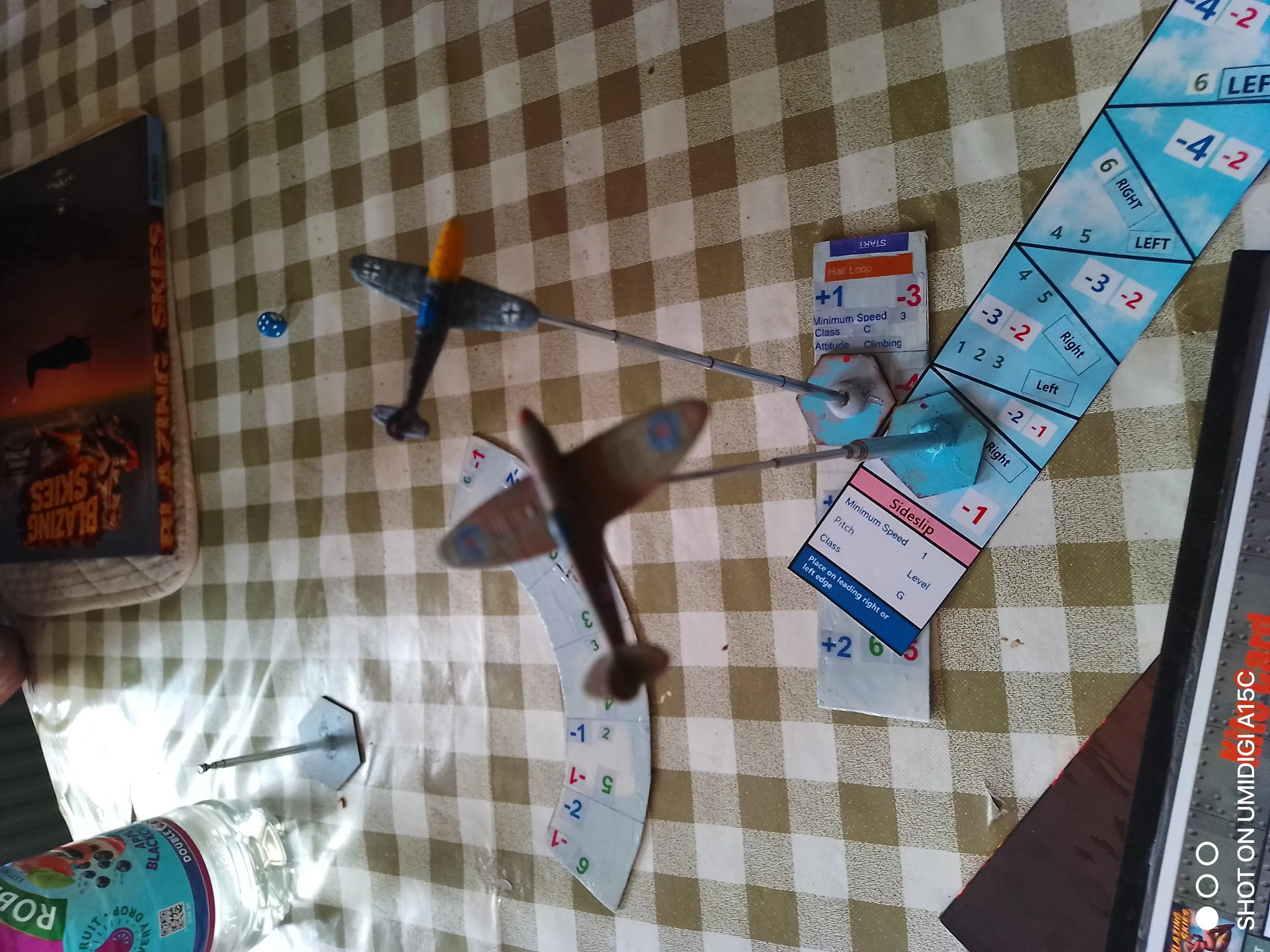
The Englander will turn into me…and I shall half loop thus putting him below me, I shall drop my pitch to level and his goose is cooked! Thought Fritz.
Squiffs had other plans. Although only at speed 1 he trusted his sturdy Merlin engine and hit a SIDESLIP RIGHT. This brought him to stalling speed, and he knew he would have to pile on the power next turn. He was rewarded though as the 109 entered his sights in a Trailing shot at point blank range. “DAKKA DAKKA DAKKA FRITZ”! cried Squiffy and his eight .303’s filled Schnorbitz’s vanity mirror.
Dealing 5 more damage the 109 fell apart in the air and span to earth. Schnorbitz howeled with rage. “VERDAMMT! HOW IZ ZIS POSSIBLE” he cursed and hit the silk. Rolling a 6, he drifted towards the drink.
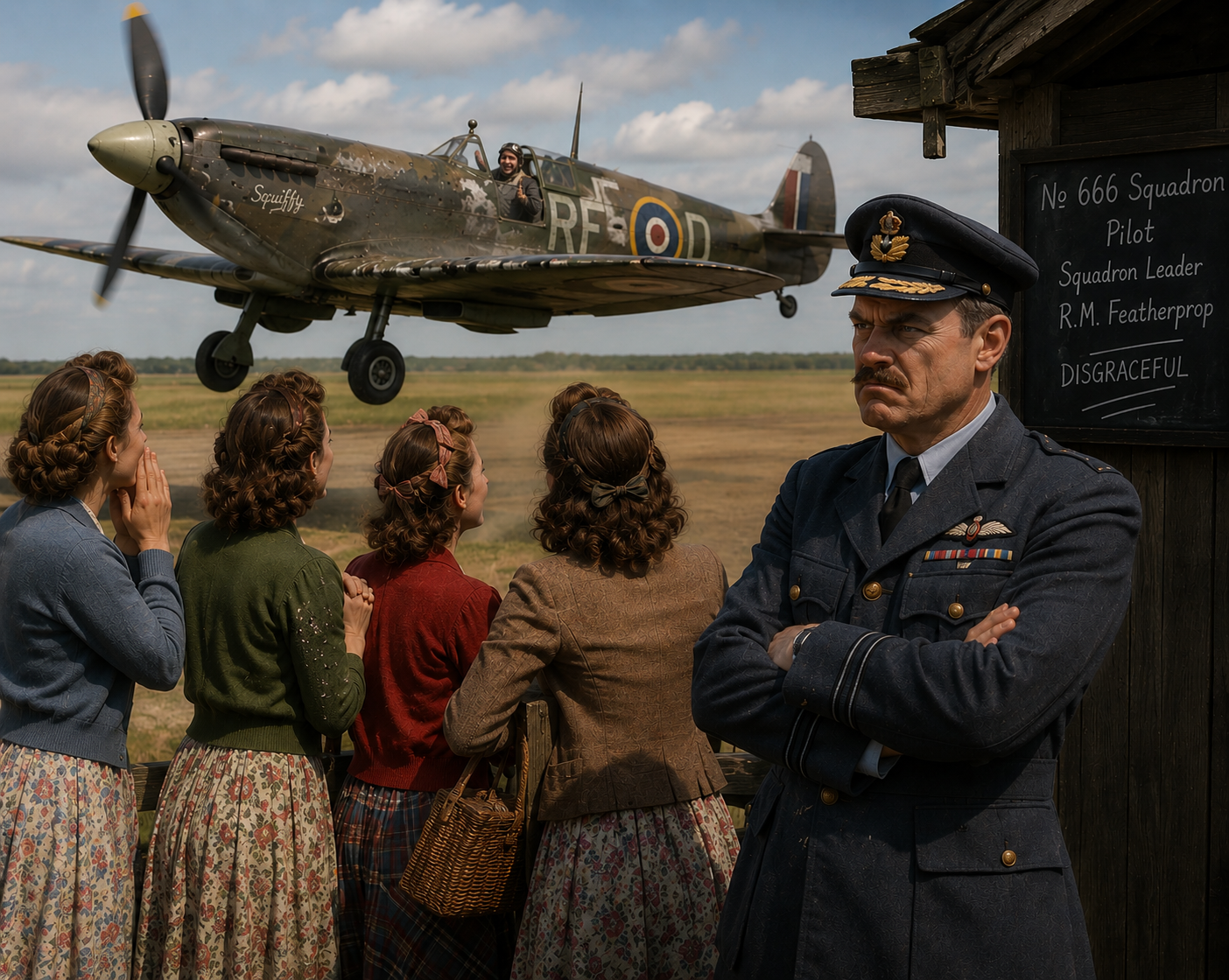
“Hullo Girls!…Never fear! Squiffys back for tonights Dance” waved Squiffs as he came in on finals at Tangmere.
“Yet another bloody pranged up machine!!” glowered Featherprop…” There’s got to be a way to get him transfered……..”
But as the Spitfire clanked to a halt, Squiffs leaped out “Thats Number 4!” he grinned at Sparky. Paint it up for us old chap”
“Only just polished it!!” laughed Sparky, “You are a one, Squiffs”
Squiffy Saves the Day
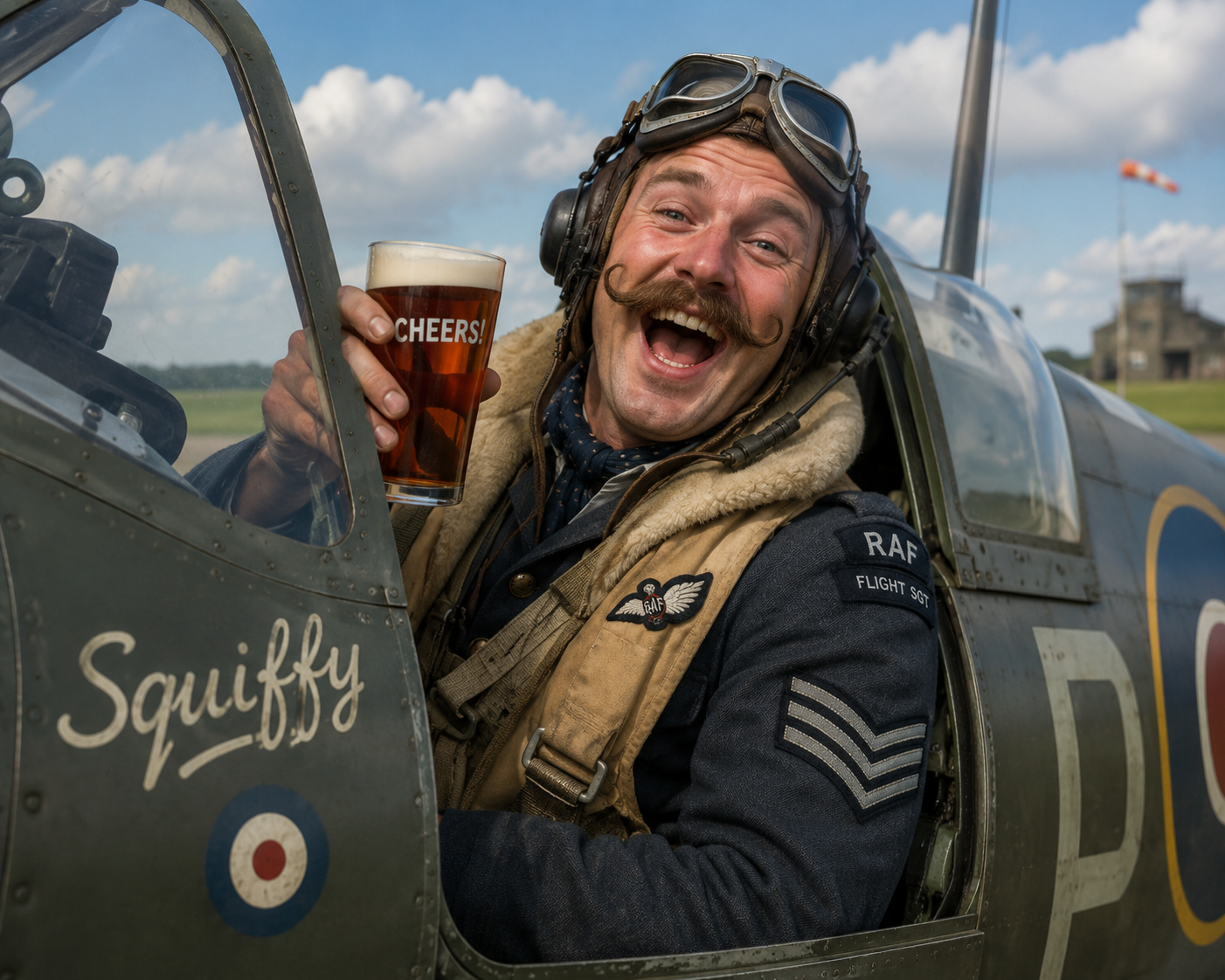
On returning from the clash with the Dornier, Squiffy was carried high in the air to the mess where Sq Ldr Featherprop was pleased to announce the awarding of an Infamous Flying Cross.
Squiffy also added up his experience Points and chose “Tally Ho” which would give him the edge in a bounce!
He also spent his paycheck on an Intimidating Paint Job for the Spitfire Mk2 he was assigned. And with all that done, he was ready for another clash with the cunning tutons. It did not take long!
For this game, I let Squiffy choose the matchup as long as I wasnt taking another bomber! I felt I needed a even chance!
Squiffs decided on his Mk2a Spitfire vs a BF10E4. The mission was a Rhubarb for Squiffy over the French Coast.
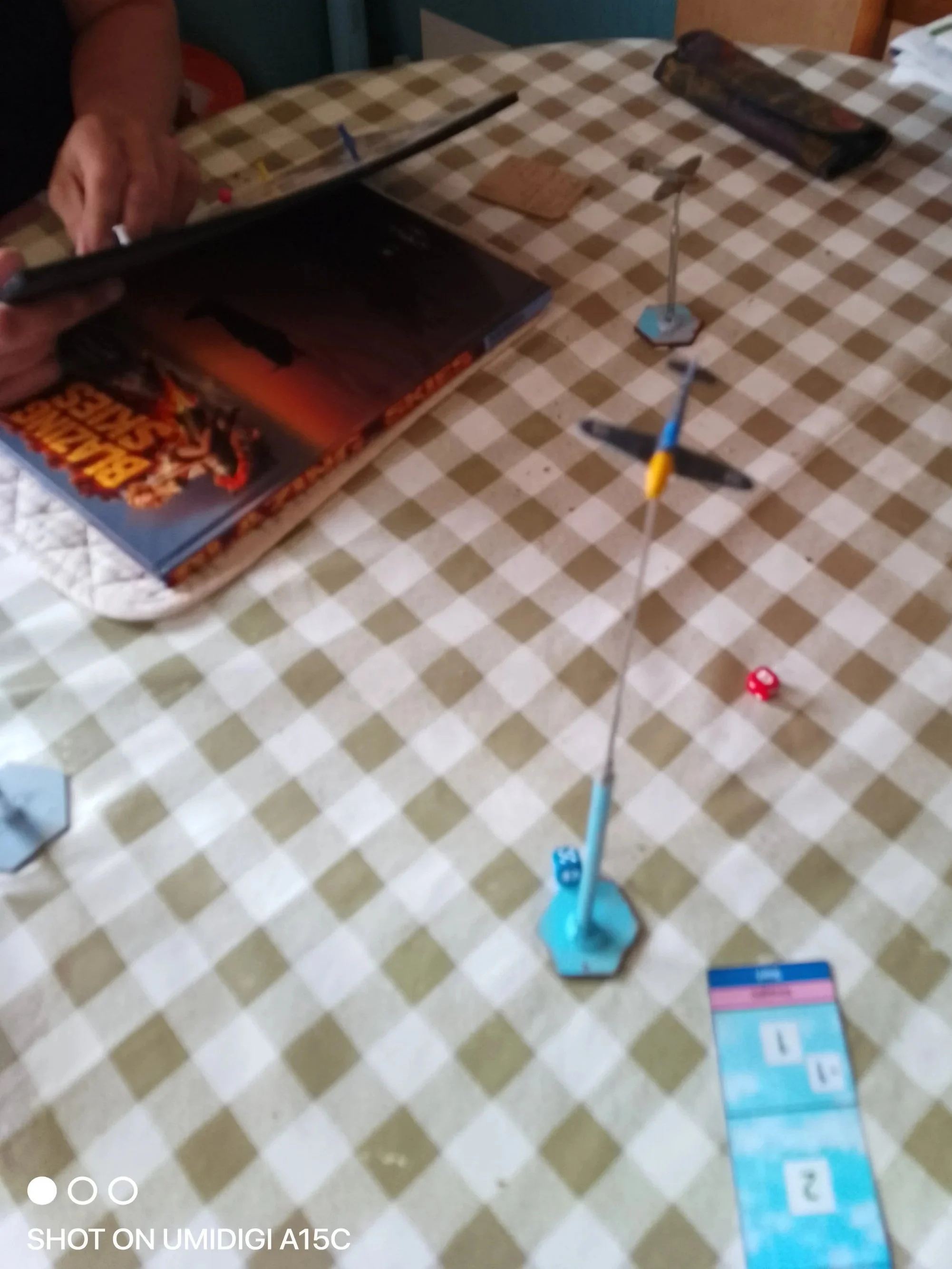
Using the random height and orientation rules, Squiffy fared badly for height being only 6000 ft, whilst Von Schnorbitz, my Pilot, was at 24000 ft. However squiffs ended up in my blind spot!
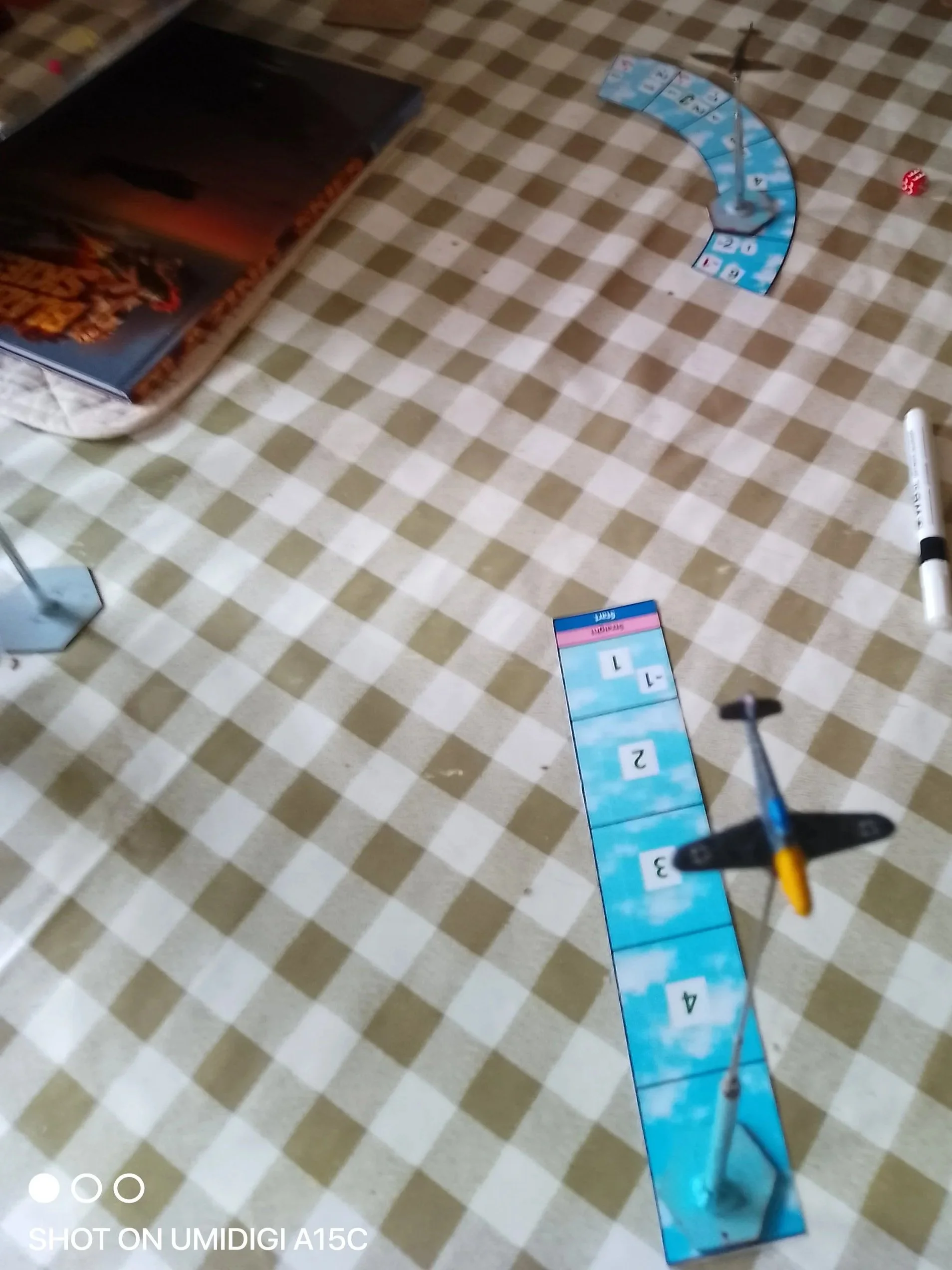
With plenty of time, Squiffy opened the throttle of his Merlin and added 5 power, curling upwards in a Right turn class C. Von Schnorbitz carried on oblivious ahead and straight, thinking about dastardly deeds and ominous plans.
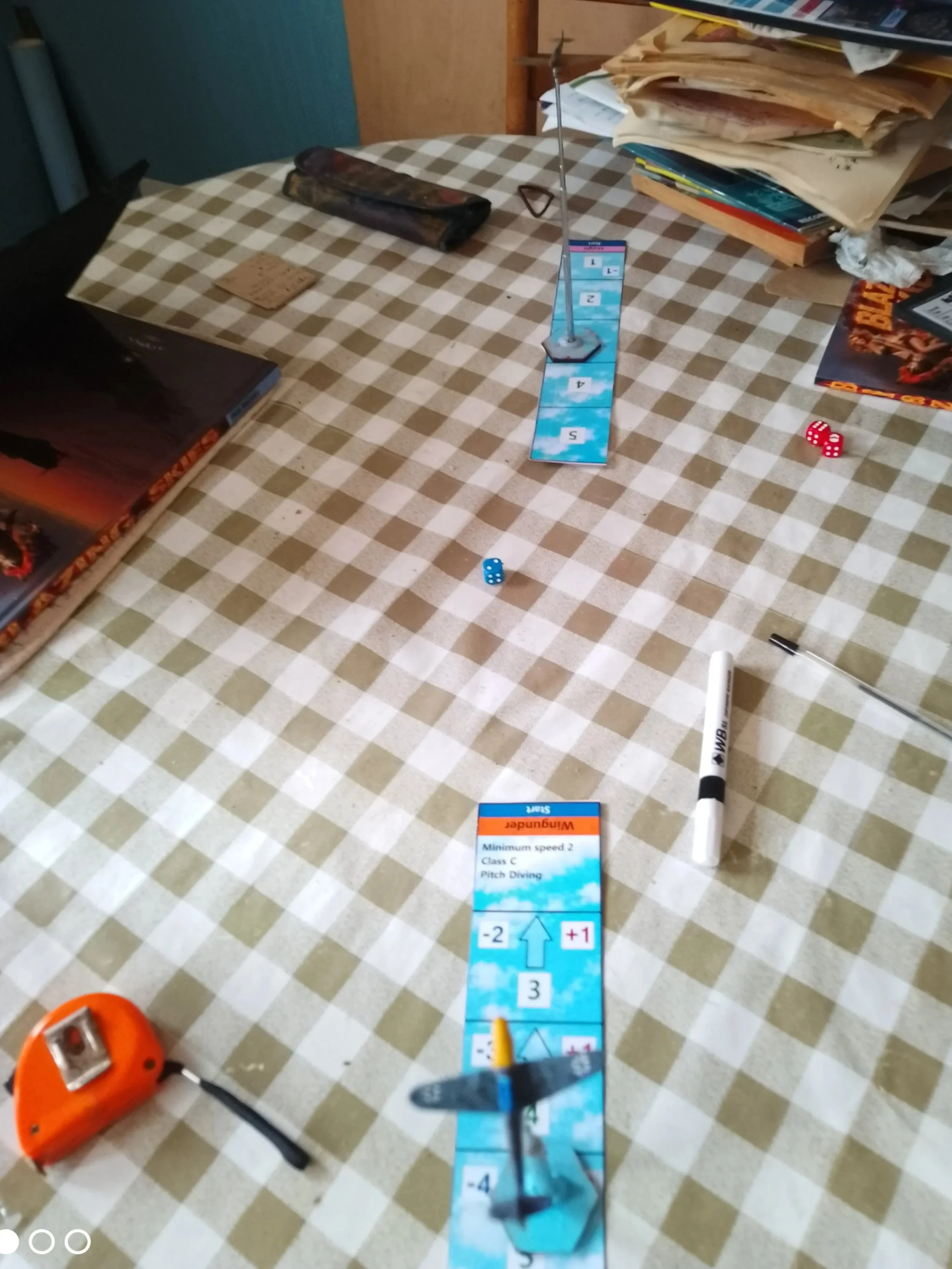
Squiffy leveled off and his Spitfire which had lust 3 speed in the climb, gained one back through the powerful Rolls Royce.
Scnorbitz dipped his wing and looked below. His Monacle jumped out of his eye! “GroB Gott! Tommy! ….I did not see you there, but we shall soon…how you say…settle your hash!”
He rolled the Messerschmitt onto its back and pulled into a tight Wingunder manouver. Now at height 9 and Squiffy at height 5, Scnorbitz had the Plucky Briton below him and he was at diving pitch. He rattled of his machineguns only and missed at the long range. Squiffy flying level couldnt bear on the German.
“Cripes!” said Squiffs “This fellow knows what he’s about, but I’ll soon show him the form”
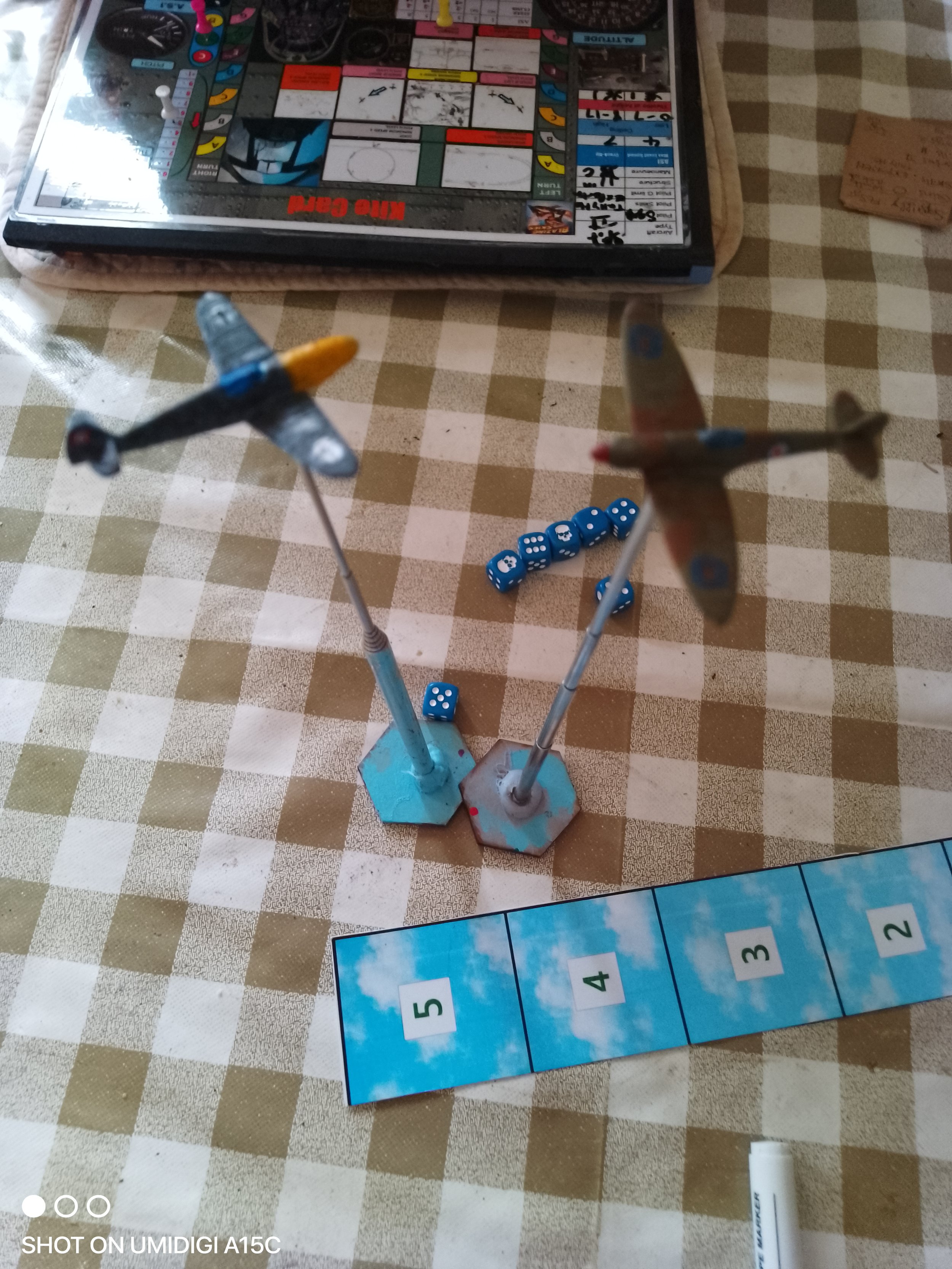
Schnorbitz pushed the Emil Red-7 into a straight shallow dive, racing towards Squiffy.
Squiffy had an Idea he might do that due to his “Experten” skill and Schorbitz announced “No Break”.
“Thats your game eh, Fritz? “ said Squiffy, “well you reckoned without two things, My inherent pluck ….and my current inebriation!”
The two fighters raced towards each other at a closing speed of 650MPH (speed 11). Neither gave a inch and as the hex bases overlapped , collission dice were rolled with Squiffy squeaking inches over Schnorbitz’s canopy. At the last second though, both pilots let rip with corking bursts of rattling dice.
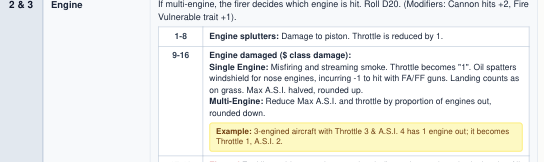
Squiffys Spitfire shuddered, a cannon shell smashed into the merlin and split the crankcase. Oil pressure dropped to almost nothing! His Throttle at all heights became 1.
Squiffys eight brownings did Fritz no favours. His BF 109 was reduced to 6 structure and his undercarridge was damaged. That was going to have to be a “Later problem”
Squiffy craned his head round, his “Experten” skill told him Jerry was going to brake left, but right at this moment he had serious problems! At speed 3 with a virtually dead engine, he needed speed! Dipping his nose again he pitched down into a shallow dive. He felt the Spitfire shudder and rattle as it built up speed back to around 340 mph.
Schnorbitz, feathered back his revs and Pulled his 109 into the tightest turn he could. Avoiding the “weathercocking” of the 109, he kept control around the B left turn.
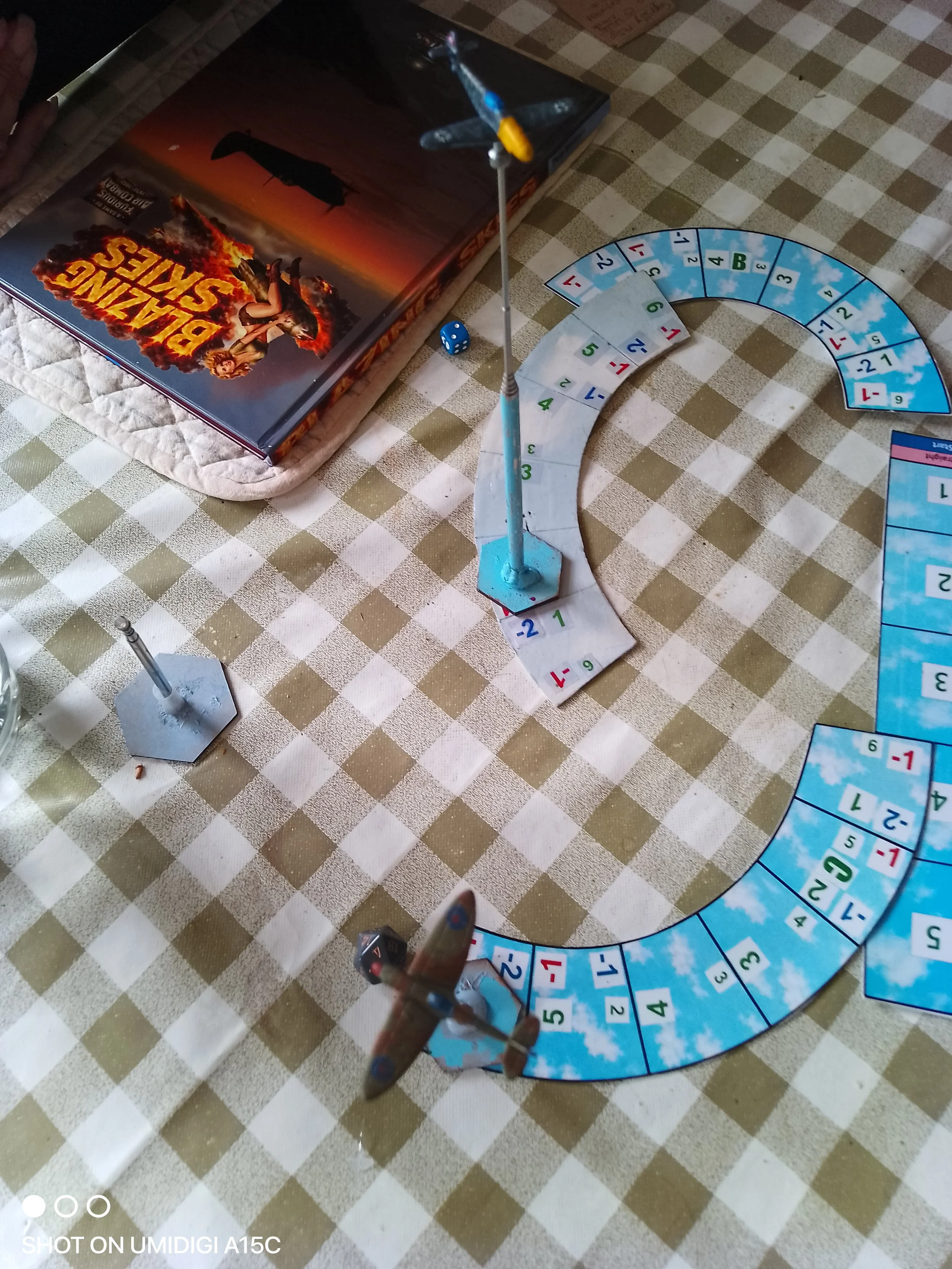
The two rivals were now very low down, and with Schnorbitz using full throttle, both had sufficient speed, but Squiffy couldnt regain any more like the German could.
Now in a “two circle” fight, the advantage would eventually go to the 109 with its full power engine. Both machines turning as tight as possible, the 109 keeping control as the pressure grabbed its icy fingers at the slats.
Both players fired again in a snapshot closing pass. Squiffy took hits in the wing and he was concerned his undercarrige had been damaged. No time for that now though!
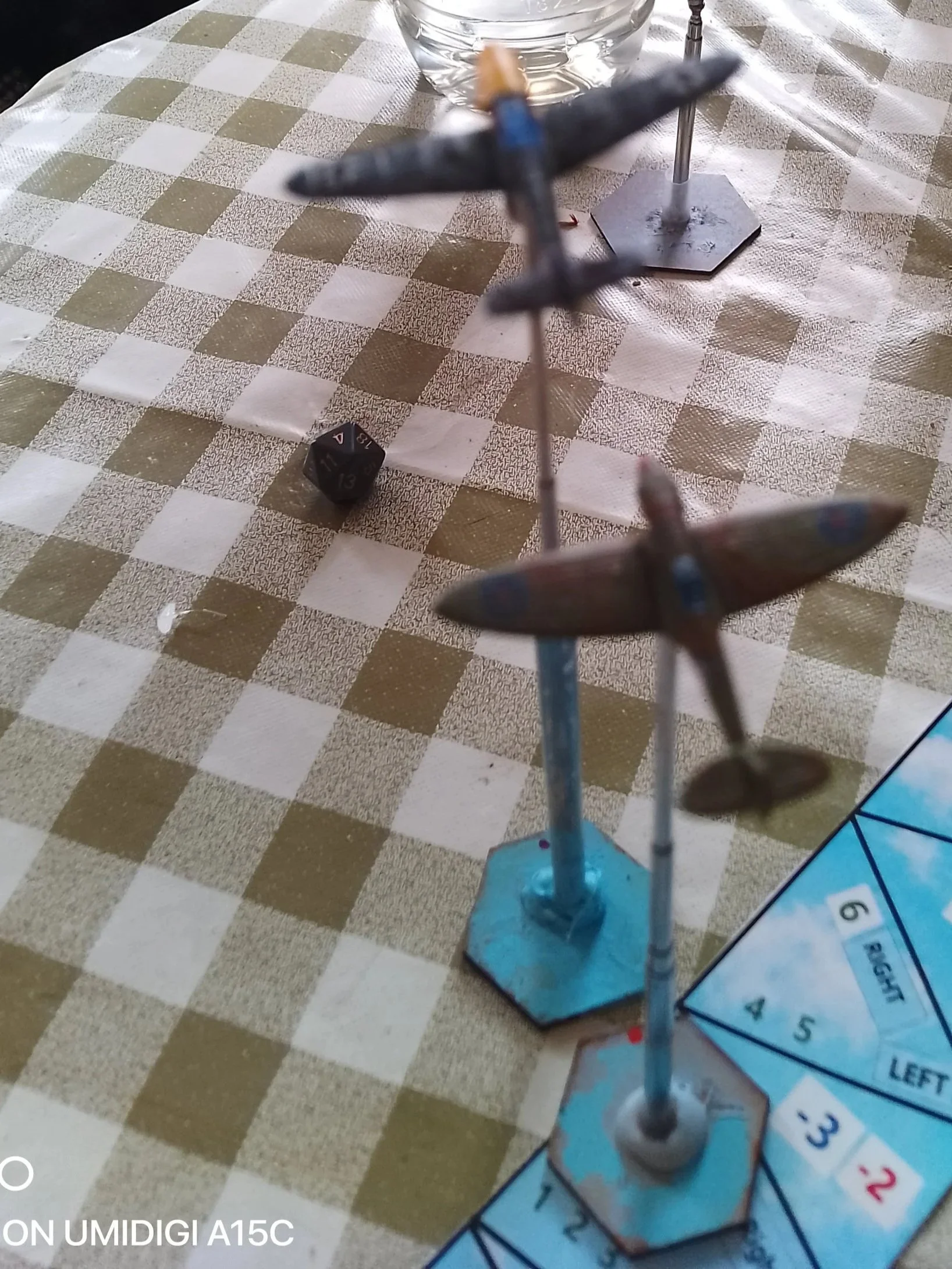
Schnorbitz reversed his turn B class right turn at Airspeed 4. Squiffy however had a trick.
“Crumbs! Looks like Jerrys trying a fast one on me! Well, not today old carrot!”Squiffy announced a sideslip right at speed 3 and although this brought his Altitude to Angels 1 and his speed to 1, he slid the little fighter to the right and was rewarded with the 109 turning in front of him.
“Right where I want you, old fellow”! cried Squiffy and he let rip with all eight brownings. The flaps and emponage of the Messerschmitt were ripped to bits and Schnorbits knew the game was up. The 109 fell to pieces and the aristocratic pilot leapt into the slipstream.
Squiffy waggled his wings and nursed the Battered spitfire back to base.
“Hmm, I dont think i’ll get the old girl down today” Thought Squiffy. “Well…time to hit the silk”
He slowly and carefully nursed the spitfire up to height 4 then baled out over Tangmere.
He watched as he drifted down the sight of his Spitfire curving through the air to land and explode on Sq Ldr Featherprops Car.
“Oh Crumbs” he squeaked as Featherprop stood waiting his landing.
Squiffy goes to Blighty
From Iceland, Squiffs received orders to return to Britain. Climbing into his Hurricat, he checked his pint was securely fastened in his drinks holder. Flipping the magnetos and starting the fuel pumps he checked the frozzen runway ahead of him and fired up the Merlin.
“Watch out for Jerry on the way old sausage,” yelled his groundcrew chief Sgt Sparkey Sparksworth.
“No bother at all my good man!” shouted Squiffy, “The Hun wont know whats hit ‘em”.
The Hurricane roared into the sky waggling its wings, then returned for a low level barrel roll over the Group Captains office.
Back at Duxford, he was surprised to find 666 Squadron had left and relocated to Tangmere.
“I say, mind if I borrow that Defiant over there to get to Tangmere? I wont prang it up”.
“Carry on old chap!” smiled the Sq Ldr. “Take Dusty with you in the turret, he’s got to go Tangmere for a party this evening”
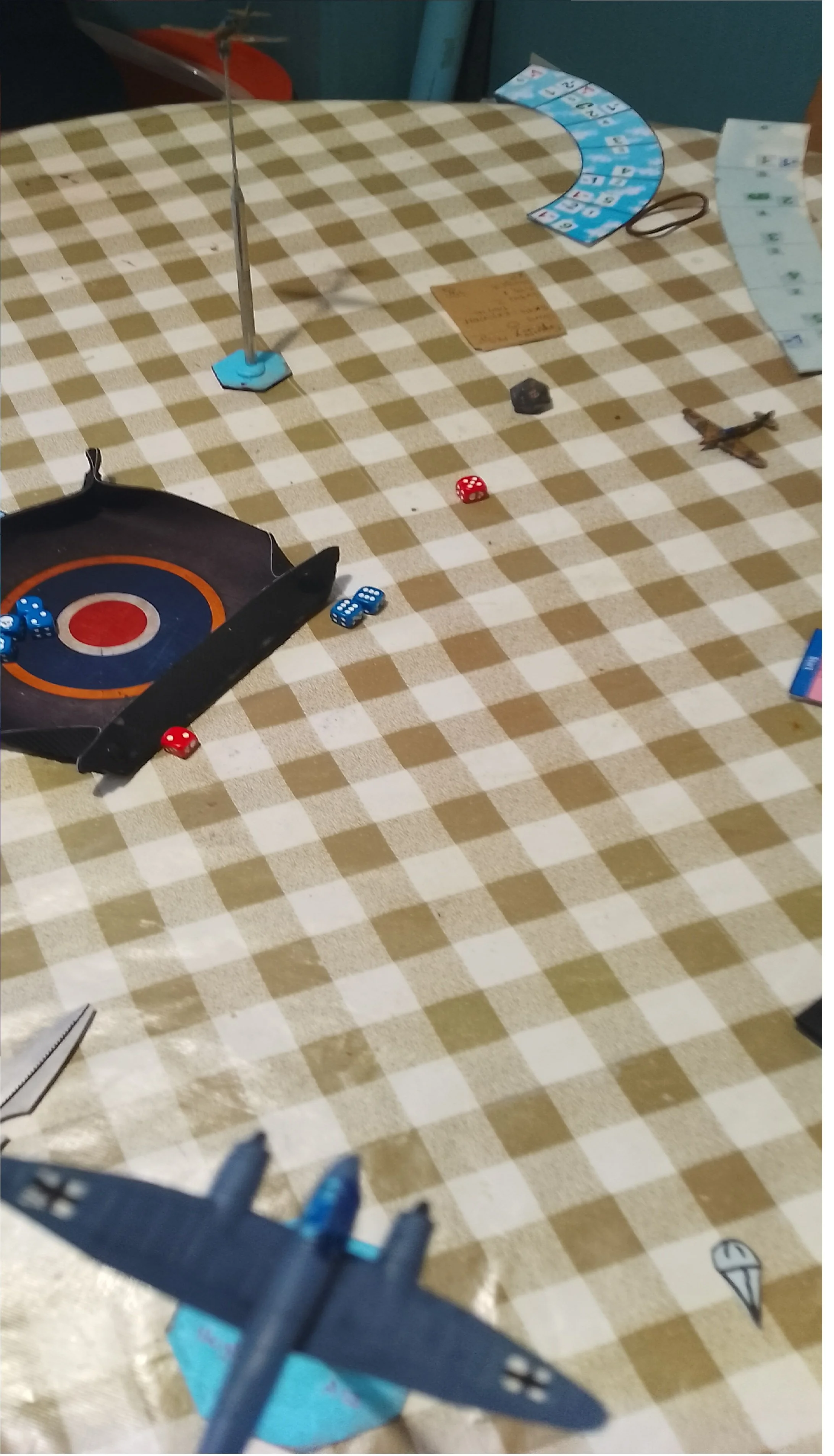
Approaching Tangmere, Squiffy prepared for his approach. “Ahh, I see they’ve got the welcoming committie up!” he said as a Twin Engined Anson appeared out of a cloud.
The Anson however as it came into focus sported a glazed nose and Balkenkrutz on its wings!
. “Dammd if that doesnt look like the Bally Hun!” he said and opened the Defiants throttle to Maximum
On the trip up for the game, I had loaded about eighty kites into the car, but unfortunatly , the Do17 that we wanted to use wasn’t one of them. We proxied a JU88 as a Do17M
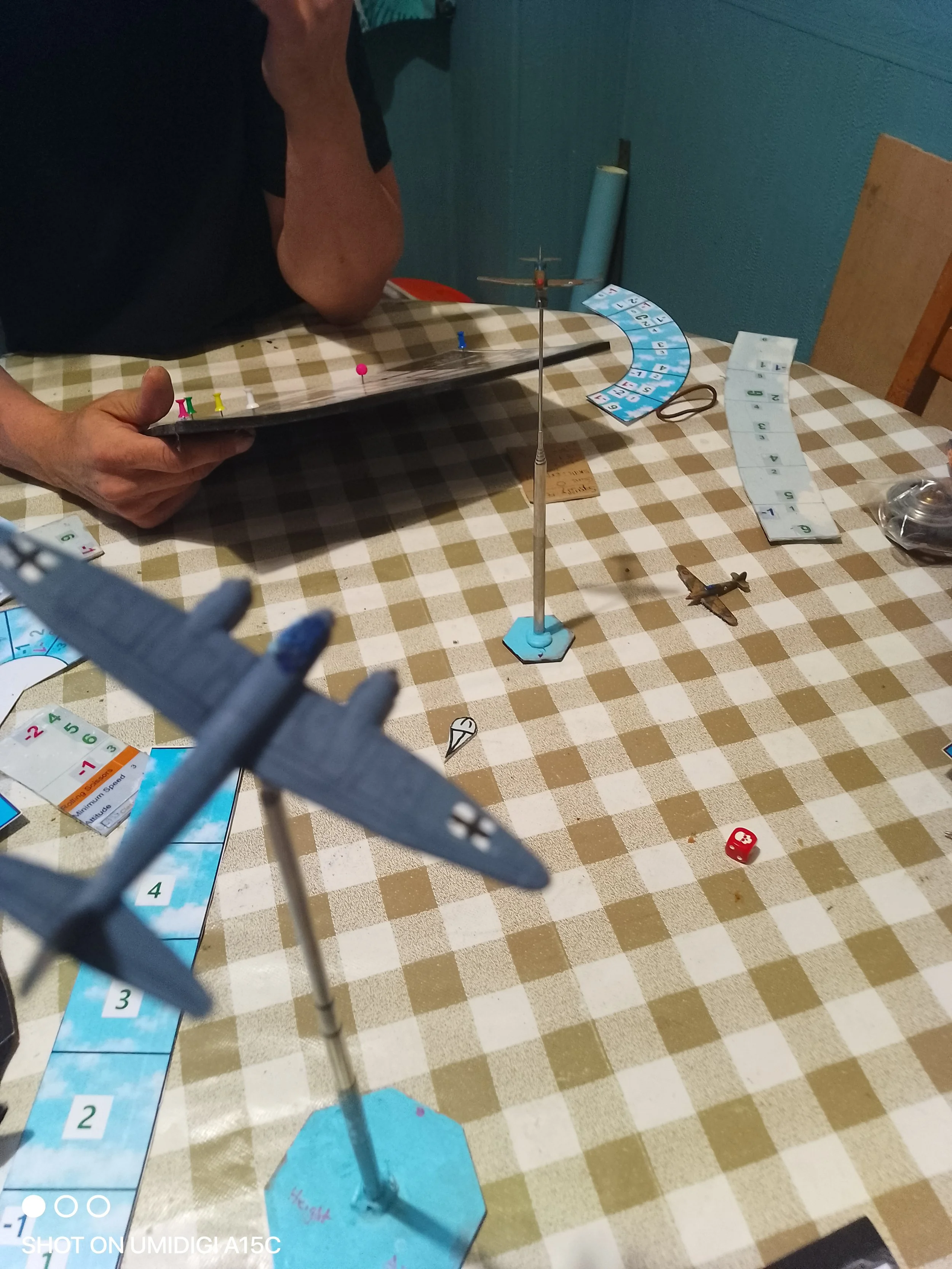
The Jerry flew straight and level after a gentle G turn to starboard and at Angels 7 dropped its eggs aiming squarely for the parked Hurricane on the airfield. Squiffy dipped the Defiants nose and screamed down from Angels 12 to Angels 9. The bombs were in the air now, but at least he could avenge his mates. The Nose gunner in the Dornier drilled steady bursts at Squiffy, who held his fire leveling out from a E class left turn. and now traveling at 400 mph or Airspeed 6
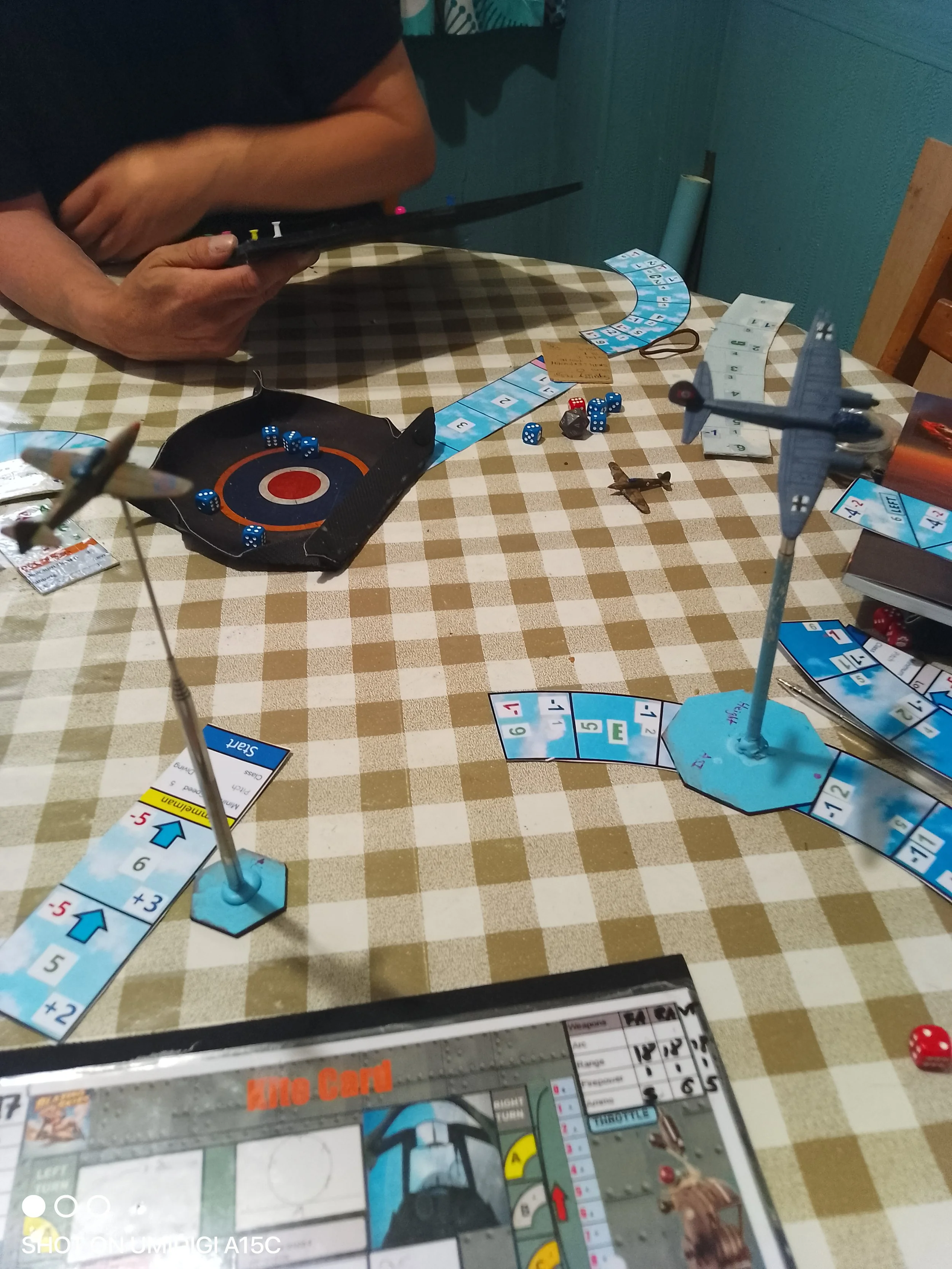
At point blank range Squiffy thumbed the gun button, only to find the Defiant had no forward guns!
Squiffs incredible forward airspeed took him underneath the Do17 and Dusty let rip with the turretts 4x.303 brownings. The burst smashed the Dorniers bomb sight and punched holes in the fuel tanks.
The Ventral gun on the Dornier burst into life and a line of holes appeared in Squiffys wing.
“Ach! Himmel” said Shtiffler, the Do’s pilot. “We must be saying goodbye now Englander!” and banked his little bomber in a E class right turn back towards France.
“Not so Fast my old Fruit!” roared Squiffy and brought the Defiant into a Immelman turn. Now hanging on his prop slightly above the German, Dusty peppered the bomber and shot through its hydraulics.
Running out of table space we decided that we would shift all kites back when we were running out of room rather than a hard edge for the game.
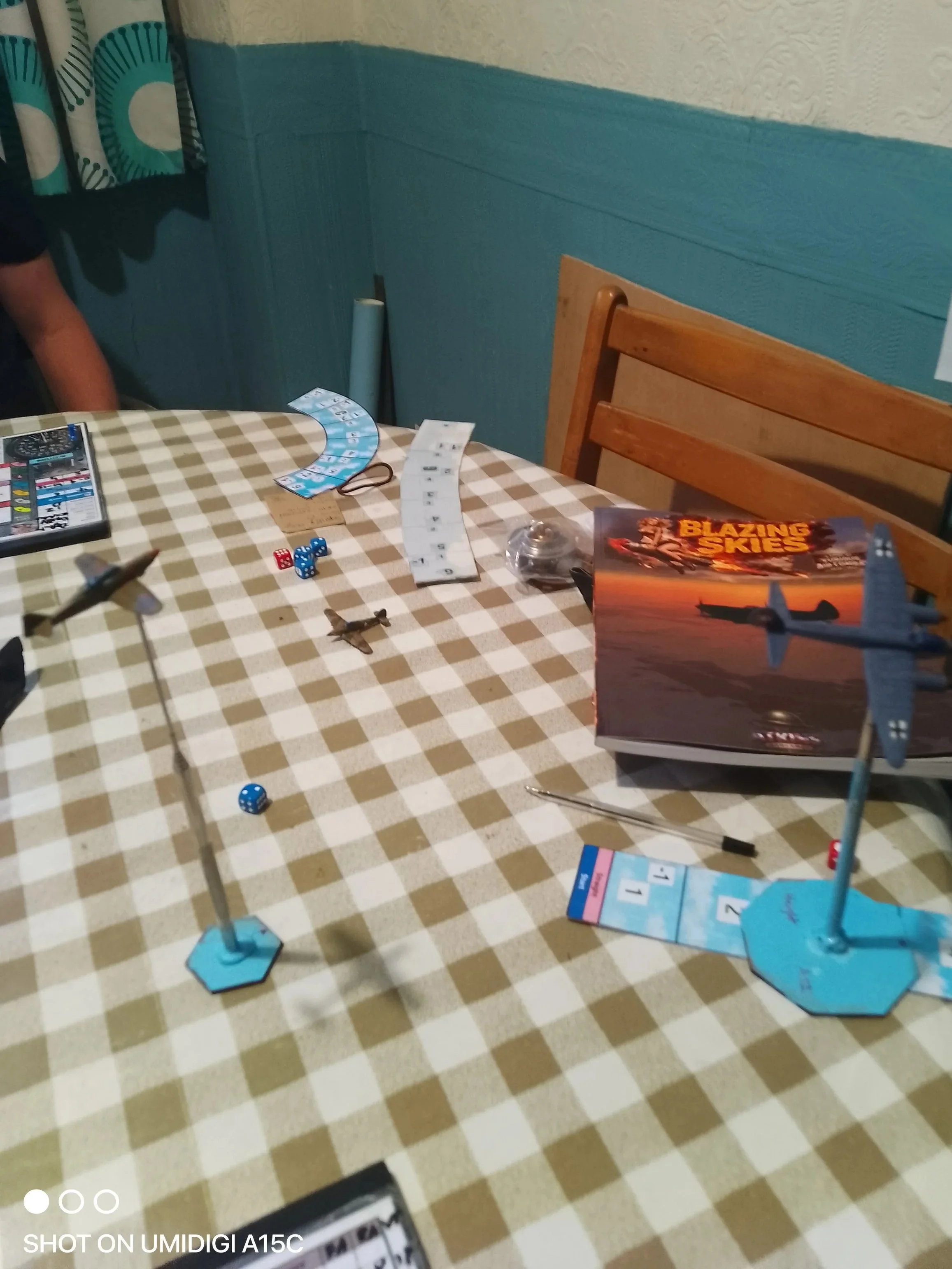
Squiffy dropped the Defiant into a dive to pick up speed and planned on coming along the Boches broadside. Dusty managed another burst which riddled the “Flying Pencil” and killed the rear gunner.
“NEIN!” cried Shtiffler and pushing the bomber into a dive attempted to gain enough speed to outrun the Briton.
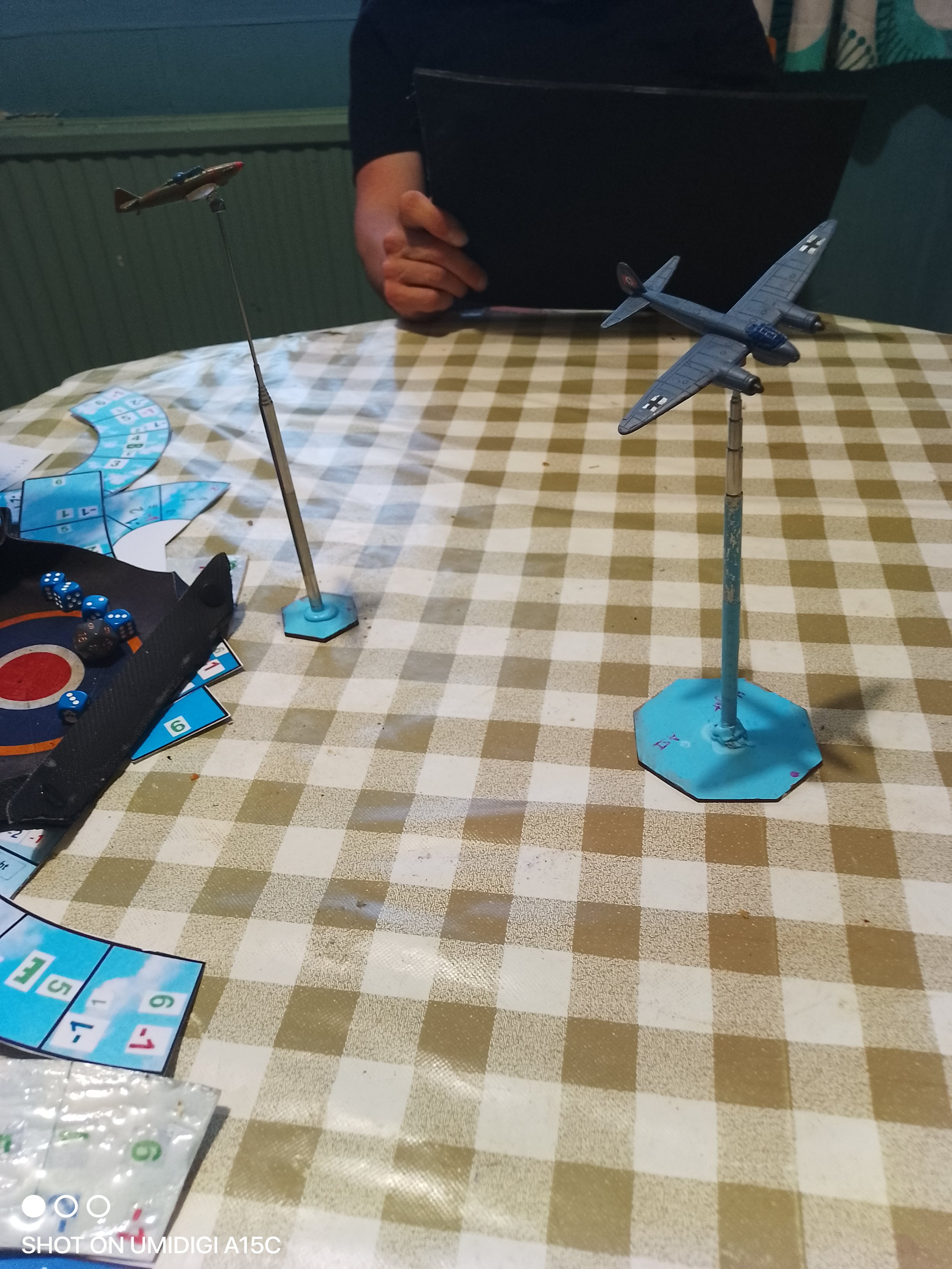
With both aircraft gaining speed by diving (after being shifted back on the table) Squiffy swung round Shtifflers tail.
We discussed if we should allow the bomb aimer to man the rear guns and decided that would be a very cramped and difficult thing to do mid battle.
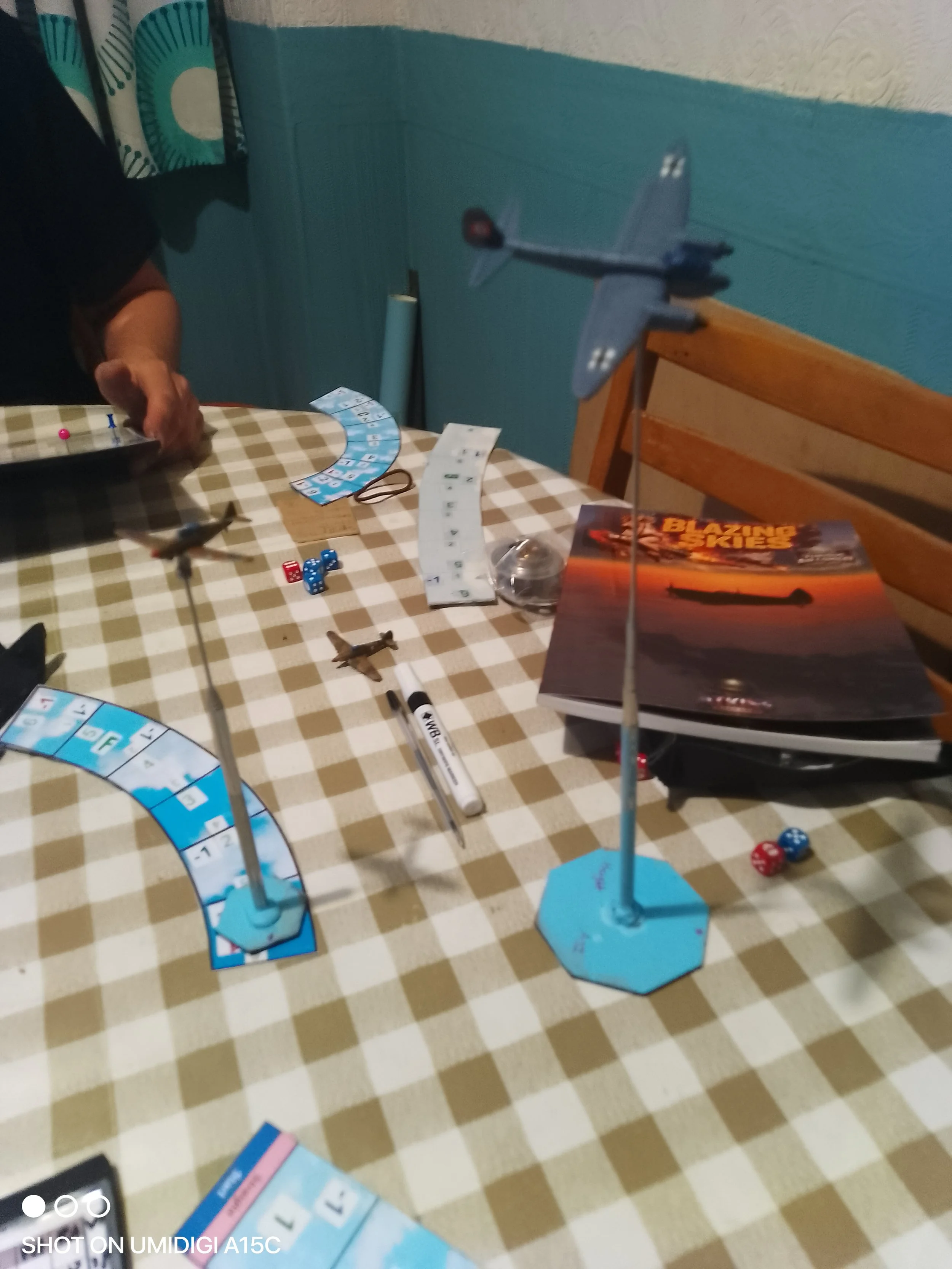
Dusty sprayed his 4 brownings bringing the Dornier down to 3 structure. But his belt was running low on ammo. Just two good bursts left!
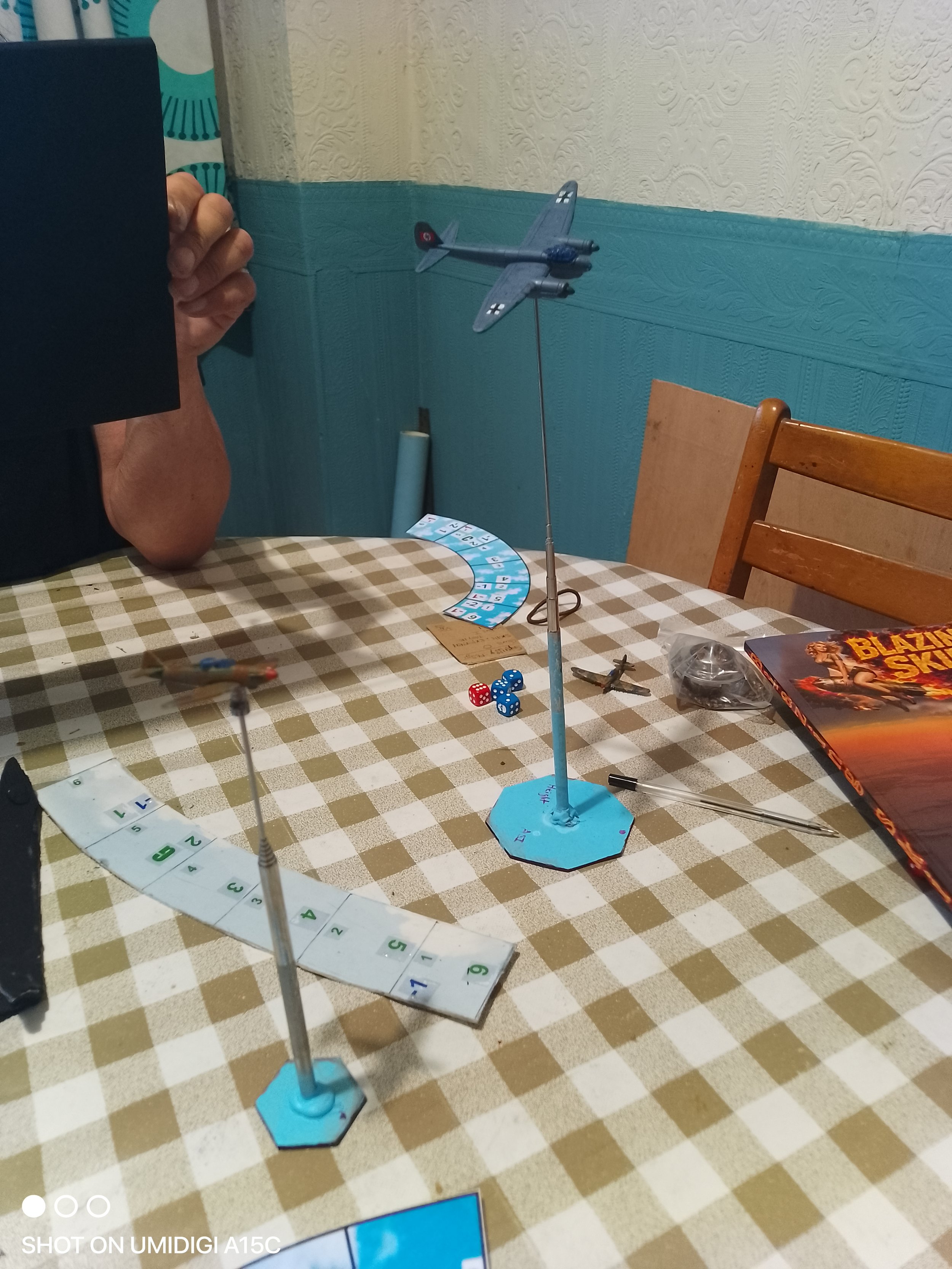
Broadside on, Squiffy matched Shtifflers speed. Dusty thumbed the trigger and two more hits left the Do on 1 structure! But that last burst shattered the main spar of the German plane and Shtifflers Port wing sheared off!
Shtiffler and the Bomb aimer made it out on their chutes. Squiffy roared past them and saluted.
“Right Ho, Dusty old chap! Its back for Tea and Medals!” cried Squiffy and turned the Defiant in to land.
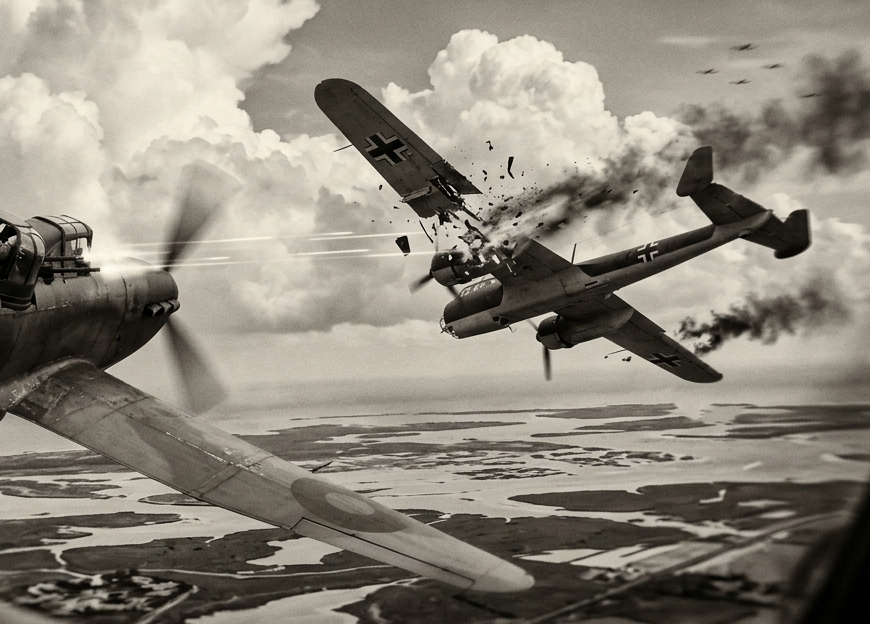
Squiffy and the Condor
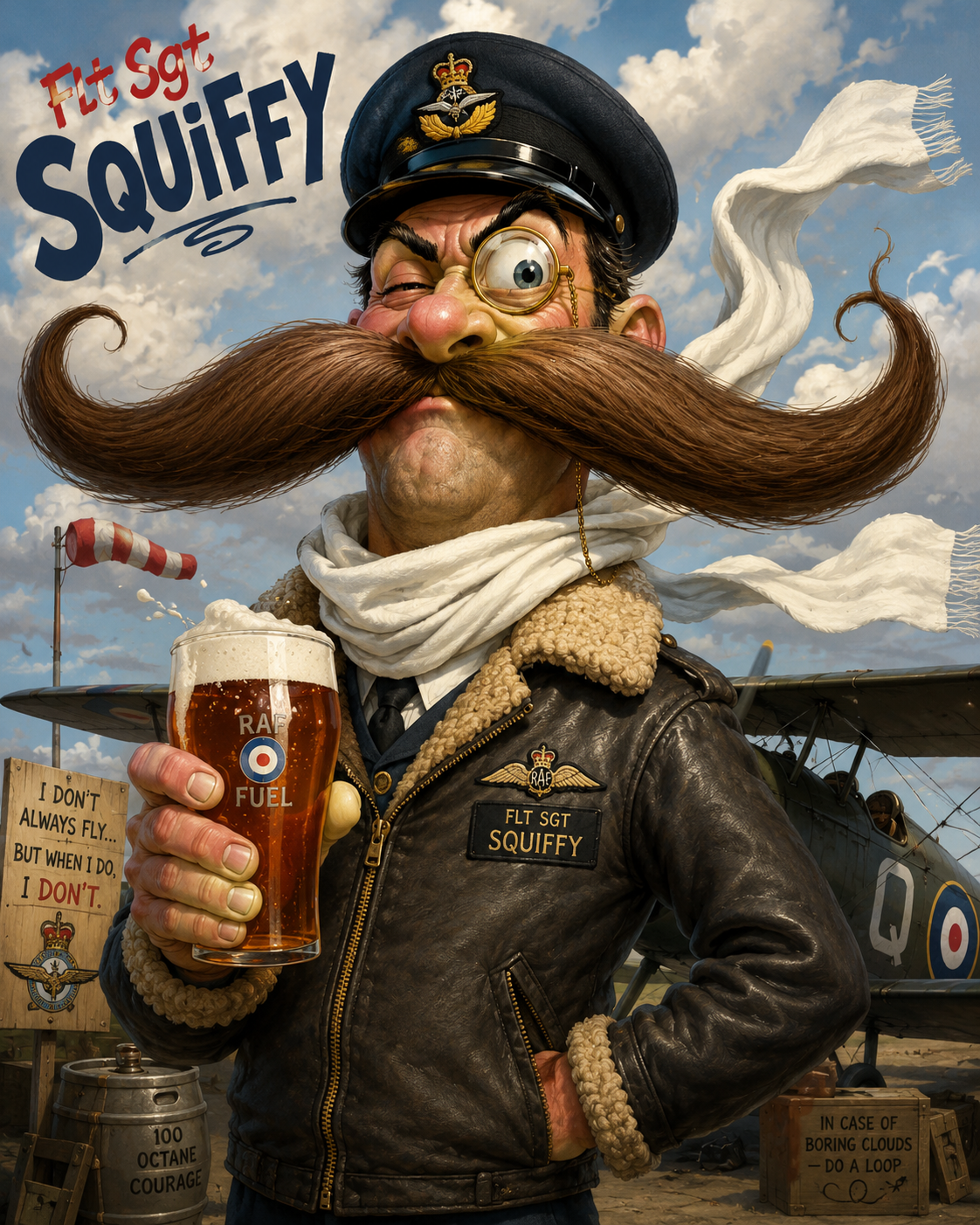
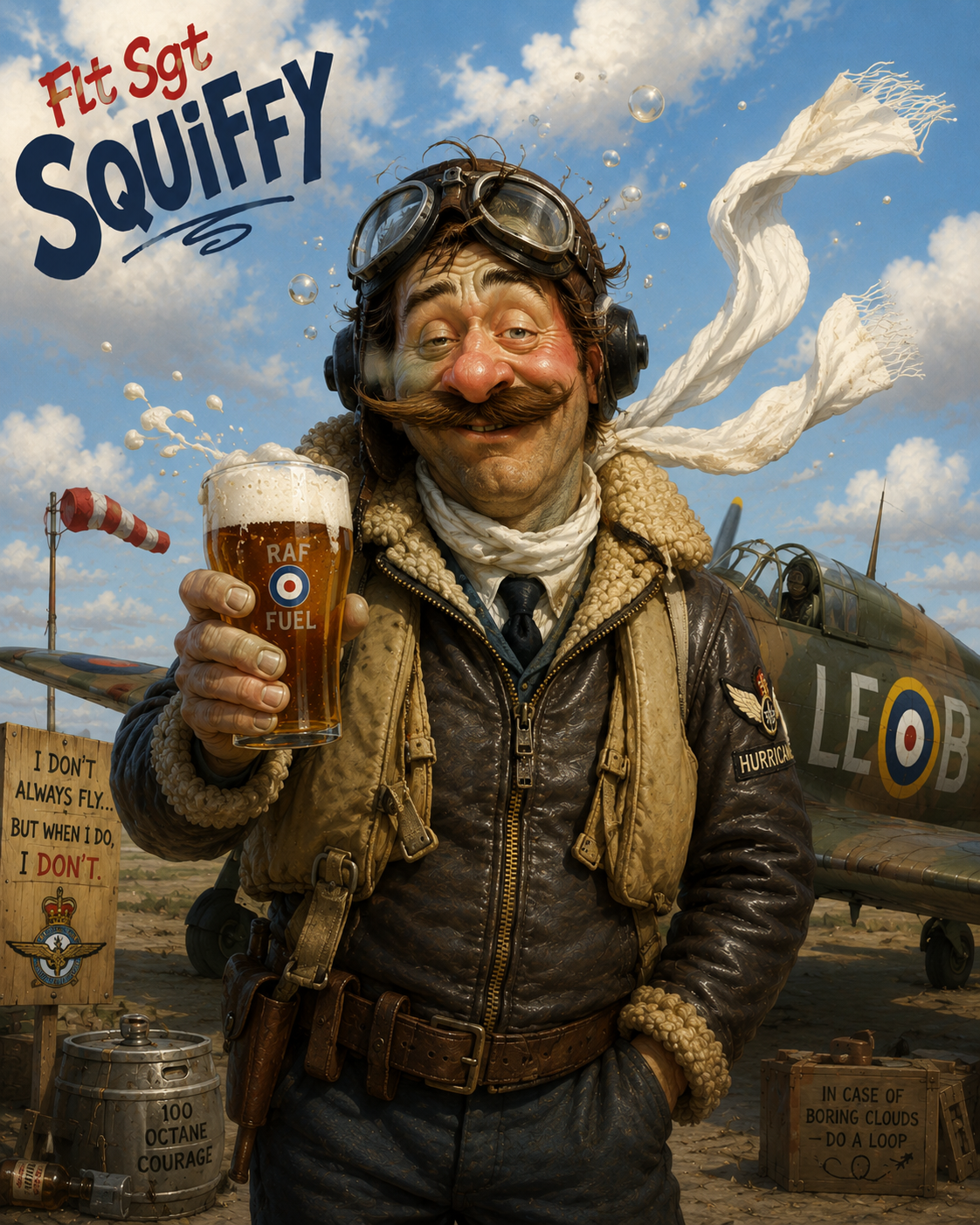
Flt Sgt Squiffy
After what seemed an age, I took a trip to Gods Own Country and met up with Squiffy for a few games of Blazing Skies. We decided to do a “sort of Semi-campaign” where instead of a Squadron, we just followed one complete tool of a Pilot and his one man war on the “Bally Hun”.
First steps were to give him stats. We were going to ingnore G force Optional rules and so just focused on Gunnery and Pilot Skills. Squiffy started with +0 guns and the Skill “Experten”, which allowed him to always see the Hun as “Streaming Smoke”. A very powerful skill!
Next we decided Squiffy would jump around in theatre of war in a manner similar to Johnny Red Redburn of “Battle” comic in the 1980s. One day he might fly a Tomahawk, the next he might fly a Dewontine. He is after all a jolly fine chap, and happy to fight wherever posted.
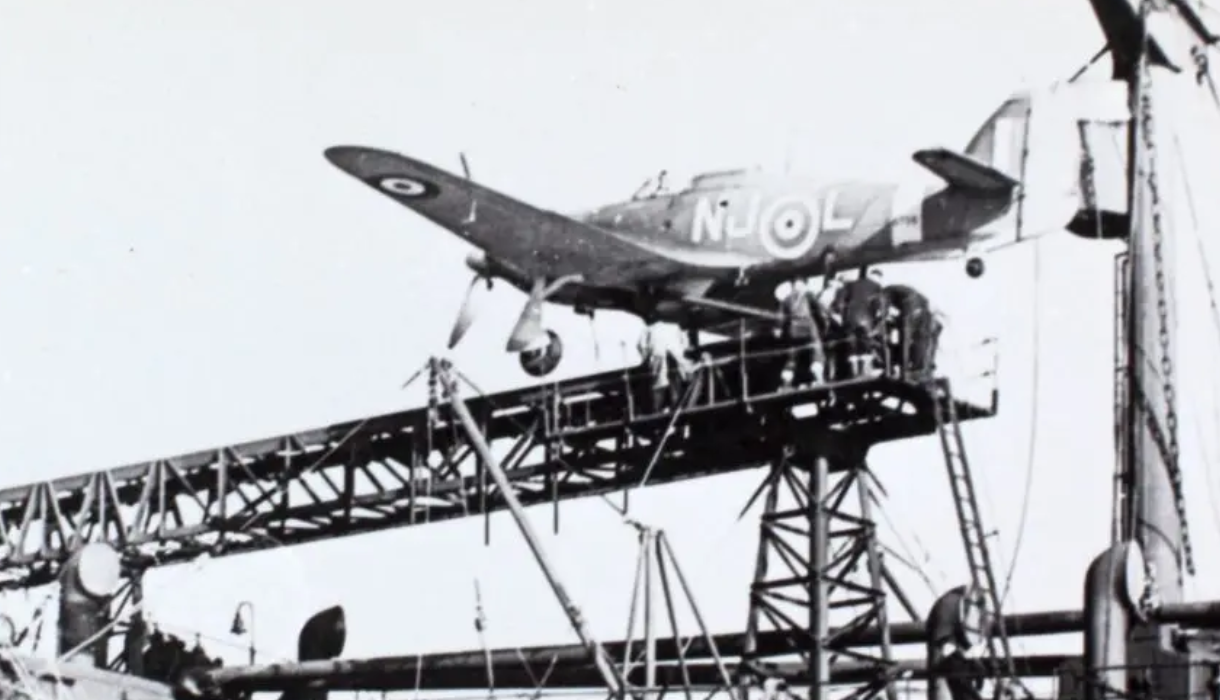
As in the Character “Johnny Red”We decided to start on a “Hurricat” a Catapult Armed Merchantman. These Hurricanes were launched with rocket assistance from a catapult on several Armed Merchants in order to defend convoys from the prwling , circling Fw200 Condor Maritime Bombers of the Luftflotten.
I’ll be honest. I had no idea what version of the Hurricane became Hurricats, and we were very keen to get into a proper fight, so I agreed Squiffy could have the Twelve Gun Hawker Hurricane Mk2 B. The most guns on a single engine fighter in the war! However with only 250 rounds per gun, Squiffy would need to conserve ammo.
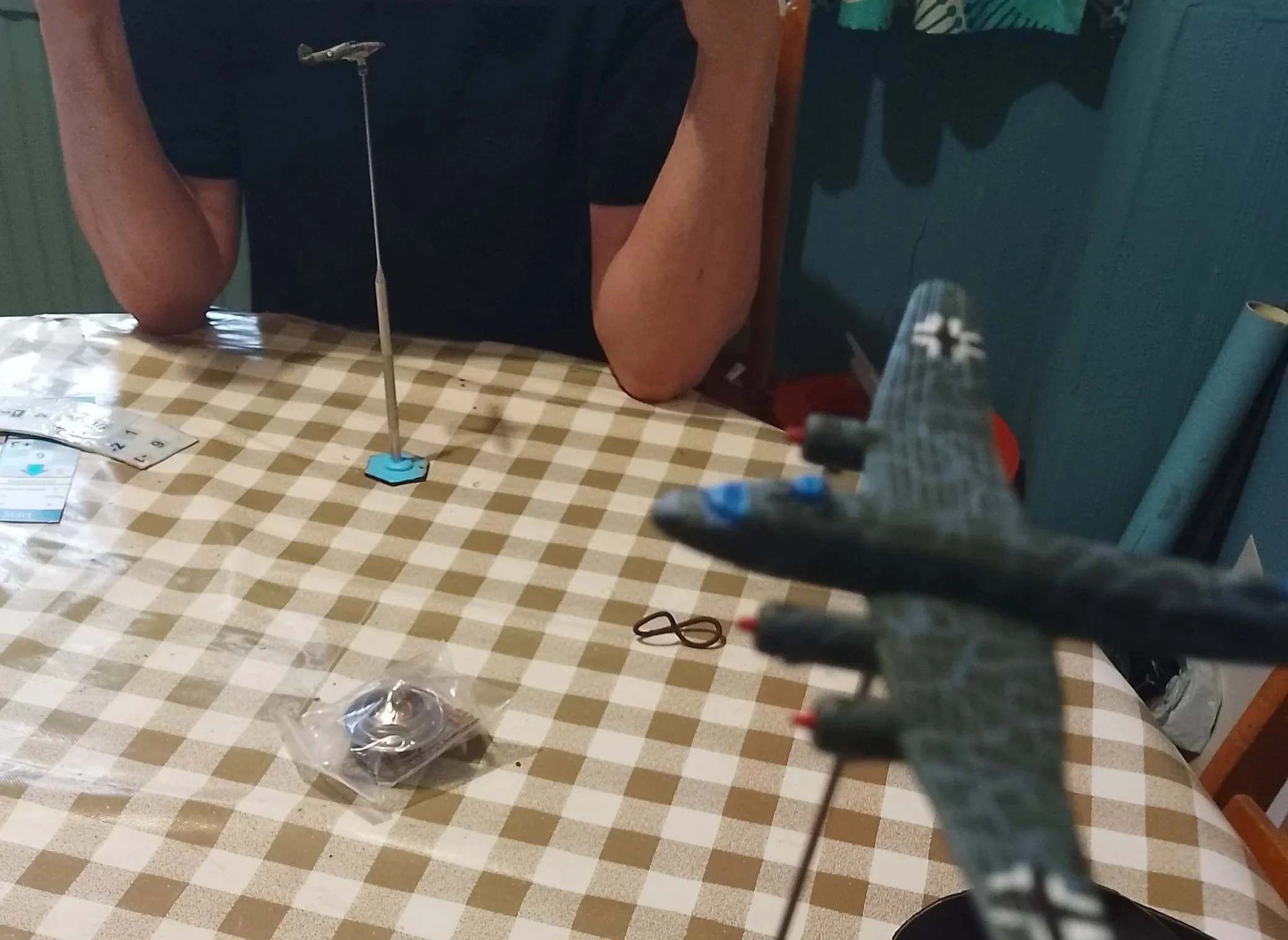
As we were not in the Atkins Gamesroom, but set up on Squiffys dining room table, this game I hope, respected viewers, demonstrates how you really dont need much space to have a really great game! The Plastic bag in the centre is notable.
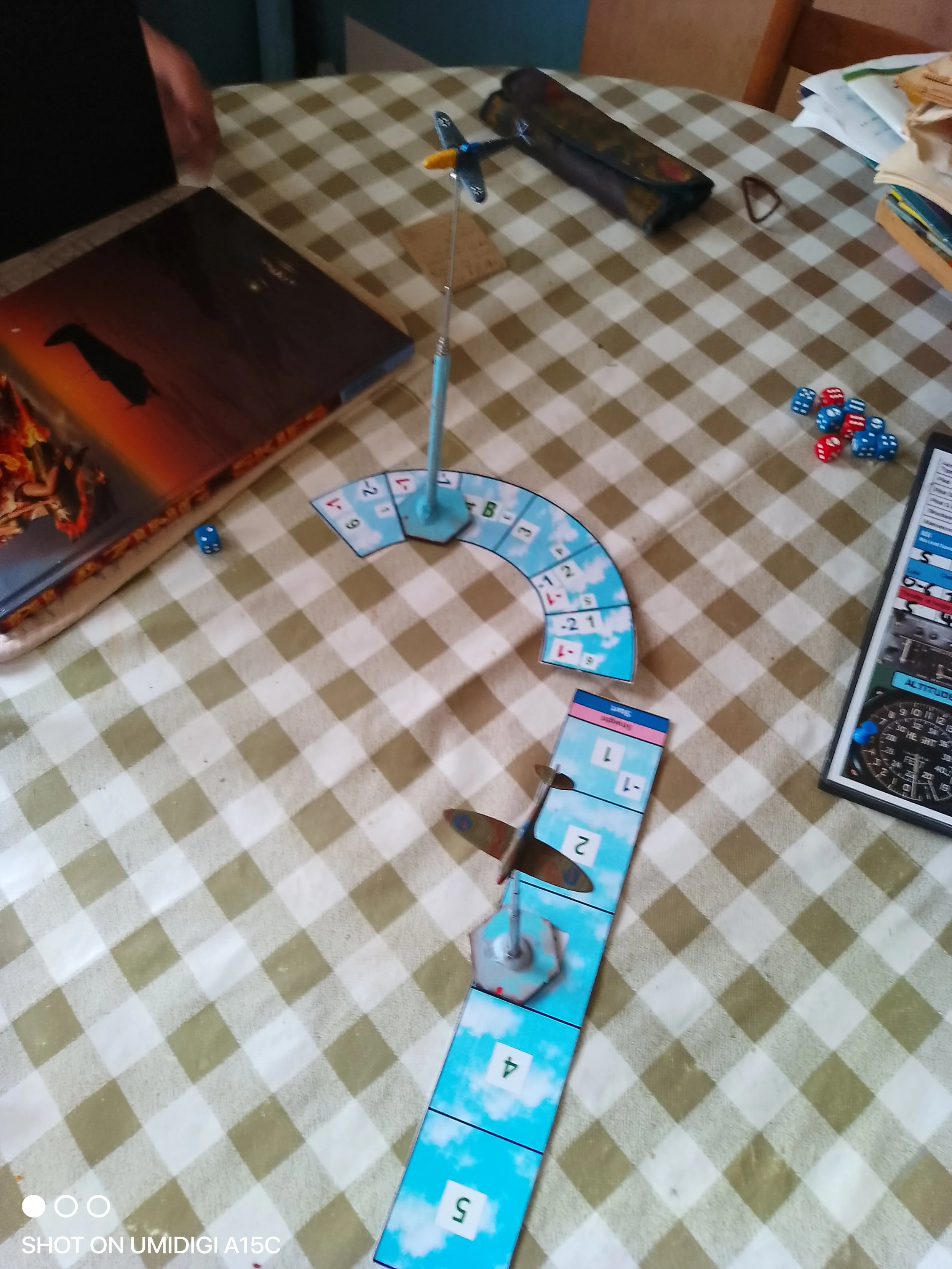
Behold in the foreground the Fw200 Kondor. Kondors were huge, 4 engine, long range, inflammable, weakly constructed, heavily armed patrol bombers. I’ll be honest here. They are nothing against Squiffys Hurricat, but because of their size, carrying a cannon, and their work in tracking convoys, they are seen ( like many German aircraft) as something special.
In the Background and above the Kondor is Squiffy in a Hurricane. If you dont know what this is, I think you came here by accident. You know what it is, what it does……
THE MISSION.
Its a Photo Recon and wireless home. The Kondor must locate the convoy represented by a plastic bag. Standard PR rules applied. Squiffs has had notice of the Kondors approach and we skipped navigation for him. The Kondor had to roll navigation to get to the battle and succeded easily. They spotted ships, and only needed a photograph to confirm!
Squiffs had climbed to Angels 12 and the Kondor was at Angels 9. His mission is to give the Jerry a dam’n good thrashing….
I was rather surprised at the low ceiling of the Fw200. 20000 ft …easily in range of heavy AA fire and not an issue for even a Firefly to intercept.
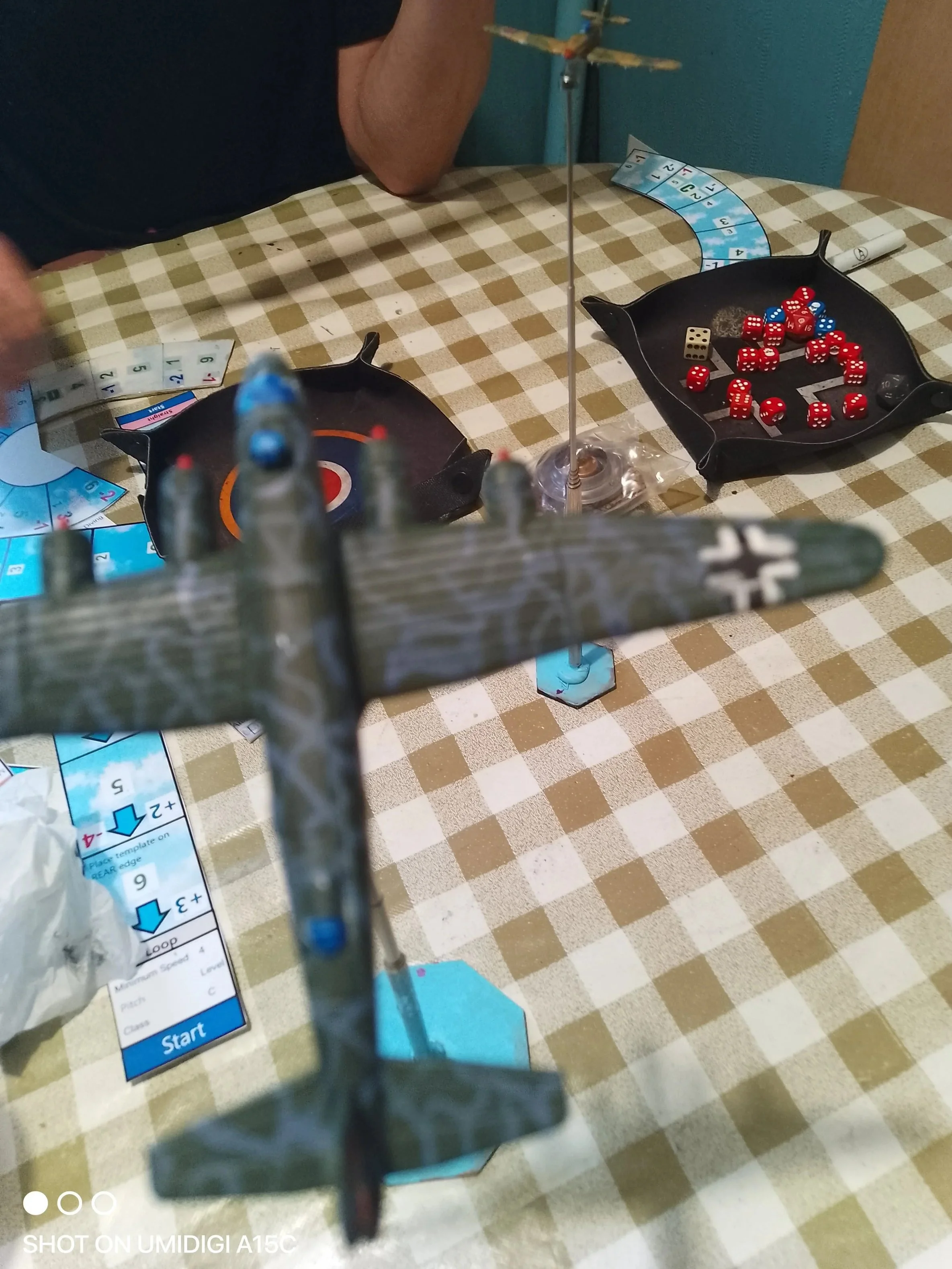
Squiffs approached in a lazy turn .The Kondor was having real issues getting lined up for its Photo-Shoot of the latest fashions of 1941 Liberty Ships.
Squiffs also dipped into a dive and gained a great deal of speed. However, when faced with the Kondors nose on angle, he held back from firing. He had exactly four bursts to finish the Tuton! Meanwhile the 20mm cannon in the Kondors Dorsal Turret, under the thumb of Hauptmann Friedensliebhaber hammered at the plucky Briton and a cannon round exploded on the plexiglass, wounding Squiffy in the face..
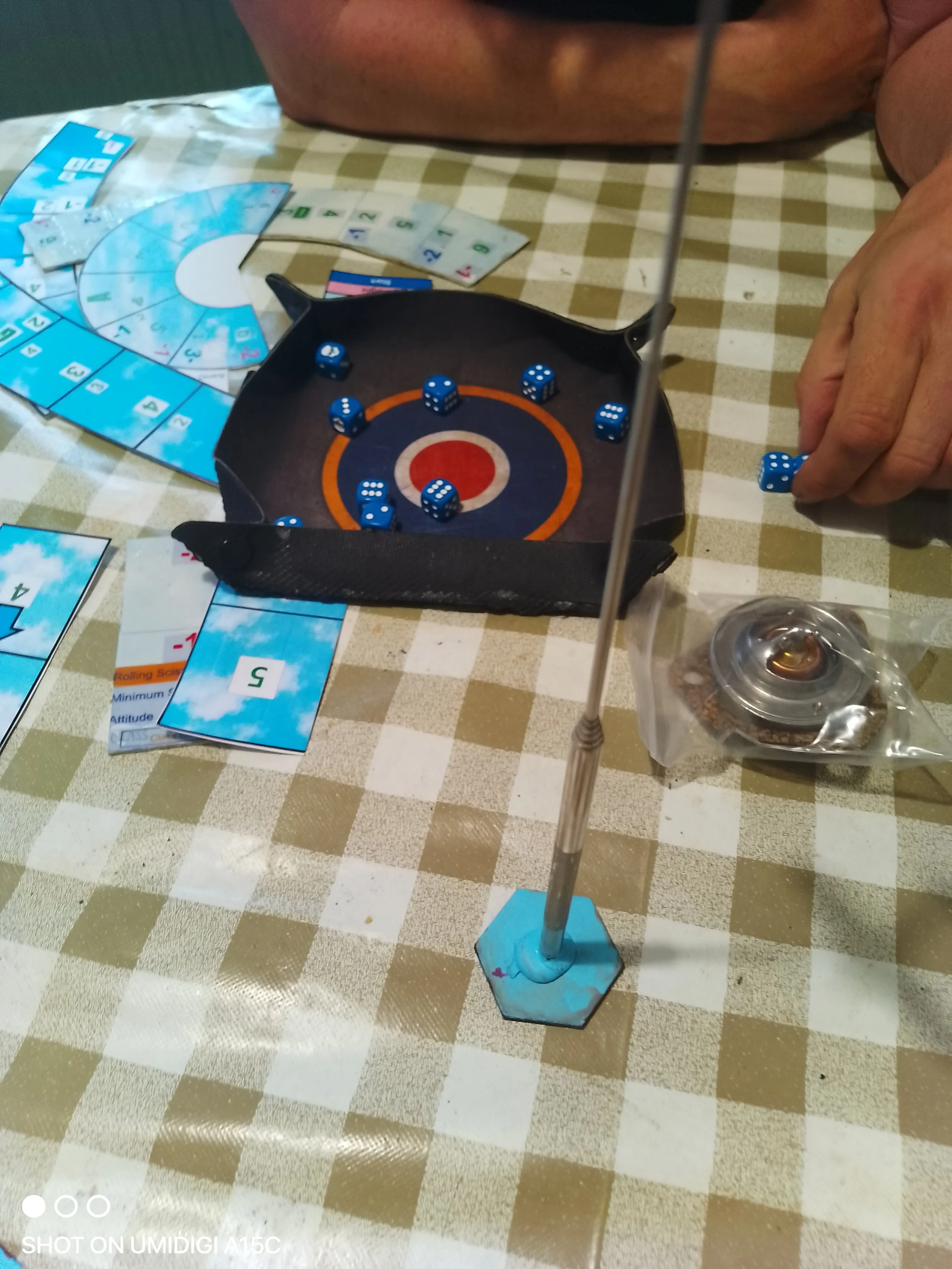
The “Large” trait in a closing snapshot meant Squiffy still riddled the Kondor.. 11 dice scoring two critical hits and 7 structure damage from 22 total , but these were to the Kondors Spars. The return fire was ineffective. Gunners hit on a 6.
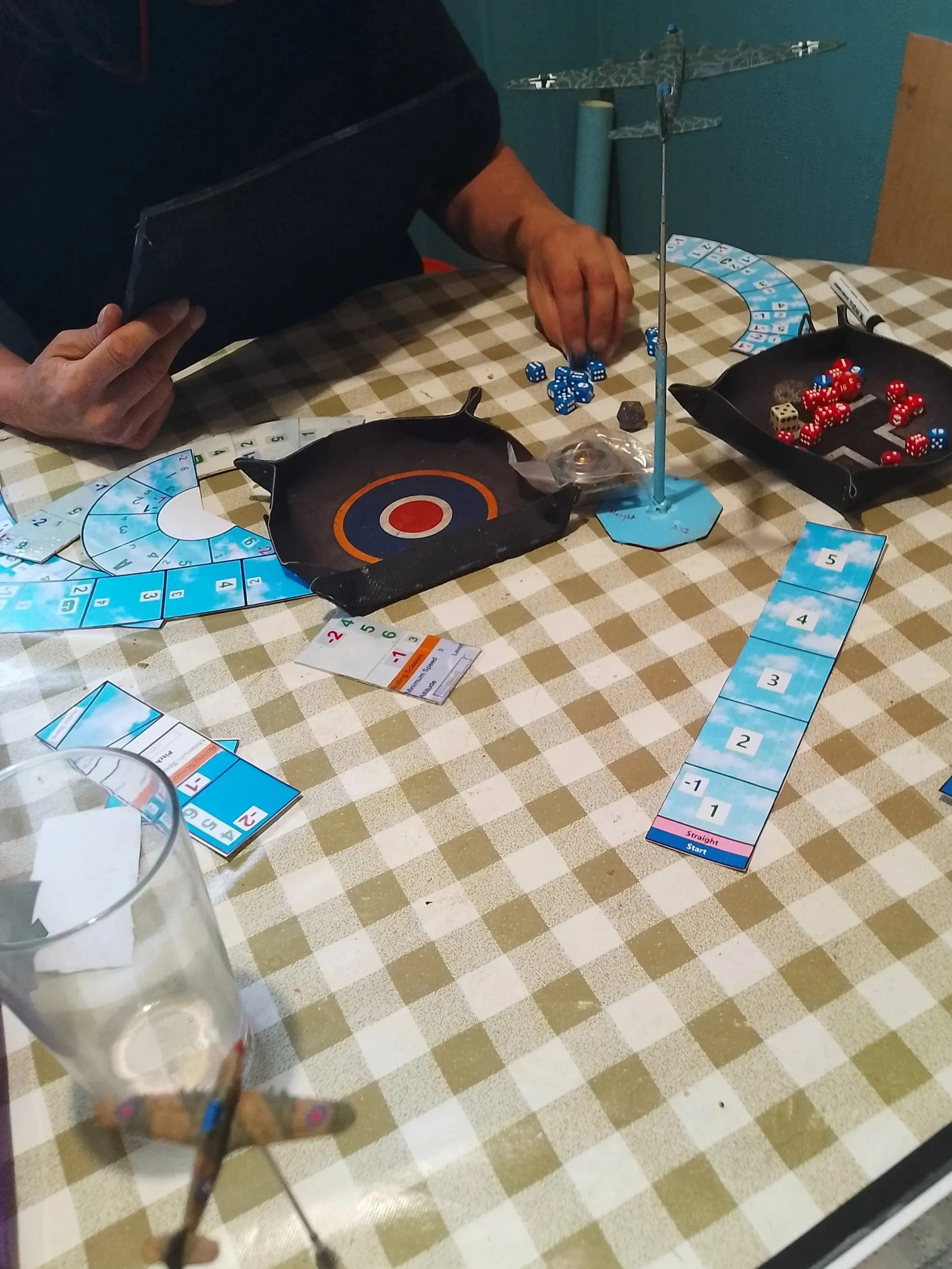
The Hurricane diving below took a strafing from the Ventral gunner. One point of damage as holes appeared in the Hurricat. The Hurricat Half Looped and bled off speed. Now firmly on the Kondors “Six” the 11 dice scored another 7 hits and shredded the Kondors wings and ailerons. The Kondor was down to 8 structure and its undercarridge was shot out. It passed over the convoy and a D6 of 6 took a beautiful picture which would be approbated at High Command!
Squiffy triggered the Radio Transmitter and spoke clearly “ Ok Old Bean. Thats quite enough. bail out and I’ll let you live!
The Jerry however noted the hurricats lack of speed after his half loop. He placed the Kondor into a Dive. If he got down to the deck, then he could extend the range and get out of the Hurricats .303s. The Kondor dived and the edge of table (Thick clouds) were a turn away, but the altitude was down to angels 3.
Squiffy had one last burst before the Kondor escaped.
The Kondor dived down. The Dorsal Gunner , kept on firing his 20mm cannon and Squiffs took a hit to the Aileron.
His return burst fired into the disintergrating Kondor. The Kondor pilot in a desperate need for speed, had dove beyond the never exceed speed of the Fw200 and the wings , weakened by Squiffy, ripped off at the roots.
The Dorsal gunner, ventral gunner and co pilot went down to the sea. The Pilot and Forward dorsal , navigator and R/O escaped.
Squiffy managed to roll well for his navigation home and despite the bleak seas and the damaged Aileron, Squiffy landed in Iceland. For Tea and the award of an Infamous Flying Cross.
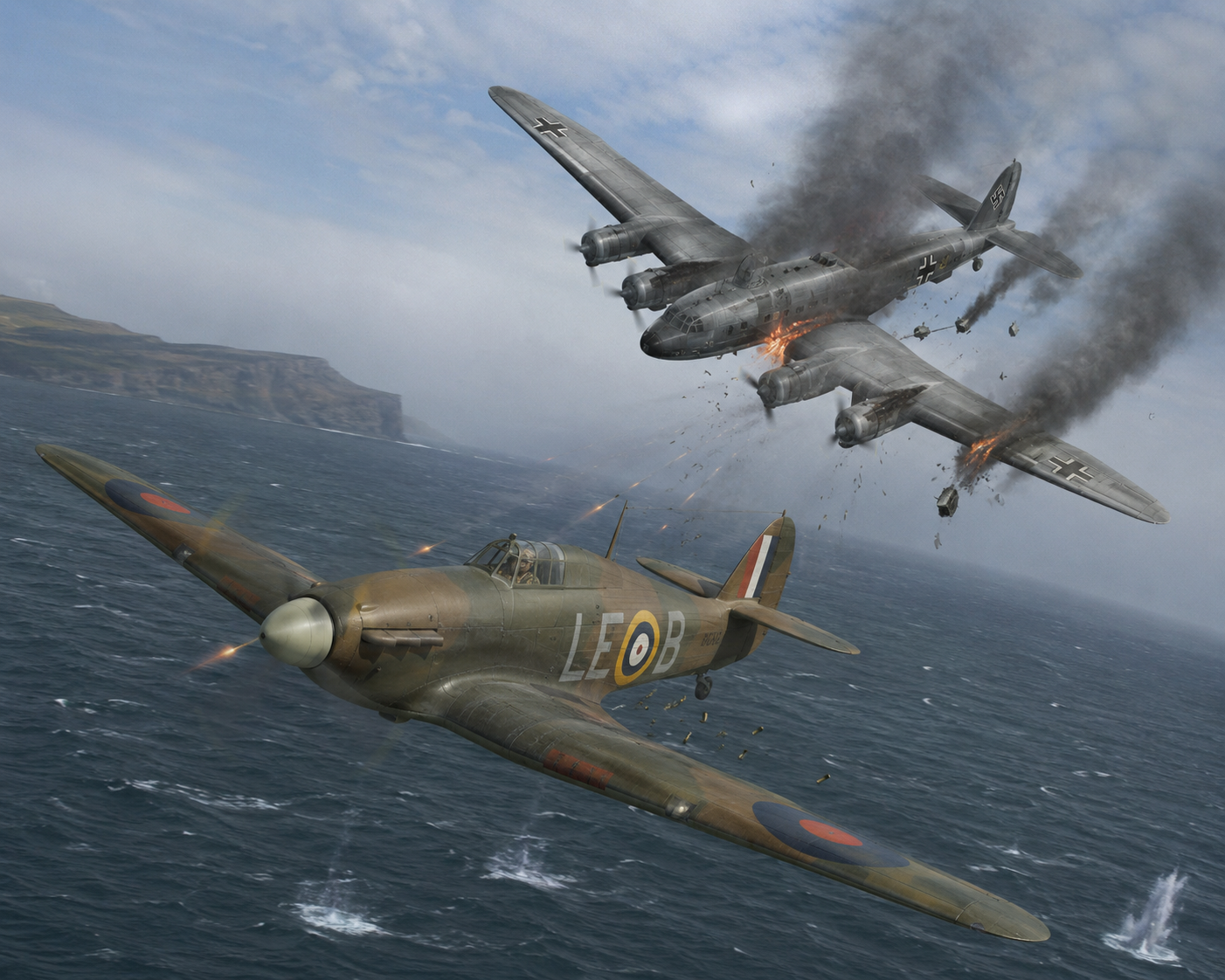
Squiffs Heads to Iceland and manages to land successfully!”
Buffalo over Java
Time for a Battle report!
In 1942 Dutch East Indies, the Dutch B339 Buffalos fought desperatly yet in vain against the Imperial Japanese army. Often their Brewster Buffalos would misidentify aircraft as “Navy Zeros” when they were actually encountering Oscar Ki43 Army machines.
This scenario pits a Netherlands B339E in a chance encounter with a lone Achi Val dive bomber over the Javan coast.
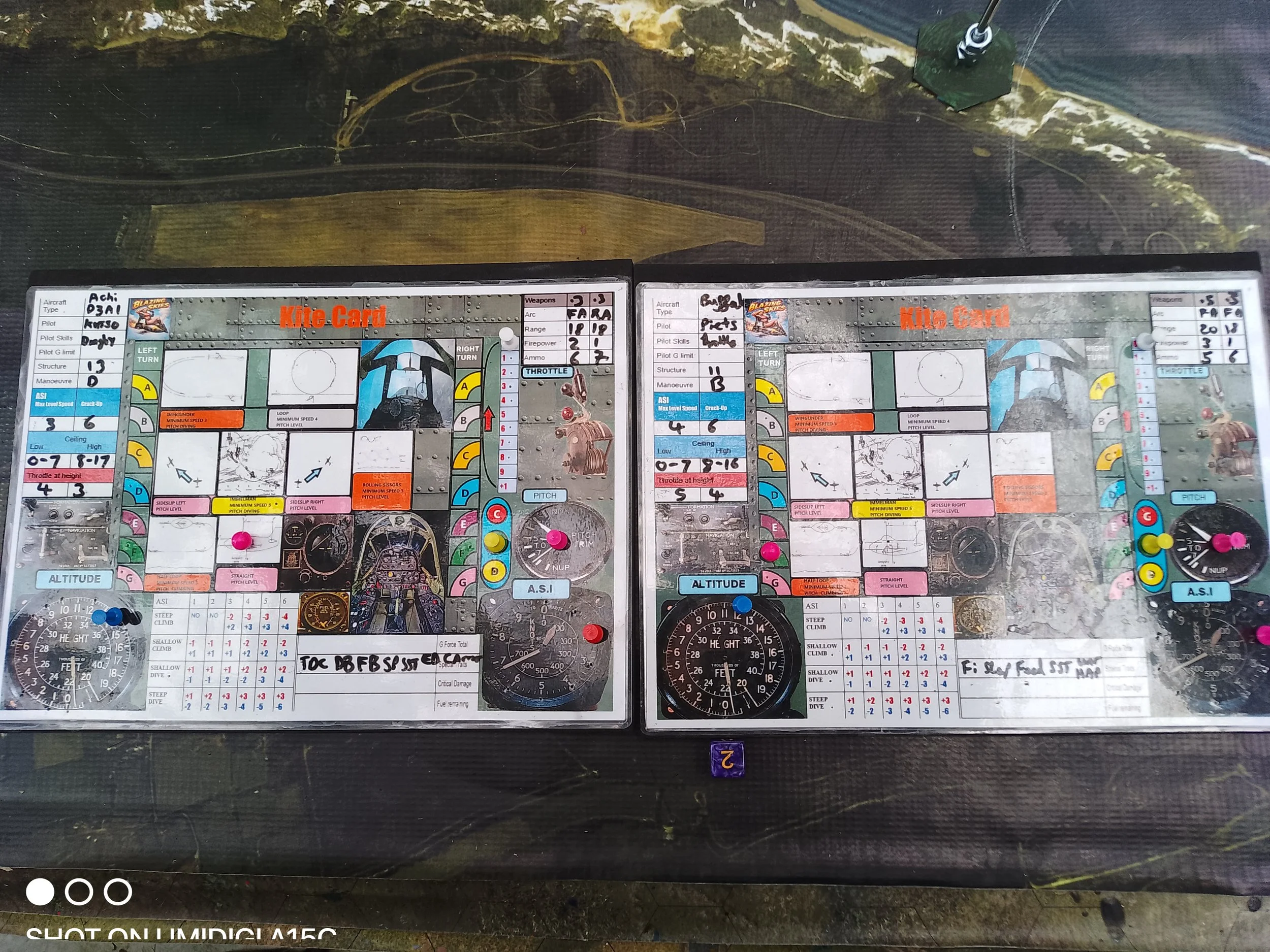
The old Mk4 Kite Cards in use here before Defensive Spiral was added.
The Machines!
The Brewster Buffalo is well enough known to our players and so I will be fairly terse here. Excellent against the Soviets, the British Commonwealth and Dutch machines had extra equipment and poorly set up engines. They were described by pilots as “wallowing” and thus have SLOP trait. They lacked firepower even when , as sometimes happened, received four .303’s. These guns also had vibration and feed issues and so have FEED trait. The lack of self sealing tanks gives them SST and also fire vulnerability. The engines lacked spares and were prone to oil leaks, poor oil pressure, incredibly loud and vibratory. They are classed as UNRELIABLE. The general toughness and the addition of armour however means I decided, quite on my own devices, to acknowlage them as HAP Heavy Armour Plate.
A Buffalo has very poor power to weight, but on choosing a random skill, the pilot here, Kaptain Piet, has THROTTLE JOCKEY and manages through careful engine management, as well as his beloved ground crew, to squeeze an extra point of THROTTLE from his Buffalo. Its known as the fastest in the squadron!
The Achi D3A1 “Val” is no slouch for a dive bomber. Armed with FORWARD ARC machineguns, FIGHTER BOMBER manouverable at CLASS D it also has a sting in the tail as well with a .3mg firing to the REAR ARC. Senior Leuitenant Kutso is no sprog. He has been shot down before and now his comrades call him “Dinghy” granting him better chances on bailing out.
As a dive bomber the Val can manage its dives with precision having “EXCELLENT DIVE, DIVE BRAKES and a NEVER EXCEED speed of 6. Its TOUGH UNDERCARRIGE helps it land on a dime with its CARRIER arrrestor gear. Unfortunatly, its also known for bursting into flame having no SELF SEALING TANKS
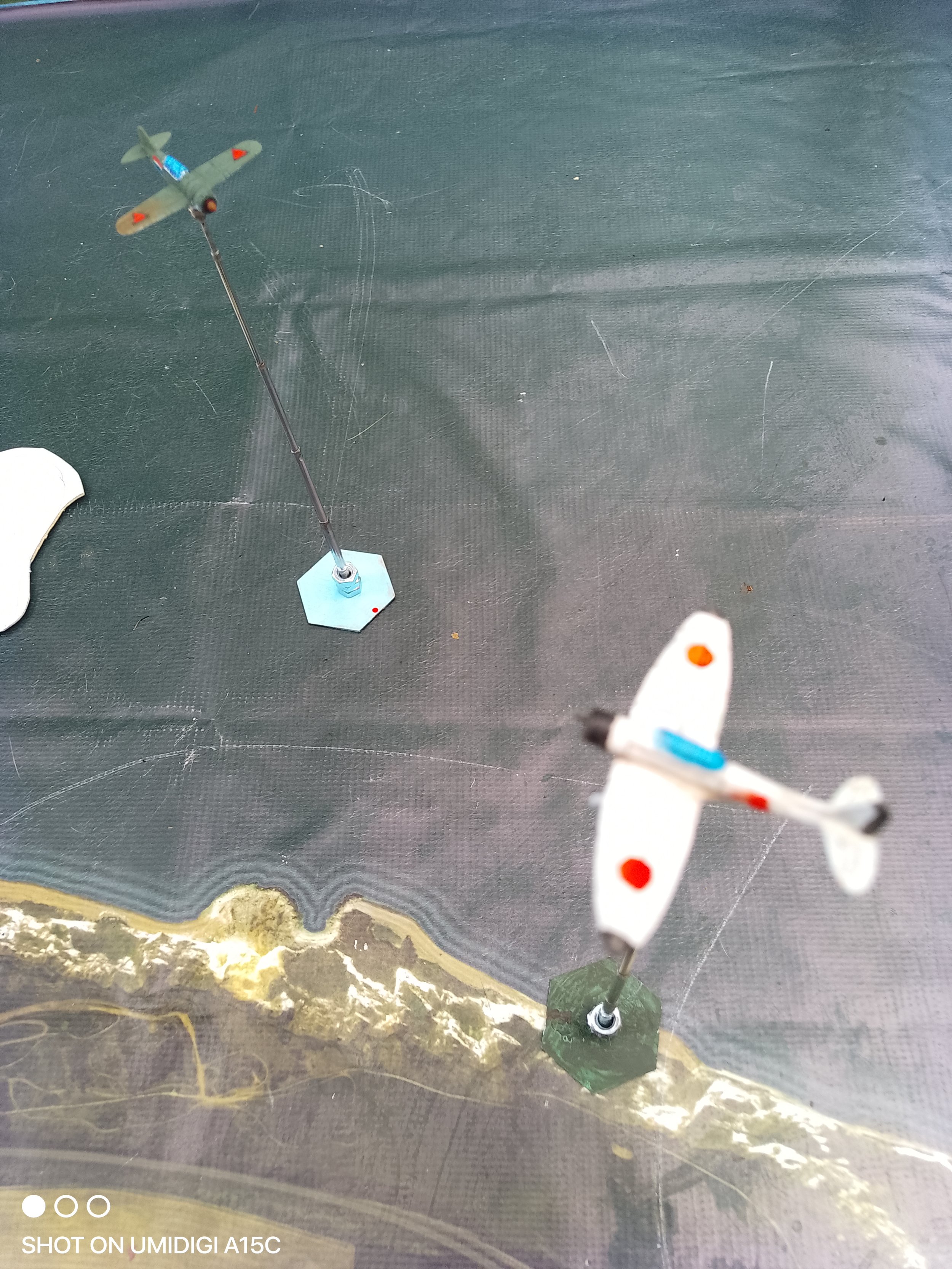
Approaching from below and front starboard angle, Piet spots Kutso
The Mission!
Piet is flying at 24000 feet and his Buffalo is not happy. He is nursing the engine and wondering why he’s been sent up alone to patrol the coast. He dreams of being back in Friesland, with its beautiful canals and the clean streets of Sneek. But a glint above him brings him back to reality. At 28000 ft, a lone and lost IJN Val dive bomber tries to get its bearings so it might head back to the HIRIU
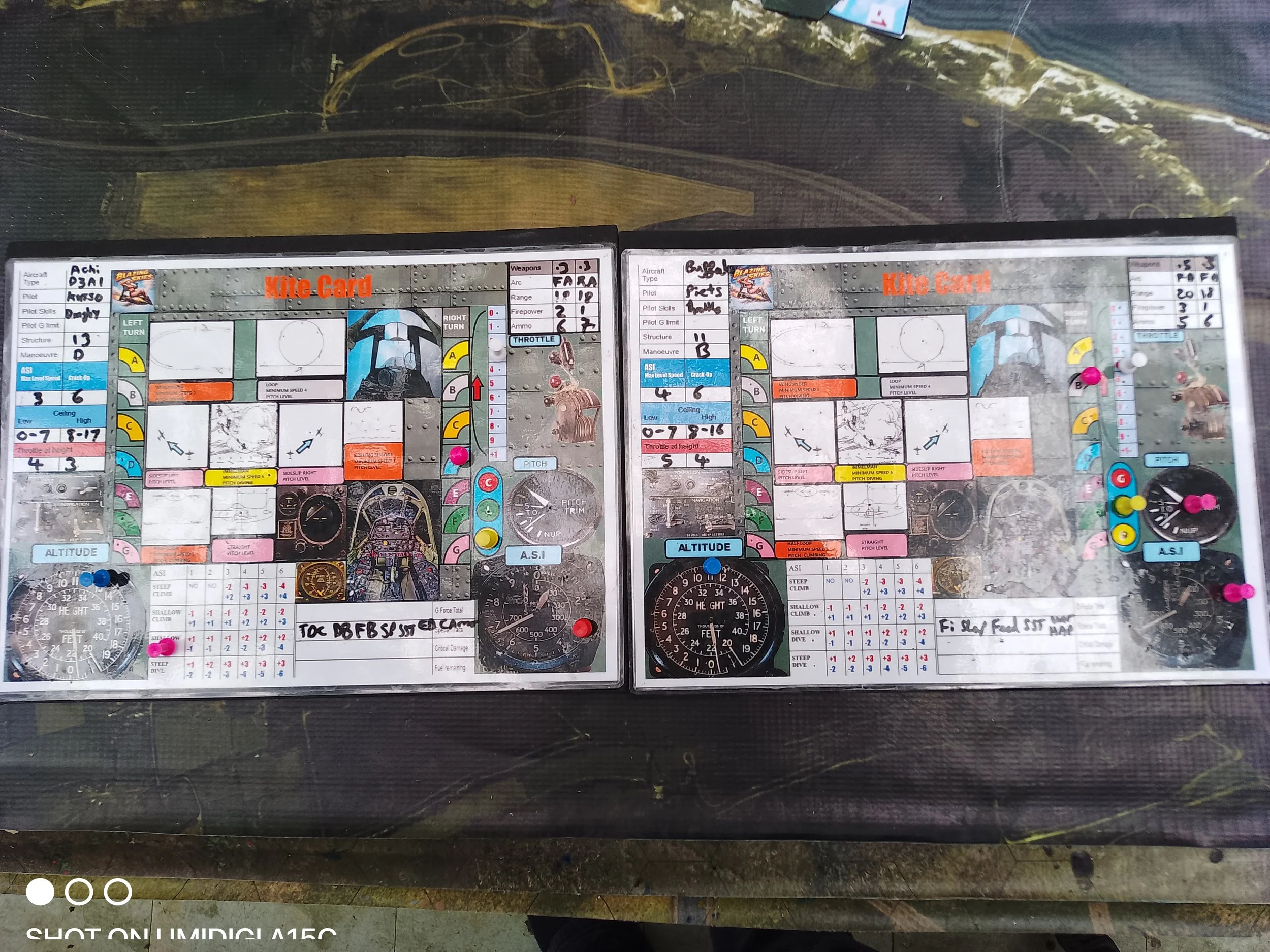
Kutso pitches over into a dive and peels RIGHT D CLASS SHALLOW DIVE with throttle wide open and dive brakes retracted. Piets pulls hard on his controls and turns B RIGHT LEVEL not trusting he has the speed to start a climb right at this moment.
Kutso noting the Buffalo at his 2 o’clock low decided to press his height advantage. Dumping his bombs the Achi sprang to life. “ BANDIT! 2 oclock! TORA TORA TORA”! He slammed the throttle to 3 and pitched over and down into a stomach churning wheeling dive.
Piets saw the Achi Pitching, but at 200 mph, he knew that climbing into the Japanese’s path would rid him of even more speed and his rebuilt Wright G-105 engine was not going to manage that at this height, even with his legendary engine management skills. At full throttle he added 4 to THROTTLE, rolled for UNRELIABLE and the engine did not overheat. He pulled the Buffalo into a turn.
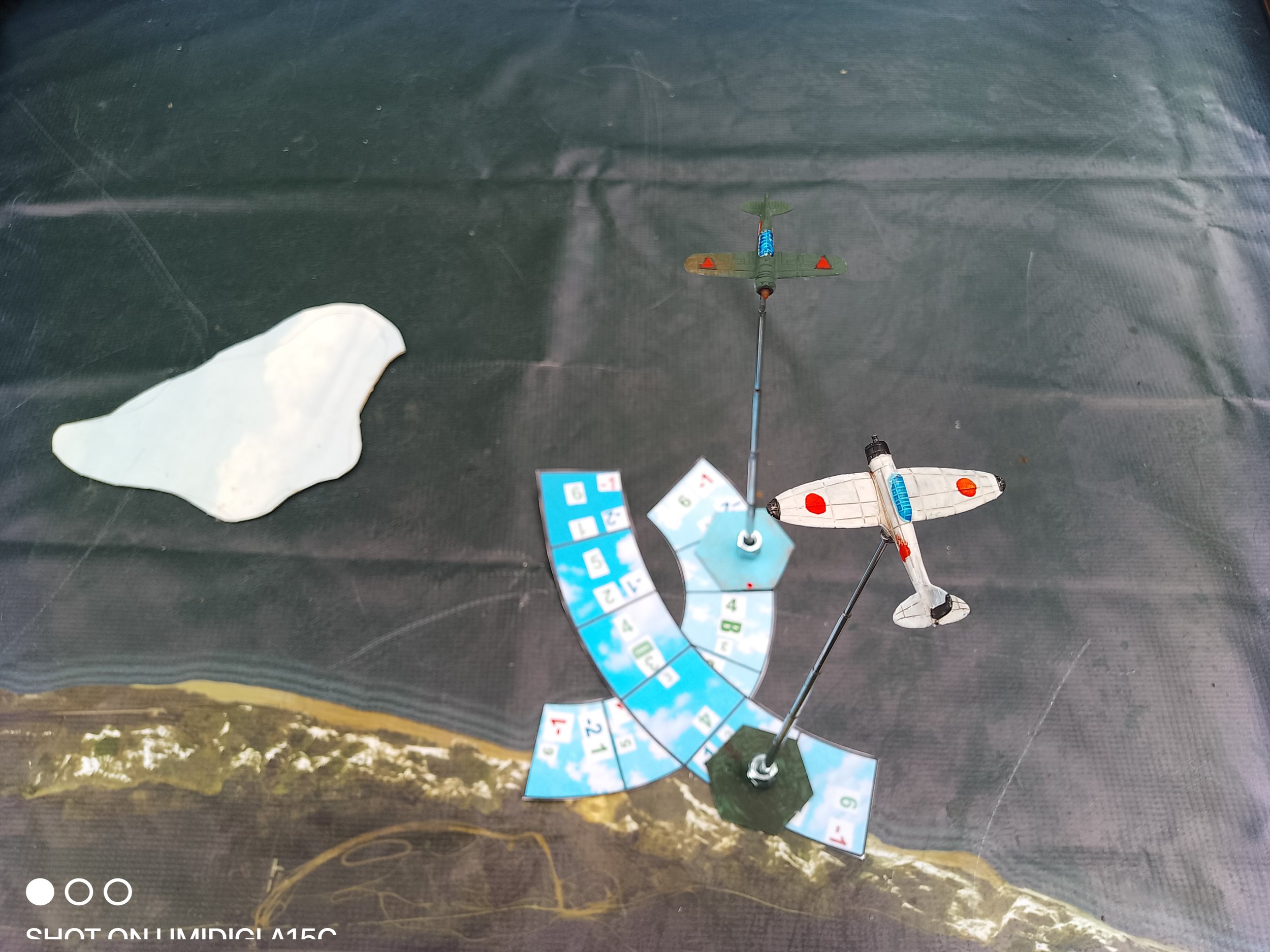
Kutso is above and diving at Piets level and below.
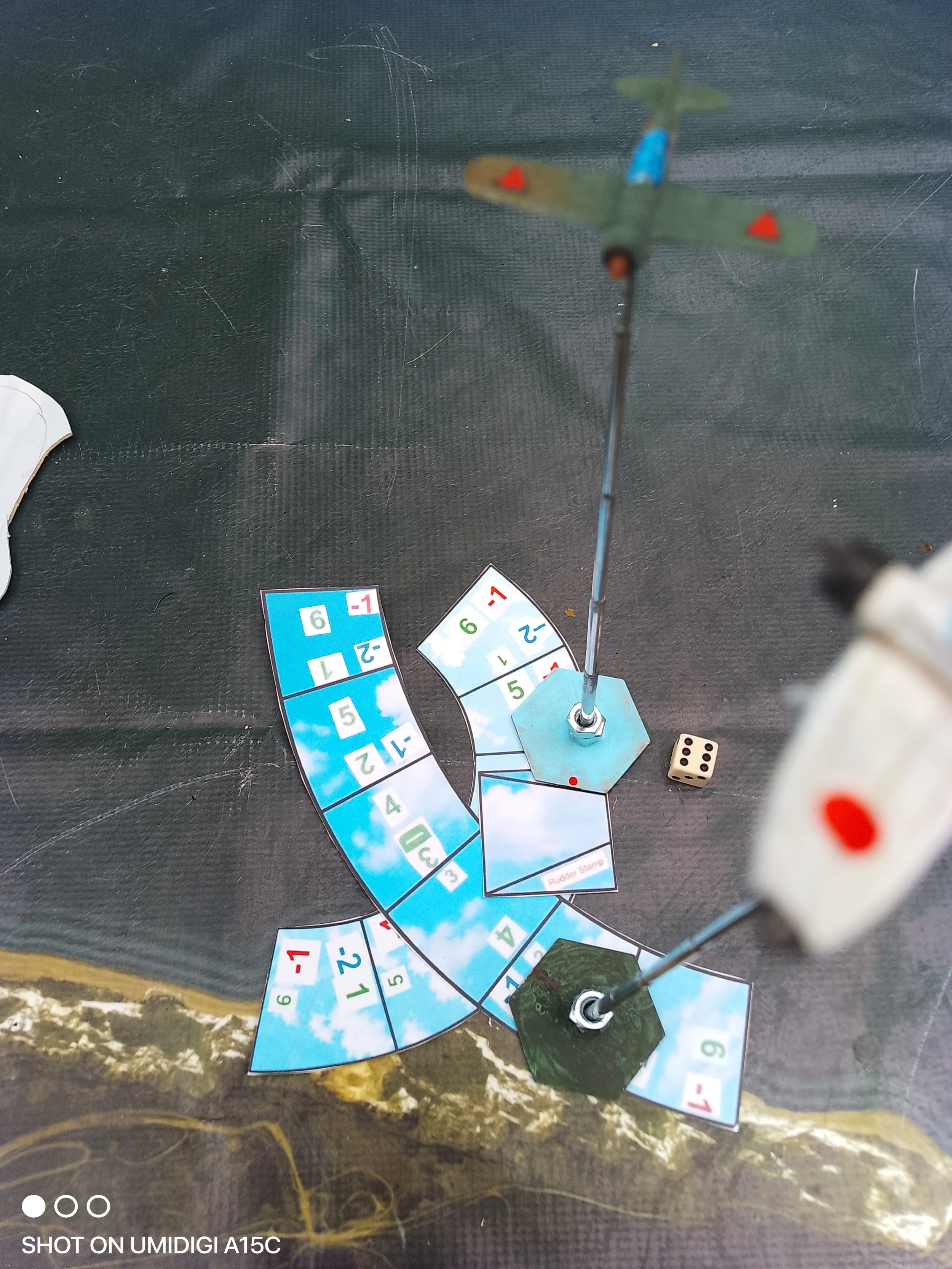
The SLOP trait rolling a 6, forces Piets to momentarily lose control and his Buffalo RUDDER TAPS right. Fortunatly that still has him on a LEADING shot at the Kutso.
Peits wrestled with the Buffalo as it slipped to the right despite his efforts. The VAL however was above him and in his forward arc of fire. Stubbing his thumb on the trigger, his Buffalo was turning tightly, but on this occassion the unreliable guns barked into life.
Kutso had a SNAPSHOT and his two MGs spat tracer.
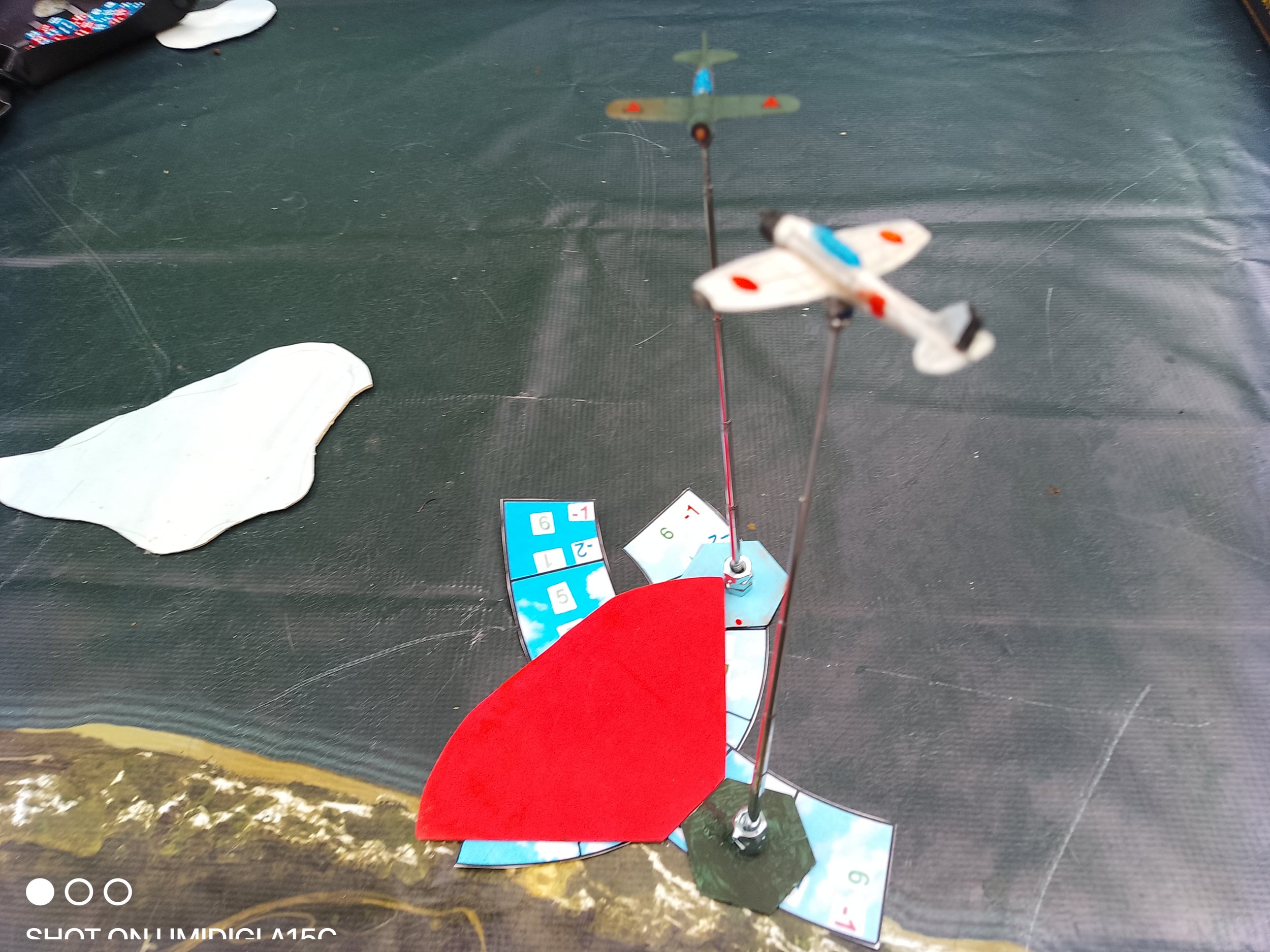
Despite the keen off angle, the VALS FORWARD ARC guns still cross Piets base.
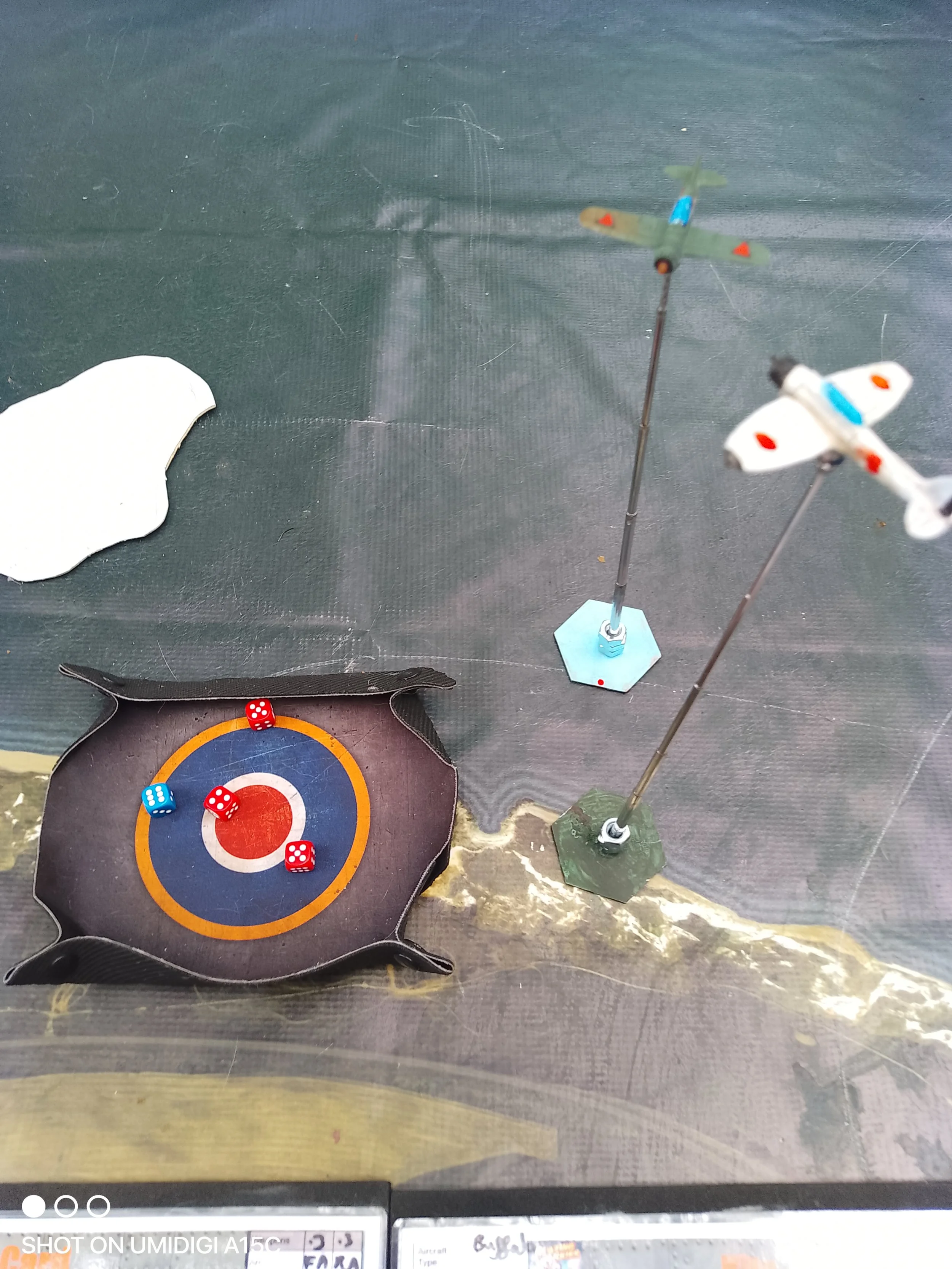
The Buffalo opened up at the rapidly closing Val, needing 5+ due to the range and angle, Piets hit three times, scoring one CRITICAL HIT. Kutso’s cabin was peppered with heavy .5 bullets and shards of plexiglass wounded his face. Kutsos return fire needed 6+ to hit and a pair of 1’s didnt cut the mustard!
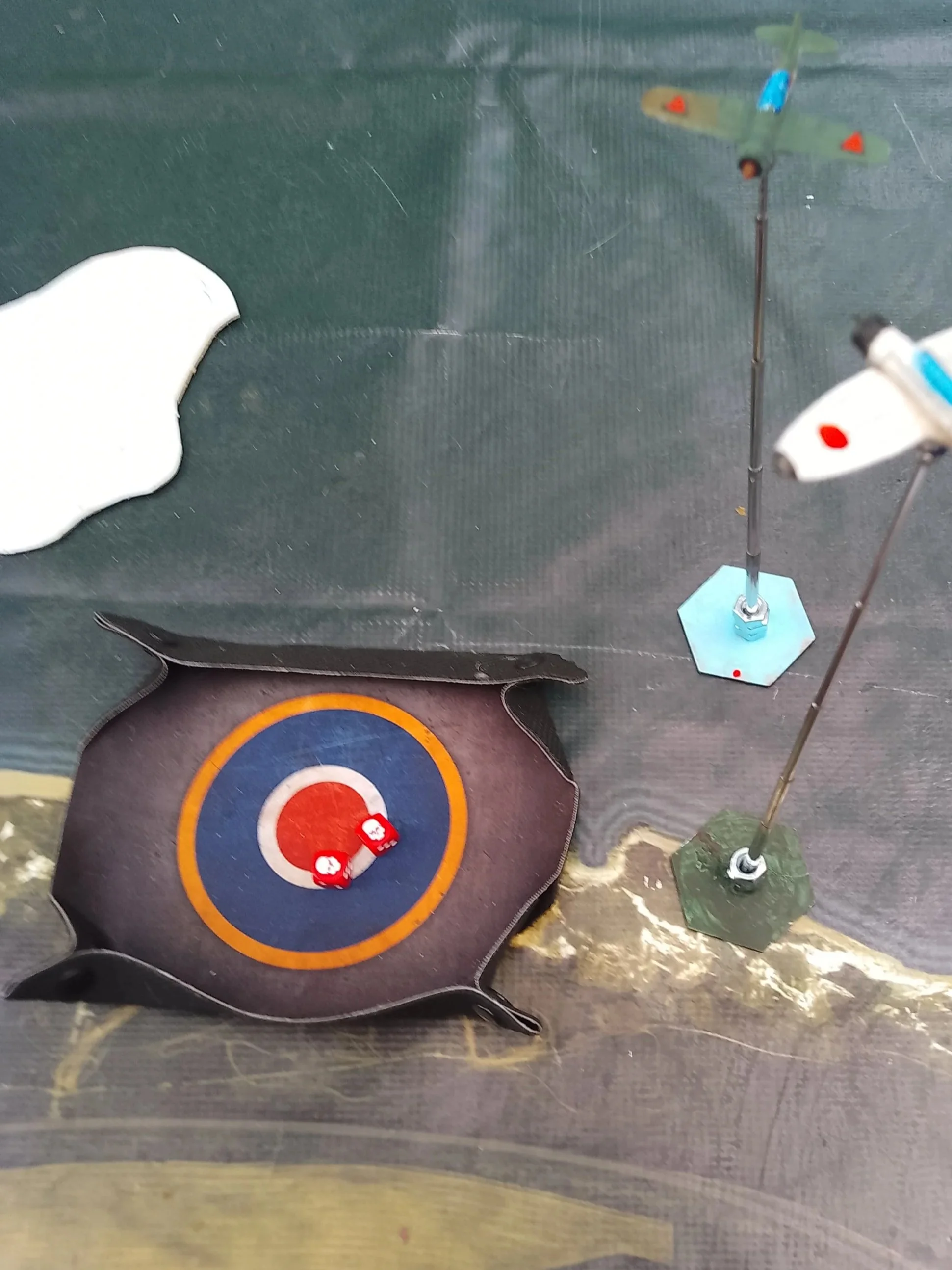
The duelling pair now had to think in fractions of a second as they merged.
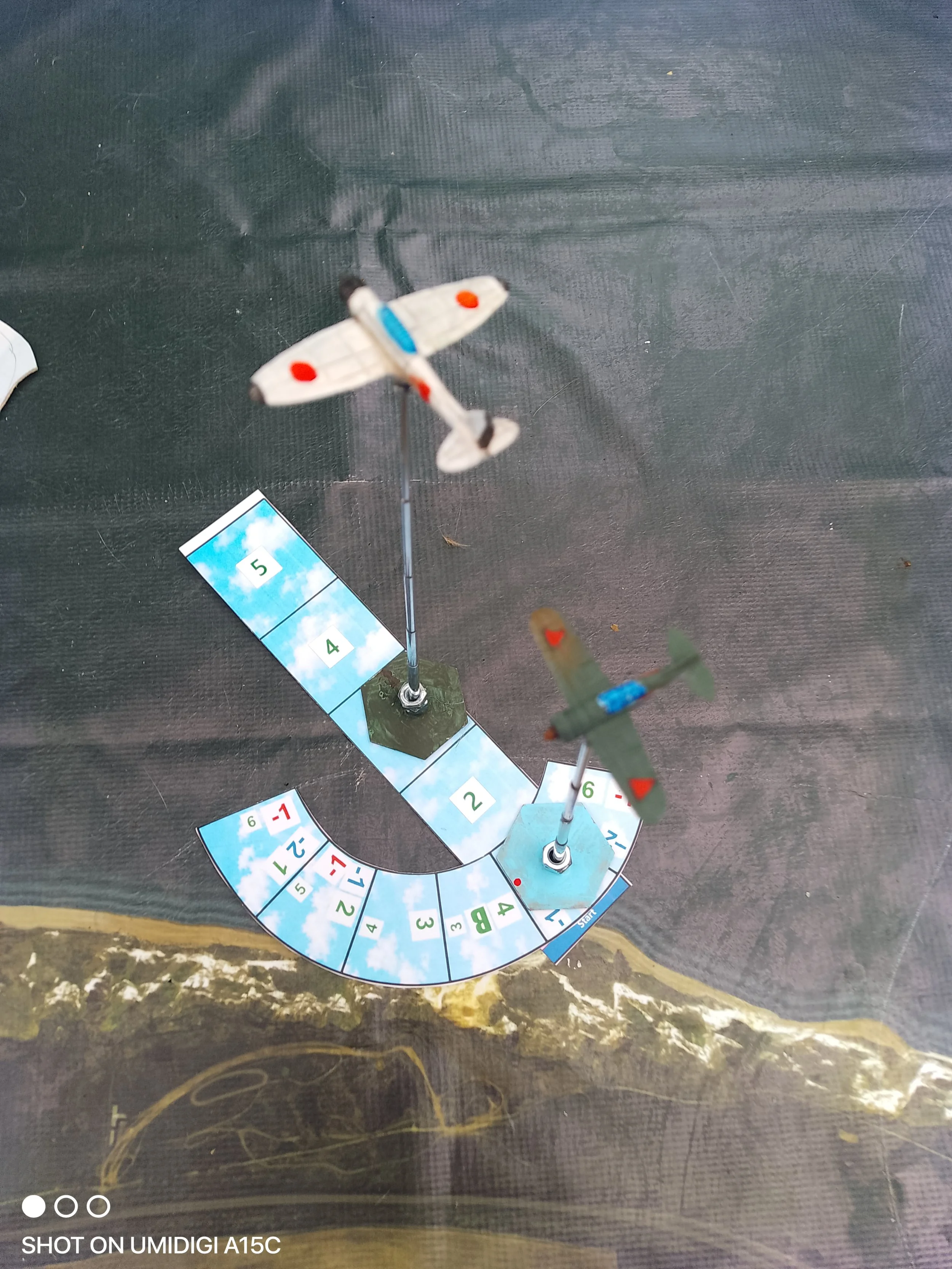
Piets still did not have power or speed for fancy manouvering, he suspected that the Val was going to turn into him and needed to reverse course. A wingunder was the obvious answer, but not availible at this speed. It would just lead to a stall and probably death. Piets needed speed and fast. The Buffalo was a better fighter low down and so he had to take this downstairs! Slinging the tubby aircraft into a B CLASS RIGHT TURN SHALLOW DIVE he picked up a speed, but the sharp turn combined with the dive took him down to 18000 feet
Kutso made a decision in a heartbeat. He was wounded and needed speed and distance, and fortunatly was in the perfect kite for this! Pushing over into a steep dive and flying straight, Kutso intended to open up his Rear Gunner, Shotsu’s arc of fire…Gain speed and then use that speed to either manouver or escape. The Steep dive took him from 28000 ft to 22000 due to the EXCELLENT DIVE trait and the Airspeed rapidly increased to 400MPH
The turn left both pilots lower and faster but as Shotsu could only fire at targets at same level and above in a dive, he could not draw a bead on the Dutchman. A Piets was in a dive and below the Val, he had no shot this turn.
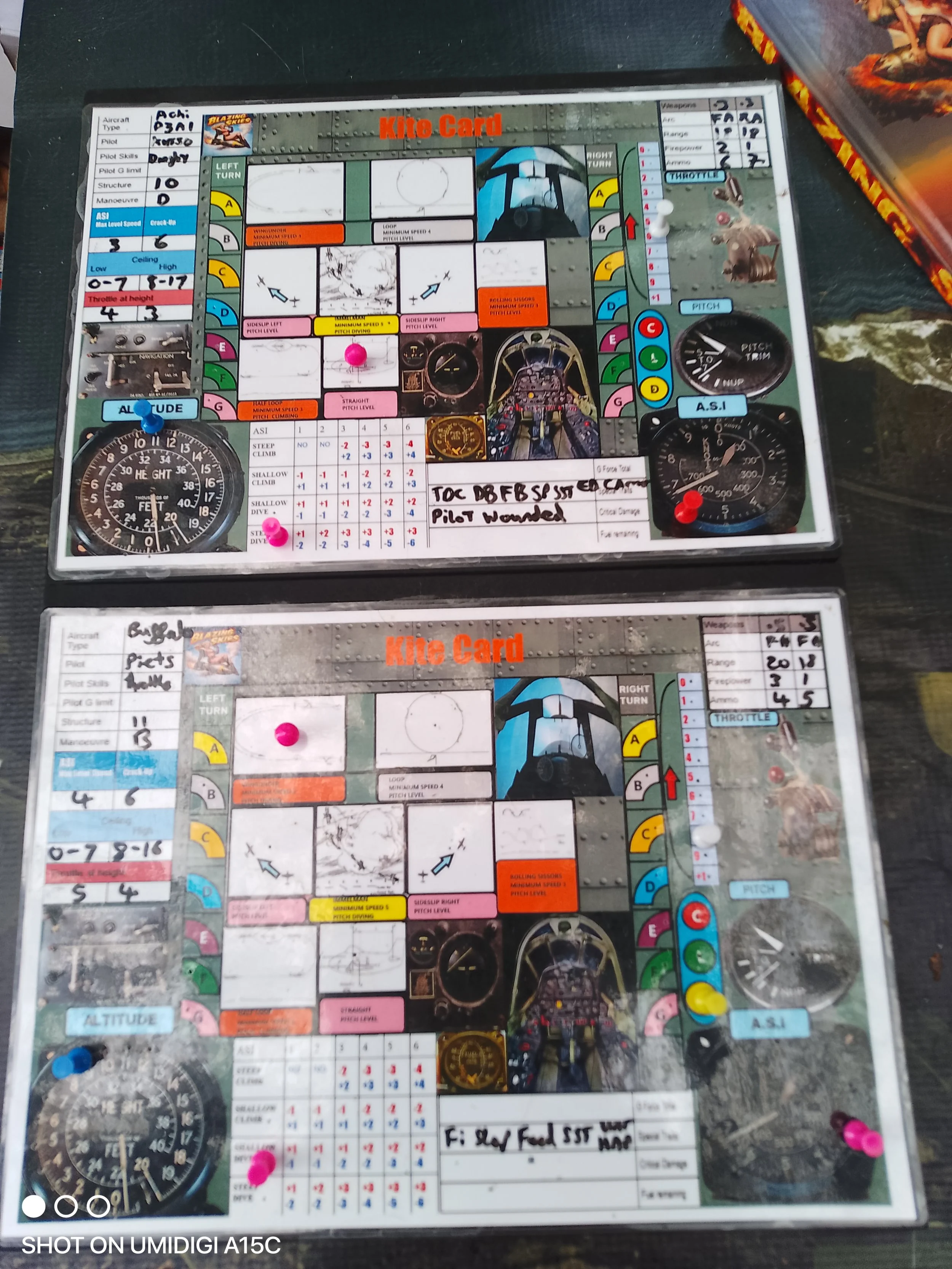
The kite cards after the dives
Both players now had more options availible. Kutso knew he had a choice now. Extend and use his superior speed to gain distance and retreat, and as his hand moved to the throttle, he paused. What son of Nippon would dishonour himself so? He had bags of potential energy here, the Val was agile and still had 10 structure.
Kutso decided on a wingunder. This would extend him ahead of the Buffalo, reverse his course and lose altitude. The danger was if the Dutchman did the same, then they would be in a similar position but running out of altitude!
Piets judged the gap between them and beleived the Japanese would extend out and probably wouldnt dive again as the Vals speed was terrific. To continue his turn at full throttle would probably bring him then onto the tail of the Achi. Slamming his throttle forwards he committed. His engine at full throttle was not affected by the UNRELIABLE trait this turn, His SLOP controls remained responsive and the Buffalo swung round having throttled up, his Airspeed now reaching 310 MPH
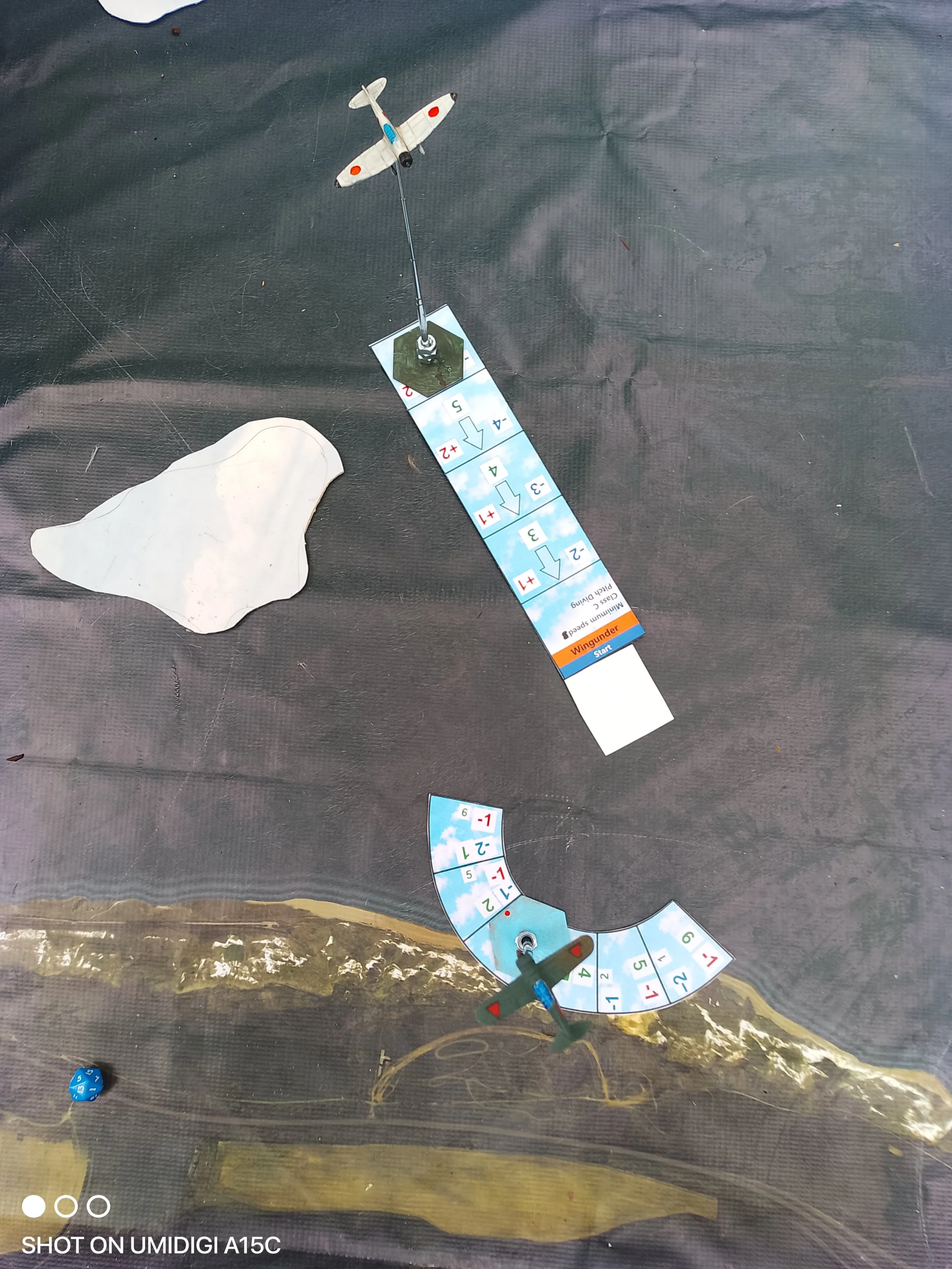
Kutso came out of the wingunder at 14000ft in diving pitch and couldnt quite bring his guns to the Buffalo who was now steady at 18000ft and diving. Piets had a snapshot and took it! His Brewsters guns raked the Val and scored a single hit, but although the rounds knocked holes in Kutsos machine, nothing vital seemed to be hit!
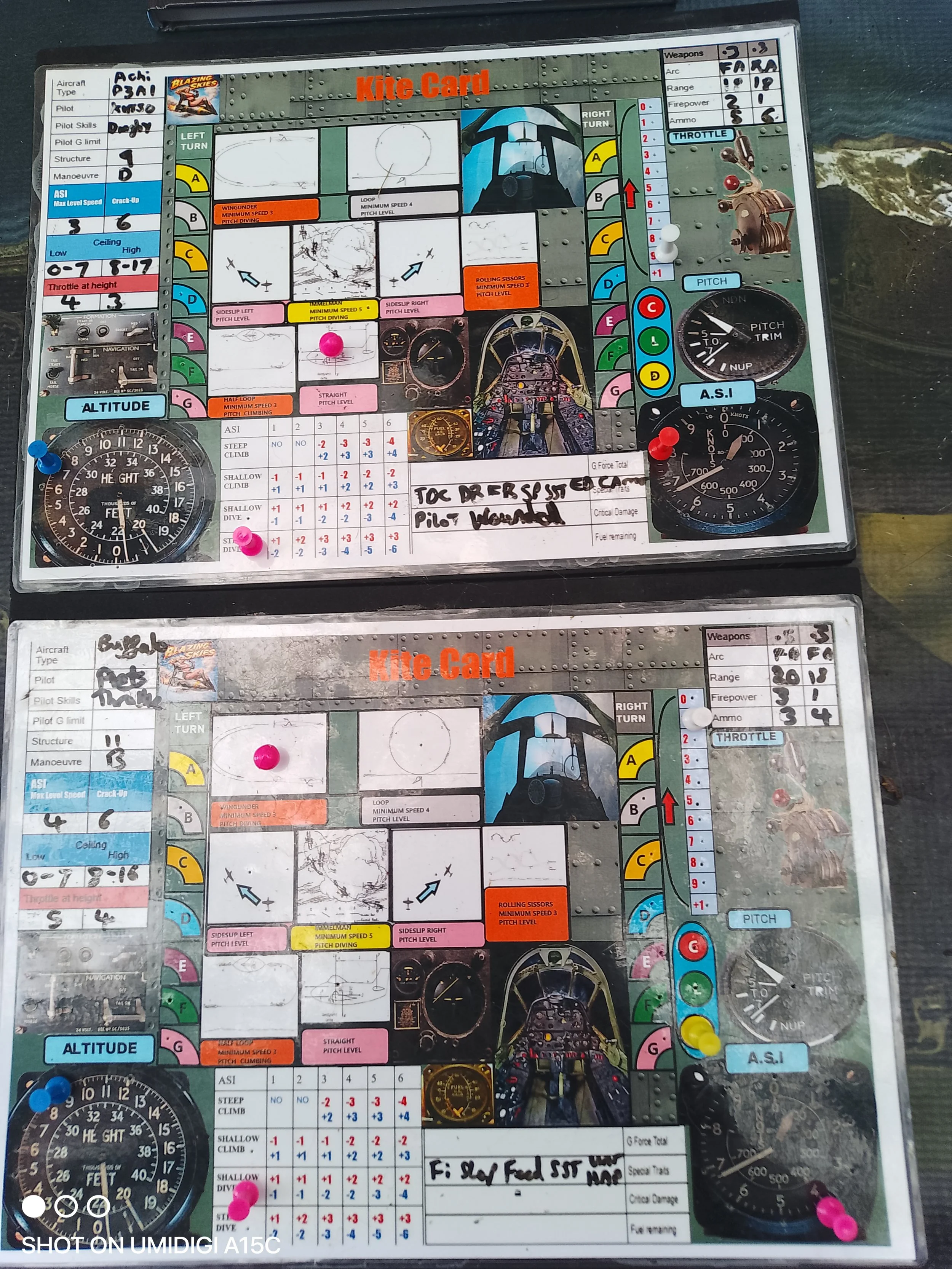
The dive and then the wingunder had culminated in Kutso travellling now at over 530 MPH! Well above his “NeverExceed speed or “Crackup speed” of 6
At the start of the next turn, Kutso immediatly throttled straight back to 0 and reduced his airspeed to 8. This was still 2 greater than his NEVER EXCEED SPEED. He rolled a dice, praying to the Emperor his wings stayed on! Rolling a 2 (+2 excess speed) this 4 was below the threshold for damage. Kutso sighed with releif. Having still excessive speed he was now concerned that he would overshoot the Buffalo. He decided to enter a rolling sissors to bleed off speed and hope that Piets would continue his turn in front of him!
Piet had spent his efforts gaining speed so far, but he could see that the Val was travelling so fast it would overshoot. He committed almost without thought! A Sideslip to the right to try and slew onto the Vals beam! This would ruin his momentum, but it might be worth it to gain a devastating burst on the damaged Japanese Dive Bomber.
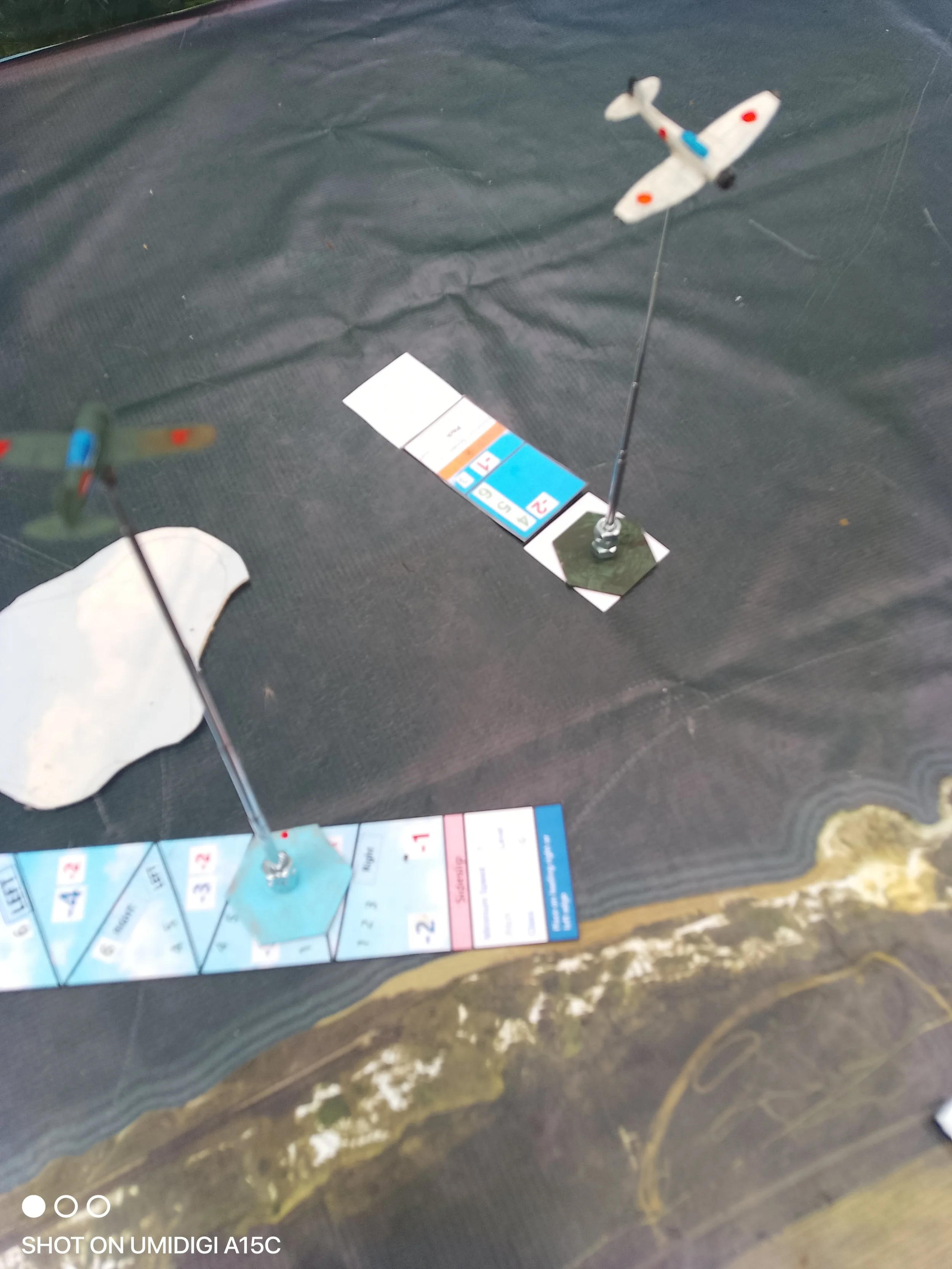
The sideslip however did not work out! The Vals terrific speed from its dives sent it two extra movement positions ahead of where Piet expected even if he had predicted Kutso’s rolling sissors. He lost speed and altitude and the Val lost speed. However the sideslip had placed him nearer the beam. Nobody had guns on target
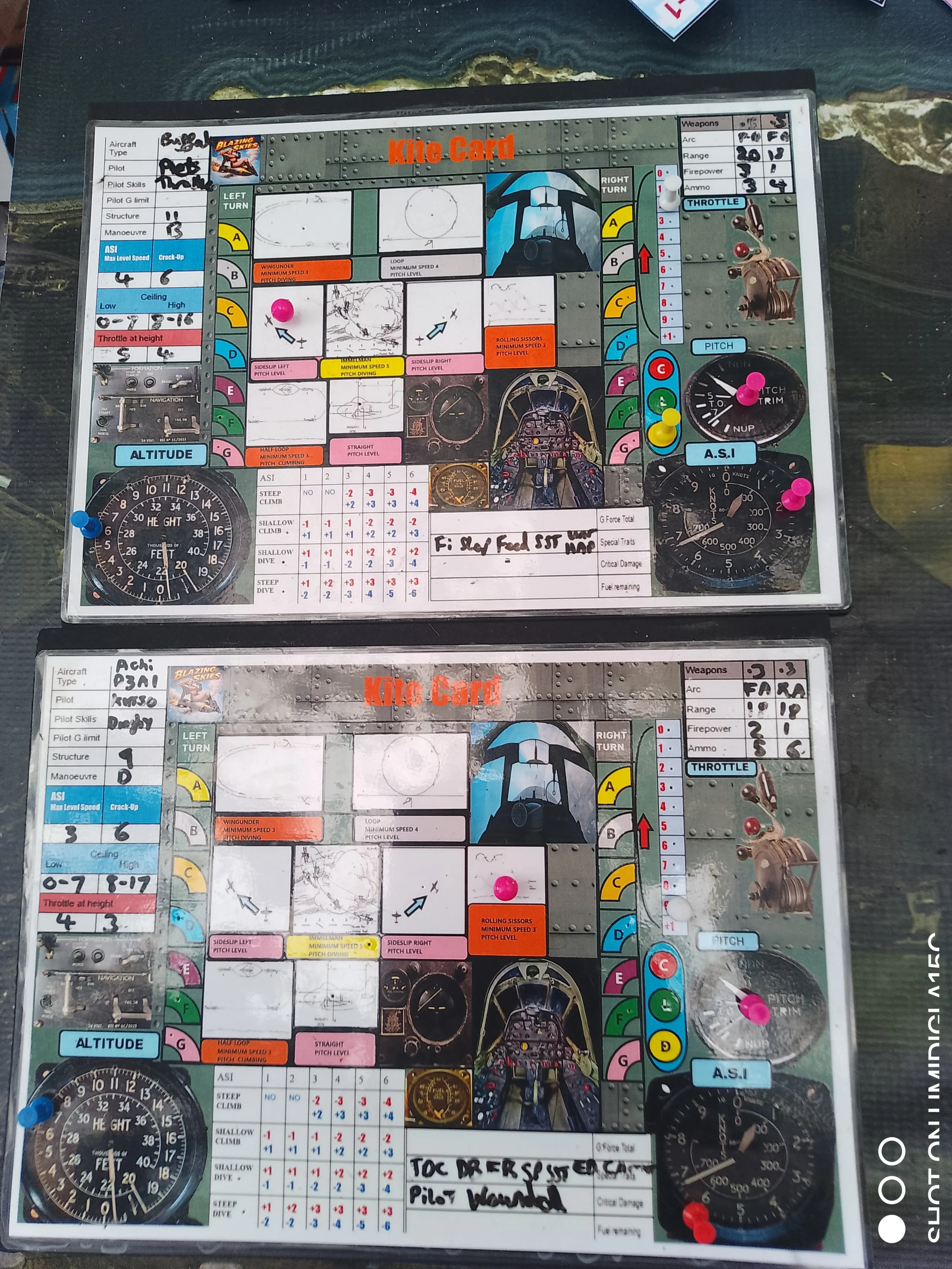
Despite the Buffalos famed obselecence, Piets was giving Kutso a hell of a fight. Now he had worked into a position where the Val could not attempt a “One circle” turning fight with him, despite the speed Kutso had gained.
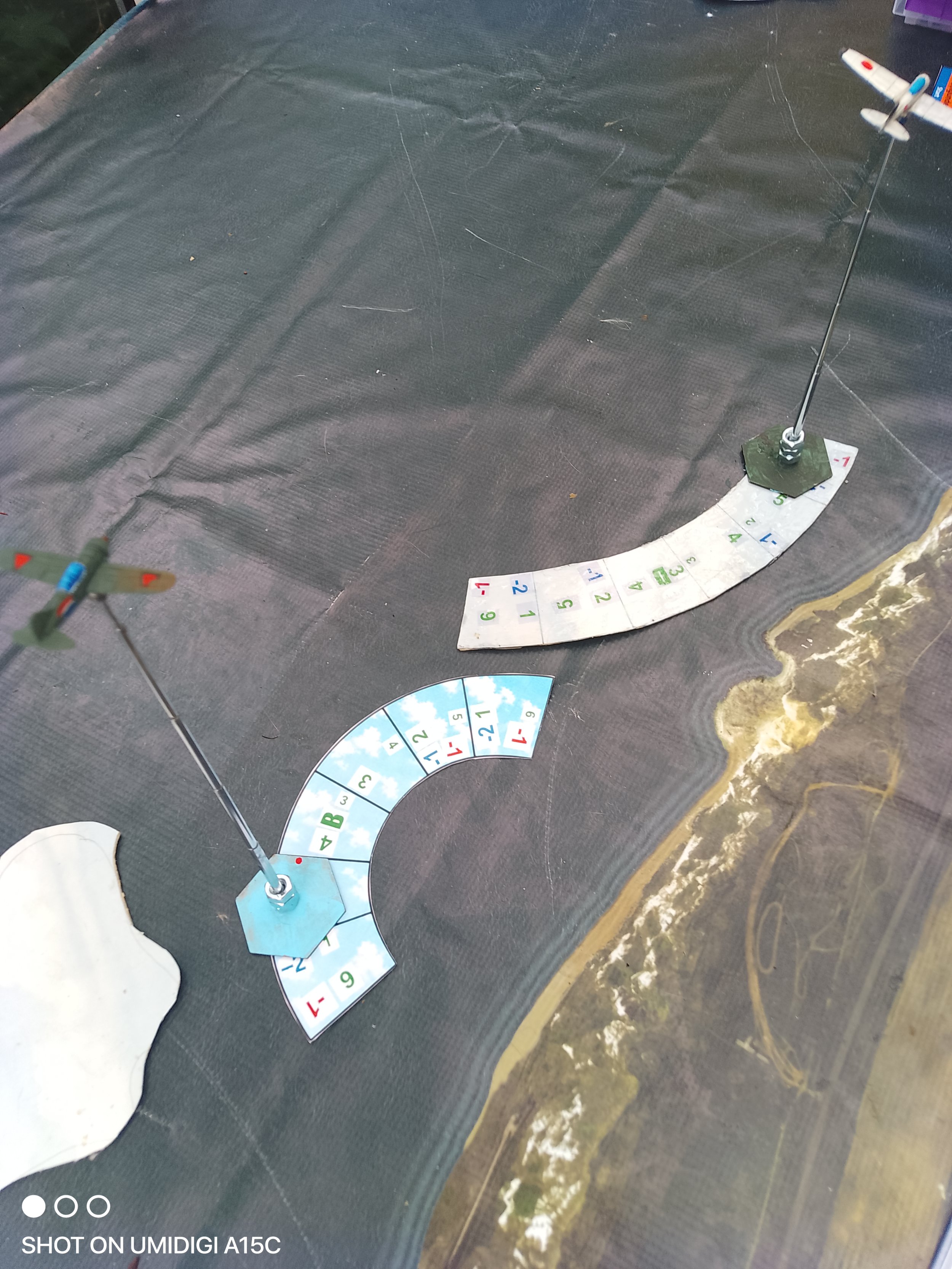
Kutso had still a load of energy, and the Buffalo had burned it away with that sideslip tactic, It was probably time to head for the Carrier. Shotsu made the decision. “ Senior Lieutenant Sir! Let me have this Honour that I might fulfill my destiny, as prophisised by the scrolls my great grandfather found in the year……” He continued for five minuites in this manner and ….in doing so , created Manga.
Kutso nodded once and broke hard left to extend and open Shotsus machine gun.
Piets was hanging on his prop, all the height he had burned, all the power of his finikky engine, He had blown it.
The best thing he could think of was continuing the turn and accepting another altitude drop as his Buffalo protested.
To his amazement, the Val broke left and was using its speed to get away. He was literally ON THE SIX of the Val. He thumbd the gun trigger. A stream of Thirty caliber and Fifty caliber fire hammered home. DAKKA DAKKA DAKKA!!!!!
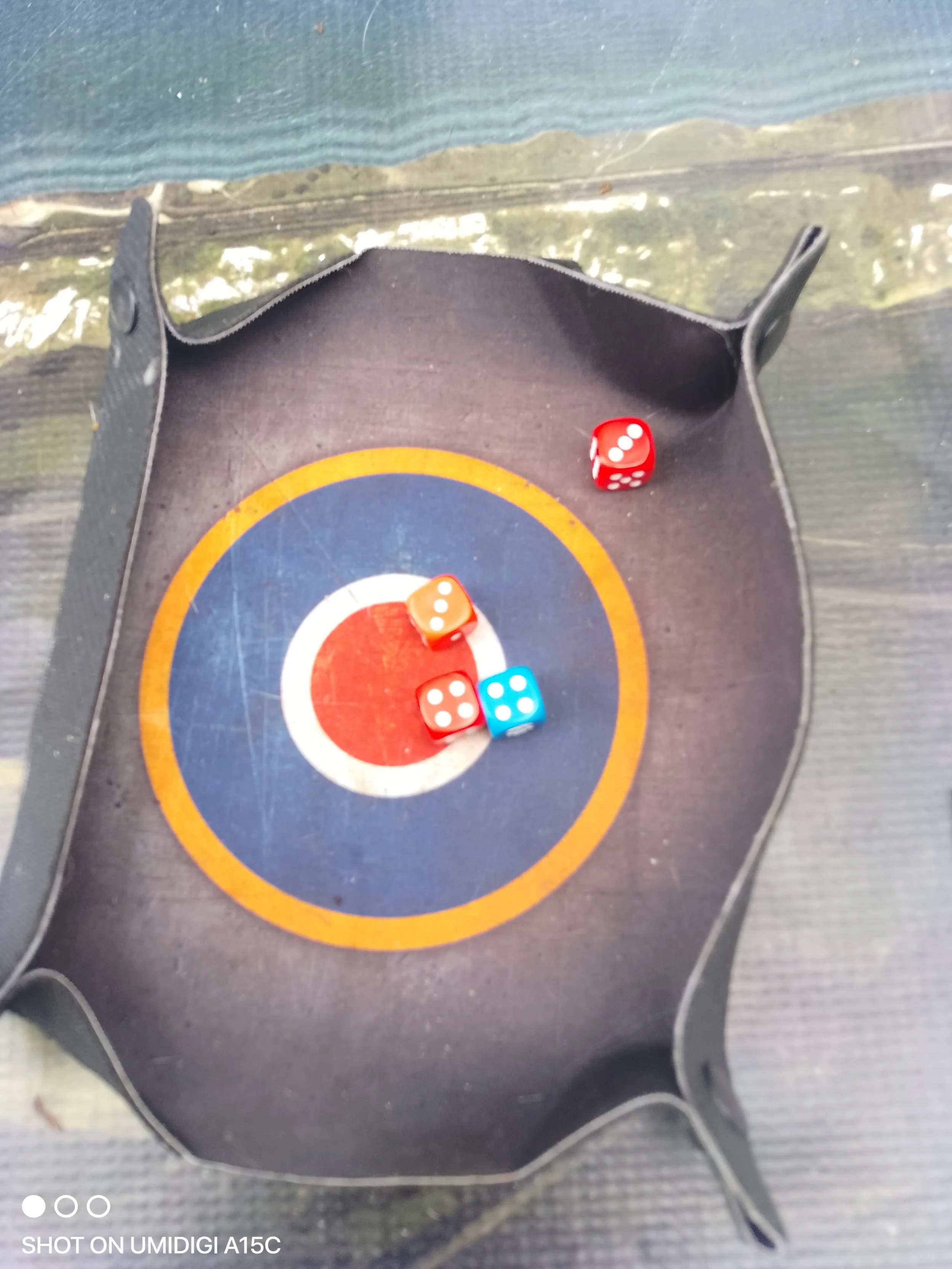
Two hits struck home. The puny thirty caliber did little, but the mighty USA made fifty caliber scored a critical hit. The bullets sheared through the Vals port wing flap actuator. Kutso felt the kick. He realised landing on the Carrier was looking almost impossible. Wounded and no flaps. He realised he was looking at a 6+ roll.
Shotku sprayed bullets in a constant stream. Needing a 6 as gunners always need a 6, he managed to hit once and punched a few holes in the Buffalo. They seemed to avoid anything vital, and would in the end , just annoy the groundcrew back in Java.
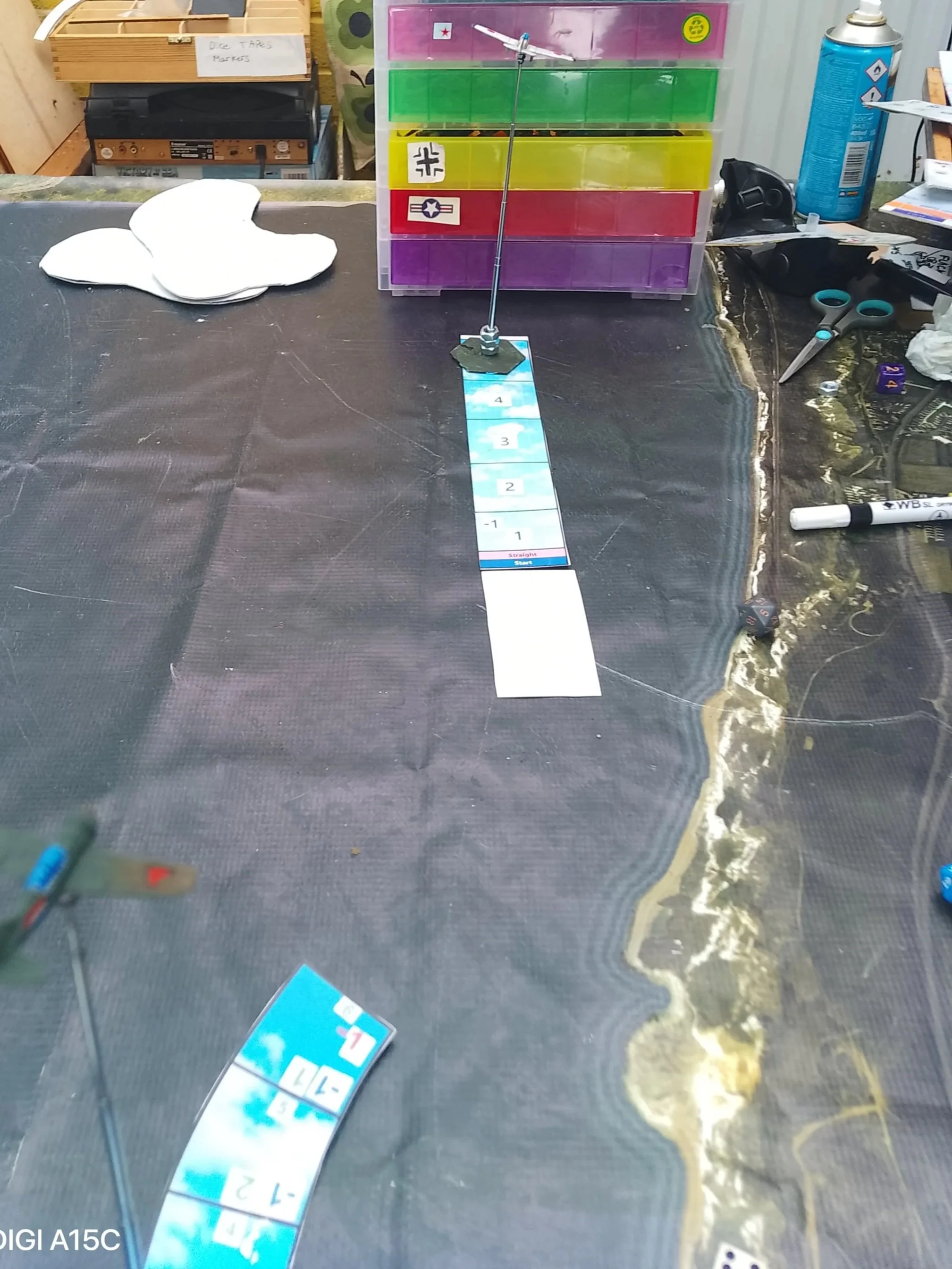
Kutso used his remaining speed to just extend. As he was tailing he announced “No Break”. Piets saw the Val was probably heading for the large rainbow drawer full of aircraft and gently turned to the right.
The range now 20”, only his fifty calibers had the range and a final rattle of his guns fell wide. Shotku saved his ammo. The Buffalo peeled away from home. One Probable Kill. “ The enemy EA appeared to hit the sea and exploded…there were no survivors.
Shotsu and Kutso claimed the same. “ I saw the Buffalo spiraling into the sea where it exploded”.
But their Val was riddled. As they returned they managed to reach the fleet. At a -3 for wounded and flaps destroyed, the friends shook hands and decided to try a landing. 2D6 scored a 9 and the Val smashed into the deck and pulled to a halt. Shotsu leaped onto the wing and helped his comrade out.
Kutso received the Purple Lung for his efforts. Shotsu nothing.
Piets returned and nobody seemed interested. There were a dozen claims and the IJA and IJN were still everywhere and ripping Buffalo from the skies.
Hope you enjoyed this.
The game was five turns and 20 mins using Blazing Skies.
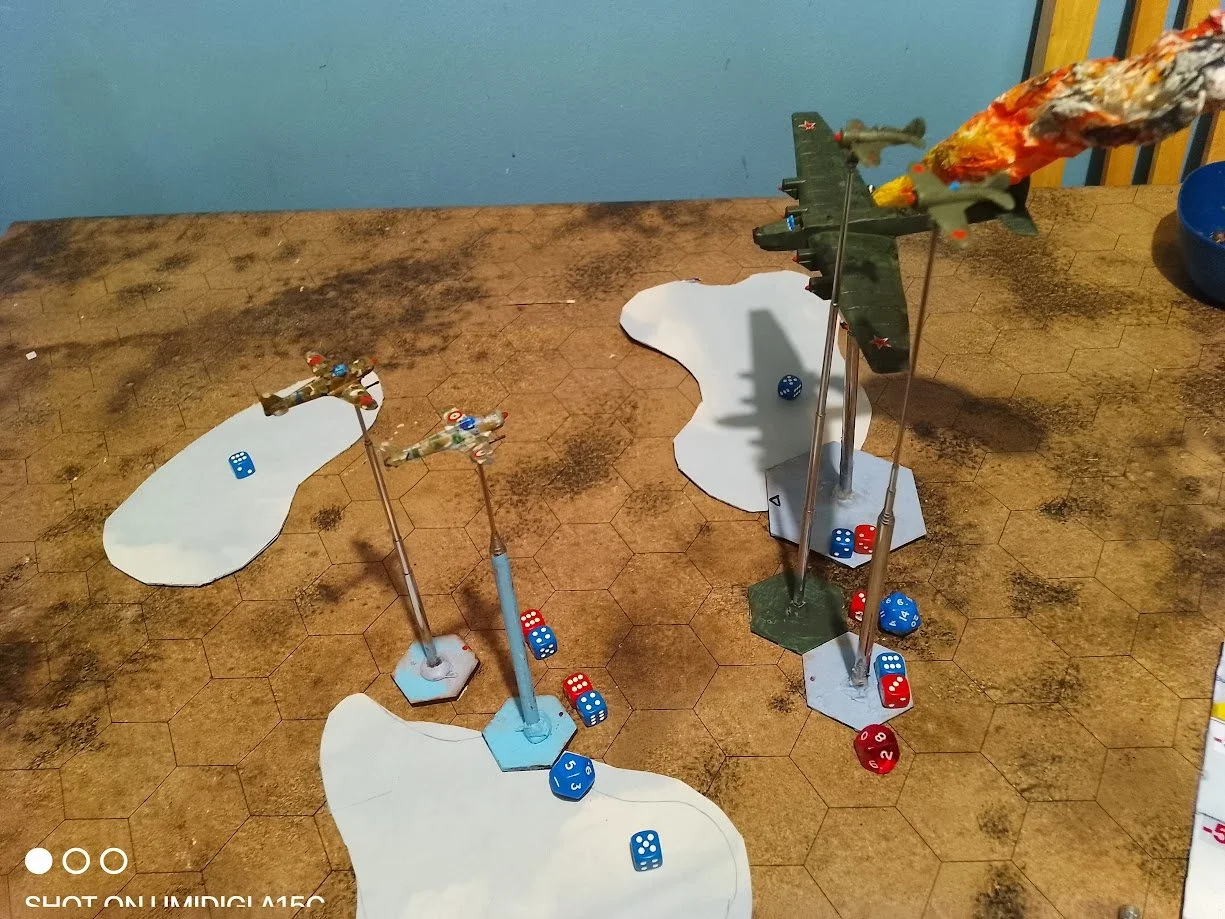
Scramble to defend!
Scrambling to defend Air Wargaming Air Combat!!
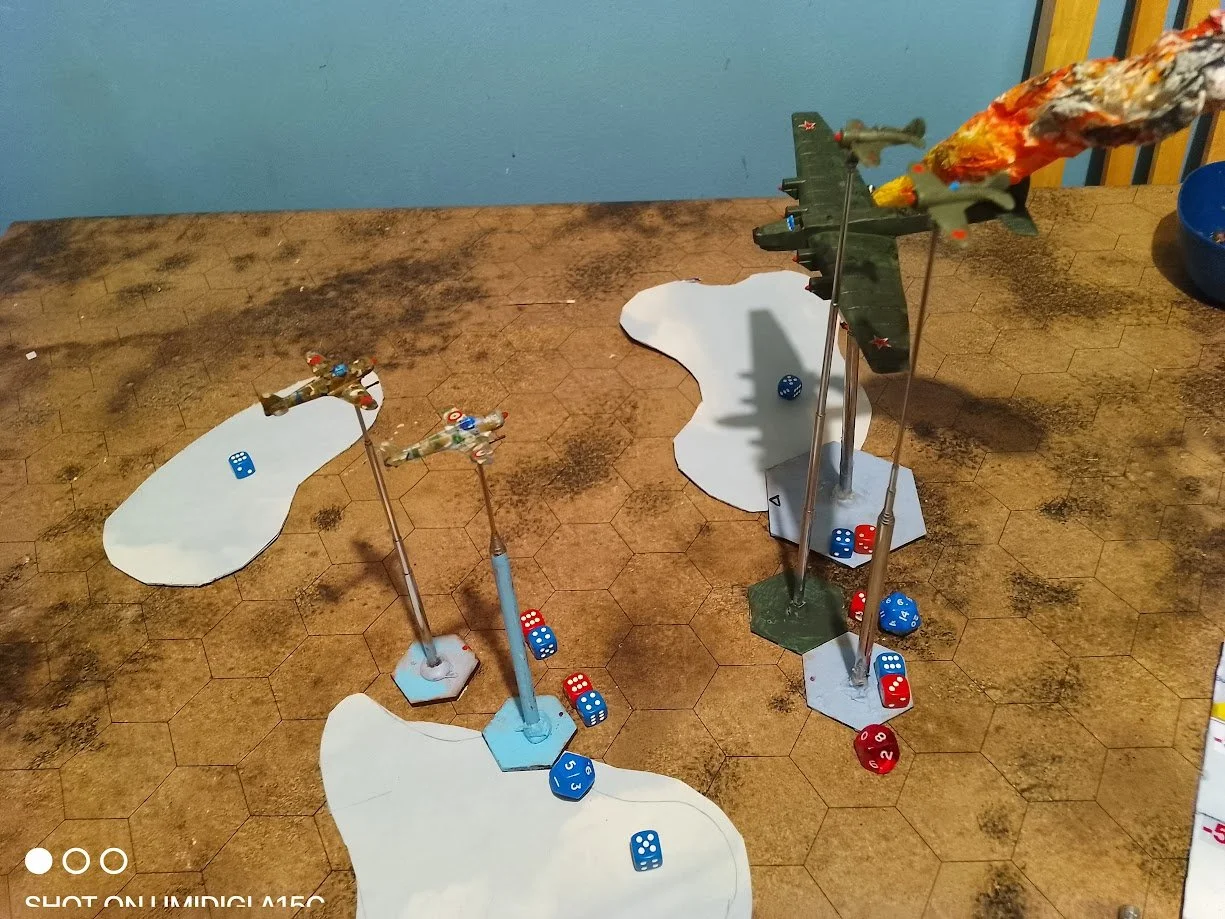
The scream of Daimler Benz 1100hp engines! The thumping of Hispano cannon! The blurring G forces that claw at the pilot as they perform 300 mph manoeuvres in sleek machines that are rich with history! Daring chases at treetop height! Surely Air Combat must be among the most popular genres in wargaming?
Well, Nope. It's a niche area of a niche genre of a niche hobby and accounts for , if I recall the huge W.I survey years ago, about 10% of historical wargamers. Perhaps less than ten thousand gamers globally?
That should be surprising. The machinery is, in my infallible opinion, far more interesting than tanks, and for those who love tanks, I say what could be cooler than a tank that flies miles above the ground, just with aluminium skin and little armour?
Whereas the “Panzer Aces" are often just the work of propaganda, air combat aces have well documented historical accounts. Maybe it is the rarity of air combat? Well, again, that's unlikely. The USAAF conducted 2.3 million overseas sorties in WW2. Even the Soviet VVS, not known for its bombers, had 7500 machines.
It's safe to say that on any day in a theatre of operation, there were duels to the death in any patch of sky you could see from the ground.
Here’s my take on it. A lot of WW2 air combat games feel like driving a toy car, or perhaps a formation of toy cars. They wheel around the table in two dimensions, often moving forwards a bit, rotating a bit and then their opponent does the same. Igo-Ugo in air combat is anathema to the smooth chaos of air warfighting. Wings of War avoids this by its clever use of manoeuvre decks, Bag the Hun abstracts the turn with random activation, but I am of the mind that only simultaneous activation and movement gives the players more of a “feel” of fighting in the air.
To this turn sequence problem must be added an advantage for tailing the opponent and being better able to react to the dip of a wing or the rise of their nose.Air Wargaming must “feel” as if you are flying an aircraft, something very few of us have done, but we all have our common sense to understand what happens to a plane in flight. Too slow and dipping a wing? You will drop off in height. Pulling a High G turn? You bleed off airspeed. A split S manoeuvre will bring you 180 degrees around, at a lower altitude and higher speed.
Gaslands is a very popular car driving game because it has a physics model. Cars behave in understandable ways. Most of us have driven in a car and seen how it works. Not many of us have tested it by strapping a minigun to our hatchback and doing doughnuts in supermarket carparks.Any air combat wargame needs a similar working physics model. Something that makes sense and allows us a glimpse into what air combat was about.
An aircraft is an amazing feat of engineering and its myriad systems from hydraulics to coolant to undercarriage all factor in some way to its effectiveness. But what if one of those systems was blown to smithereens by a stream of high explosive cannon fire from a furious Zero fighter on your tail? Then this will need recreating in the damage model. “Hitpoints” are not enough! Many rules have some unique ways of tracking damage from Blood Red Skies abstracted “boom chits” to Bag the Huns detailed damage table.
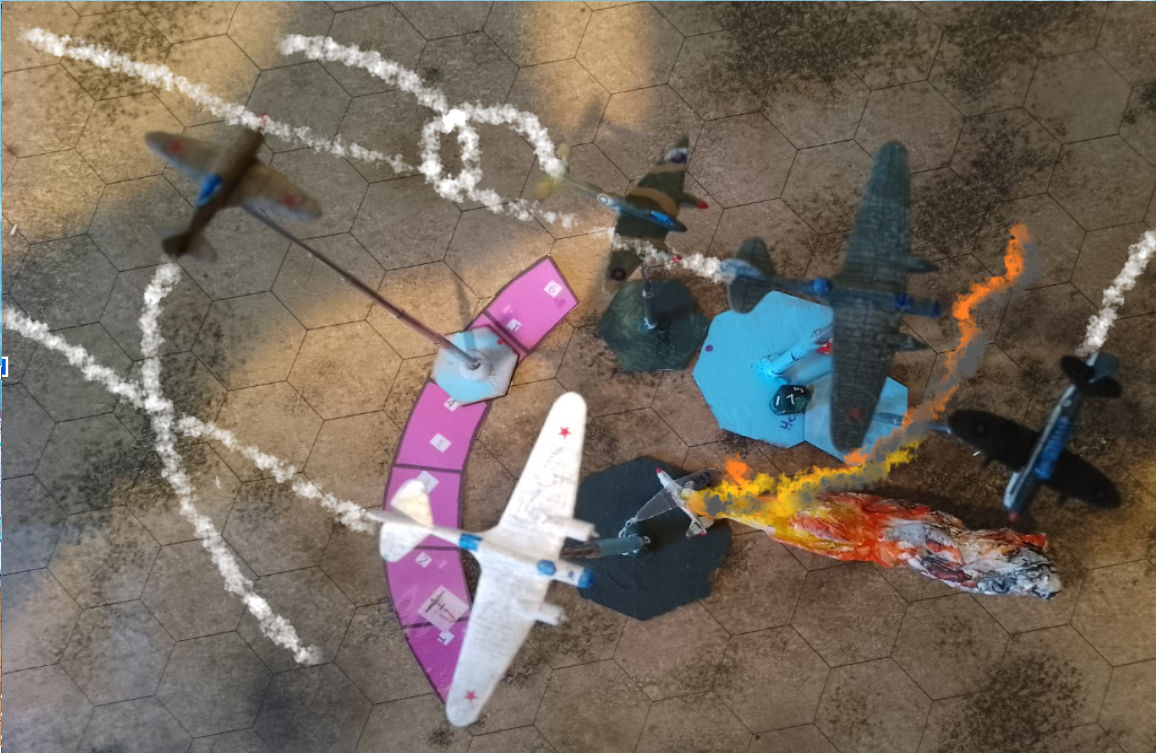
I’ve thought for many years that if you are playing an air wargame, you need to be in the cockpit. You need to manage the throttle, have hands on a control column, keep your eyes on your airspeed and altitude, on your pitch and yaw. All that before you spot an enemy! But all of that needs to be done in a very natural and intuitive way. No harder than riding a bike, and putting an experienced miniature air wargamer right in the cockpit.
Many rules I think drift away from this level of detail and so zoom out to a “flight” of aircraft. This of course is perfect for a club game! This level of gaming is both popular within the genre and definitely has its place. But, as with a skirmish game of Sharpe and his mates, versus a recreation of Waterloo, the further from the mud and the blood you get as your responsibilities increase!
WW2 air wargaming “feels” best I think when you are operating as much as possible right in the thick of the action, which is the most scary, thrilling, high tension place to be rather than a plotting table back at Dover!Blazing Skies aims to get players back into the cockpit.
The cockpit is a “Kite Card” which represents the pilot's aircraft and contains a throttle track, the altimeter, air-speed indicator, control column, pitch controls and data needed to fly and fight. The manoeuvre templates themselves give instructions as to how the speed, altitude and pitch are affected. A pilot chooses how far to throw the throttle open, which manoeuvre to do and then, when both players have chosen, they execute the manoeuvre and make adjustments on their kite card. Tailing an enemy gives an opportunity to adjust your manoeuvre to better follow theirs! Altitude is energy, energy is speed,speed is positioning,and positioning is victory. As in WW2 fights may start high, but end up low as machines burn off their advantages of speed and height.
Air wargaming has a wealth of choices of machines and in the 1932-1955 period of Blazing Skies from amongst the 600 plus aircraft listed, it's fun to pit the strangest combinations against each other. A Catalina vs a Hawker Hart? A Saber Jet against a TB3 monstrous Russian bomber carrying two IL16 parasite fighters?But each aircraft has its own particular idiosyncrasies. Your Manchester Bomber has undeveloped Vulture engines; These may overheat! Your Morane Saulnier 406 has a cannon that's prone to jamming. Your P47 can outdive most things in most situations. Knowing your machine is all part of the fascination of air combat history and of air wargames. It is also a key advantage in combat to know your strengths and the enemies.
Blazing Skies also includes rules for Nightfighting, Takeoffs and Landings, Navigation, bombing and ground attack, (which can be integrated easily into a combined arms game) Photo Reconnaissance, a full campaign and progression system. Other optional rules include G forces, fuel use, FLAK and bouncing rules and 6 scenarios.
3D printing has opened a whole new world of availability for unusual aircraft types and superb models such as 3D Plane Printer on Patreon make 1/200 and 1/144 scale perhaps the new standard scale for Air Wargames, which means aircraft are cheap!
Of course, If you have a Spitfire, you also need a Hurricane…and a Fairley Battle, and a Fulmar, and a Firefly. There is little chance of your wife being grateful you are into a cheap new genre, but a few hundred planes will fit inside a games case!
10 ME109’s out of the sun!
So after twenty years and many updates, I’m starting the Blazing Skies site up again. Im hoping to be able to support it better now from my retirement!
My intentions are that I can use this blog to add new scenarios, battle reports, take ideas for new Kites, answer questions etc.
After collecting around a hundred Die-cast aircraft in 1/72 scale, they were all thrown into a cardboard box as they were cluttering up the place…
The damage was pretty much complete, the squadrons looked like an airfield on the first day of Bodenplatz.
Rebuilding everything with the help of a 3D anycubic resin printer and files from the most excellent https://www.patreon.com/c/planeprinter/posts, I have finally polished and fine tuned the rules, and expanded the Kite lists to pretty much include any aircraft of the ww2 era.
I have recently had some excellent playtesting games with Beard , Dave and other friends, so as with any project, lets get the chocks away and scramble!